

A Photo, a Friend, and a Decision That Made All the Difference
A photograph that wouldn’t leave me alone. A 14-hour flight that almost never left the ground. A friend I hadn’t seen in 36 years waiting in a hotel lobby in Dubai. A horse, four years after an accident that had limited me to equine therapy — still against all medical recommendations, given that I couldn’t feel most of my body — not in my own arena, not on my own horse, but in the open desert, on an Arabian I had never met, at dawn. And somewhere over Iran on the way home, in an Emirates First Class suite at 40,000 feet, the certain knowledge of what I was going to do next. This is how Equestrian Destinations began.
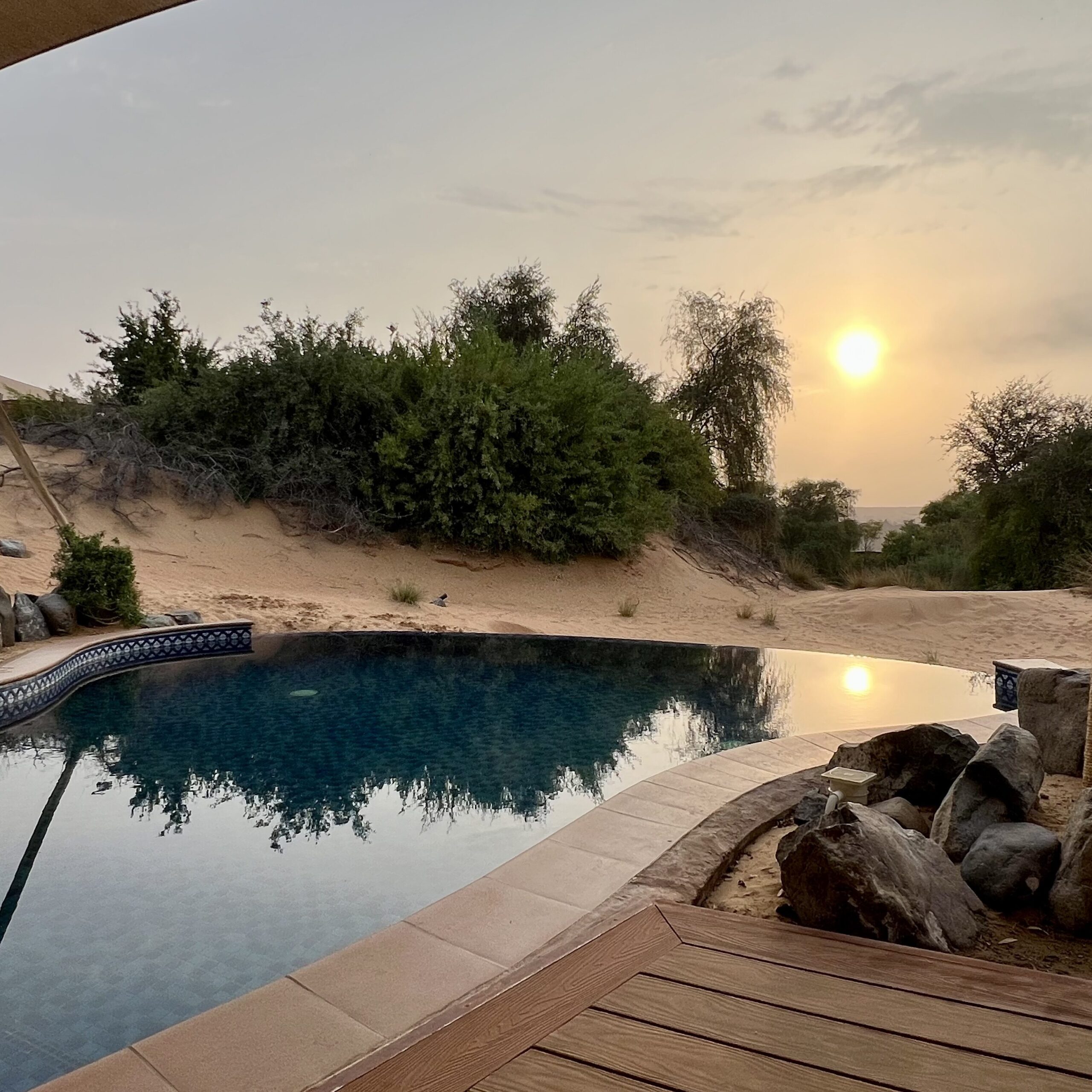
I woke before sunrise. The light cresting over the sand was the kind that simply stands you up out of bed — no alarm, no deliberation, just an instinct that something worth seeing is happening and you should not miss it. I walked out onto the pool patio in the early quiet and took a photograph. The stillness of the desert at that hour is a different quality of stillness entirely. In a little under two hours, I would be out there.
I got dressed carefully that morning. Not on my own trusted horse, not in the controlled safety of my indoor arena, not surrounded by the familiar walls within which I had spent three years quietly relearning how to ride through equine therapy. This was different. This was what the whole trip had been pointing toward, even when I hadn’t admitted it to myself.
I had chosen my outfit with intention. A beautiful white blouse embroidered with hieroglyphics, bought with a dear friend in Cairo — for luck. Ariat tall boot socks from a friend from the barn , the word Ariat spelled out in tiny rhinestones along the side. No one would ever see them under the boots. I would know they were there. The boots themselves — Parlanti, broken in and trusted — had been sold to me by another friend. I had traveled with my own Samshield helmet. And my Helite safety air vest, which had traveled with me from Washington, went on last. I was not just dressed for the ride. I was wearing my support system. Although, I did reason with myself, if I was going to come off — the sand would be soft, right?
I called for the golf cart. I wasn’t sure what the morning would hold — whether I would walk only, manage a slow trot, stop at that. I was quite certain I would not canter. I had not yet met my desert horse. What I knew, stepping into that cart with my helmet under my arm, was that I needed to do this for myself. This was what I had come for — not the opera, not Fouquet’s, not the shower at 40,000 feet, though I was grateful for all of it. This. Something I could have done closer to home, but that would never have been enough. It needed to be extraordinary. It needed to be cinematic. It needed to happen in the most opposite landscape from my accident as I could possibly imagine. It needed to be a desert.
The Ride
Four years earlier, I had a near-fatal riding accident. I had been falling off horses since I was four years old — that is simply part of the education, and the rule has always been the same: you get up, and you get back in the saddle. Only this time, I couldn’t get up. I tried. I remember lying on the ground thinking, with some irritation, that this was really going to ruin my week. Little did I know it would change my life. The recovery had been long. During it, I had ridden only in my own indoor arena, on my own horse, in the controlled safety of a space I knew completely — and even that, still against medical advice, given that I couldn’t feel most of my body. That was what recovery looked like. That was what I had allowed myself.
This was different. A horse I had never met, in a desert I had only ever seen in a photograph, on a morning ride in one of the most remote locations I had ever been. And it was exactly right.
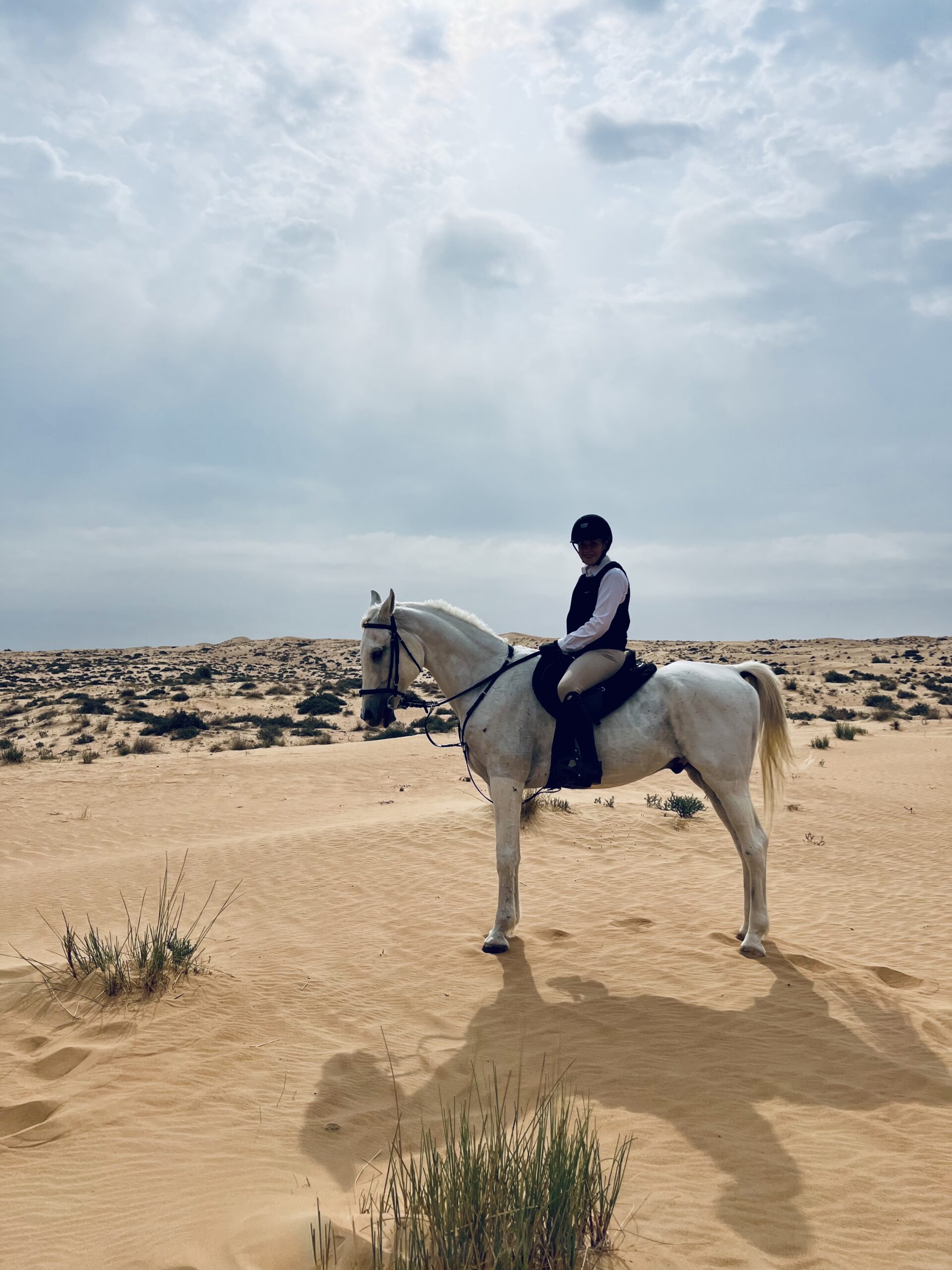
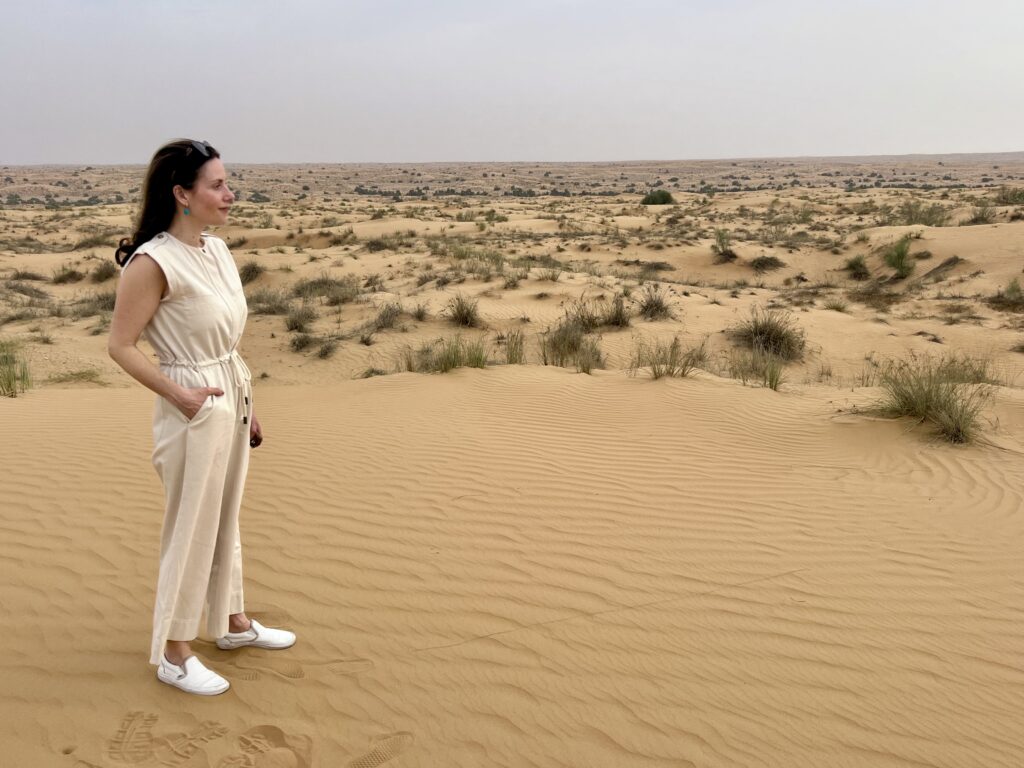
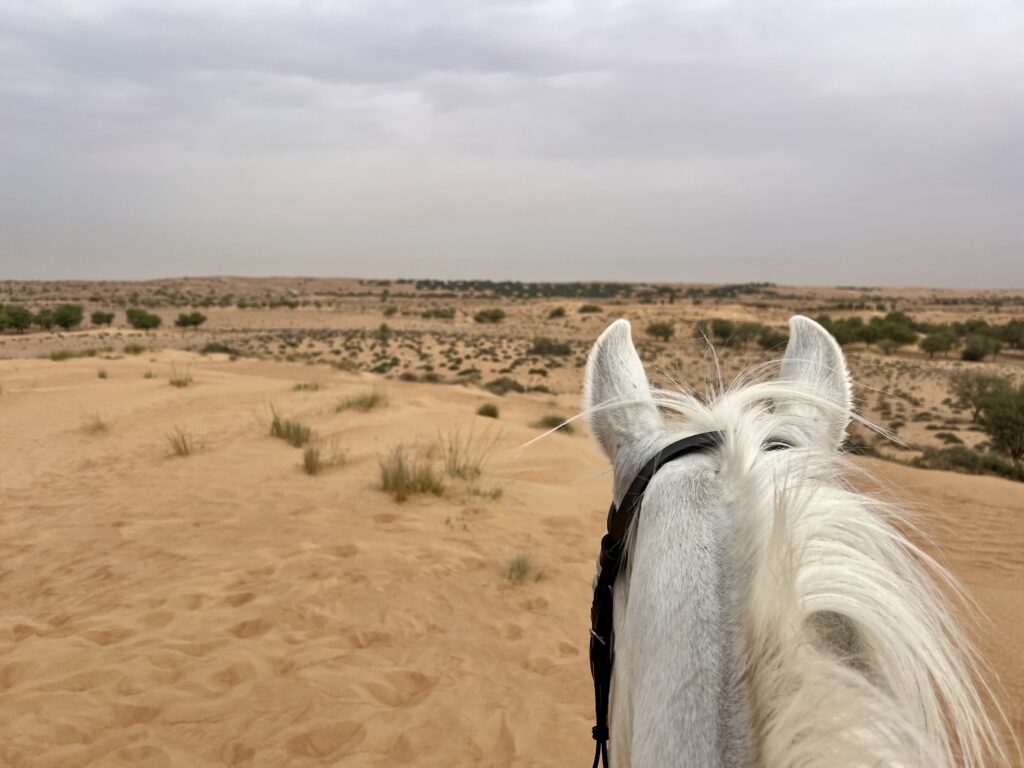
We set out early. A light overcast kept the heat at bay, and the desert at that hour holds a specific kind of quiet — not the silence of an empty room, but the deep, undisturbed quiet of a landscape that has been this way for a very long time.
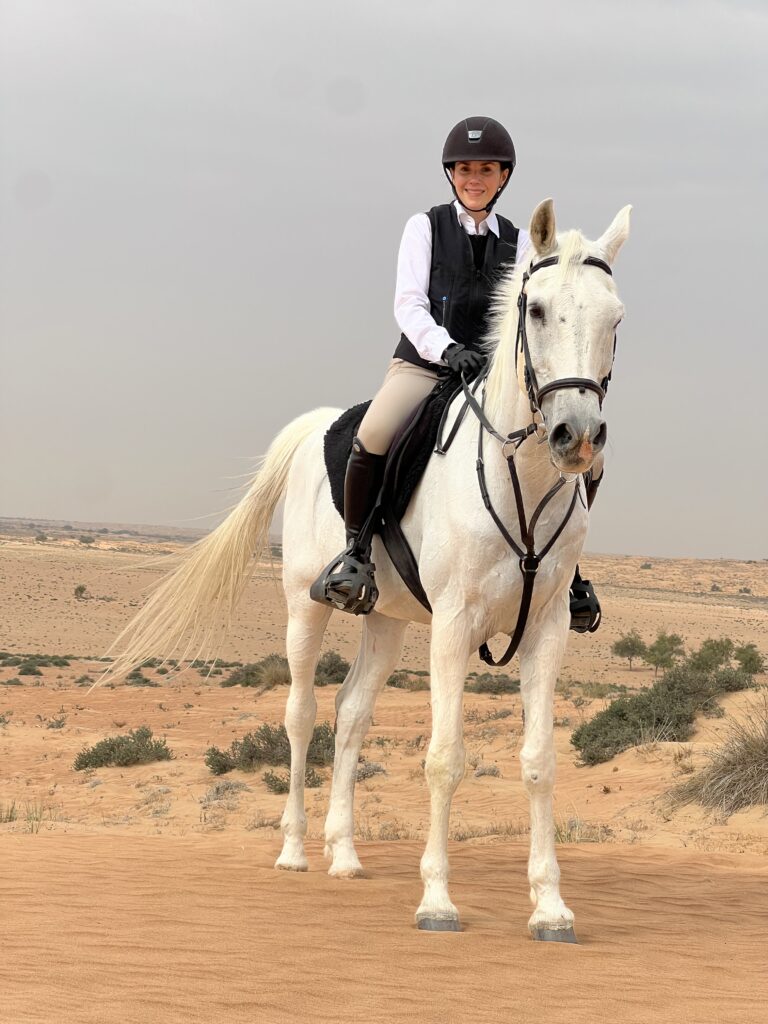
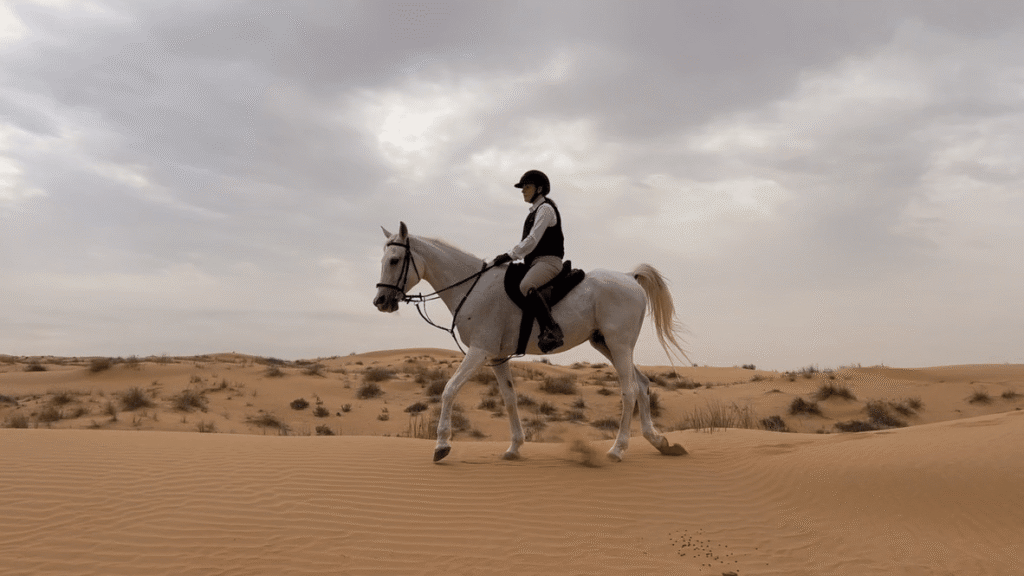
The Arabian moved forward with the loose, ground-covering ease the breed is known for, and I let my shoulders drop, and breathed. A light breeze moved across the dunes and whispered, quite clearly, that this was not the foolish decision everyone I knew had made sure to voice to me before I left.
The sand was so fine you couldn’t hear hoofbeats at all, only the soft swish of it being pushed aside with each stride.
I had been waiting four years for a morning like this. I had almost not gotten on the plane to reach it. And I had a friend who had eased me up to this moment without ever realizing it — simply by spending an entire week doing normal, joyful things with me across Dubai and Abu Dhabi, until I arrived at this desert dawn feeling, against all odds, entirely like myself.
To understand how I got here, we need to start with a photograph.
The Photograph
For years, I had been turning the idea of Equestrian Destinations over in my mind. And for years, life had a way of intervening. The pandemic, which brought the world to a standstill, was no small part of the hesitation. How could I launch a travel platform when no one could travel? So the idea went back on the shelf. Notes were made and filed away. Dreams were deferred.
Those who know me would not be surprised by any of what follows. I have always been something of a female Maverick (yes, that one) — someone who has spent a lifetime pushing the odds, betting on herself, and doing the thing she has been told she probably shouldn’t. It is simply who I am. The pandemic slowed me down. What came next would do considerably more than that.
Then I fell from my horse. After four decades in the saddle, I knew how to fall. This was not that. This time, I could not get up. The recovery that followed — and the news, in those early days, that I might never walk again — put everything else on hold in a way the pandemic never quite had. Travel was no longer a question of when. It was a question of whether.
In between the long hours of therapy, I kept coming back to that photograph. And to others — places I had always meant to go, trips I had been quietly assembling in my mind for years. From a wheelchair, with a recovery the doctors weren’t sure was possible, those images were not idle daydreaming. They were something closer to evidence. Proof that a life I wanted still existed somewhere, still looked like that, still had horses and desert light and places I hadn’t yet been. Looking at them helped me keep going. Helped me keep fighting for what I’d been told was the impossible.
That photograph — the desert resort — kept finding me more than any other. A peek at it between sessions was an escape from a daunting reality. A reminder of what I was working toward, even when working toward it felt absurd.
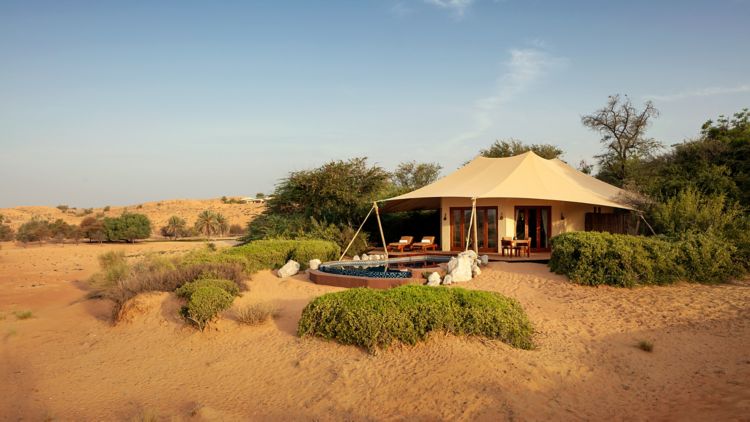
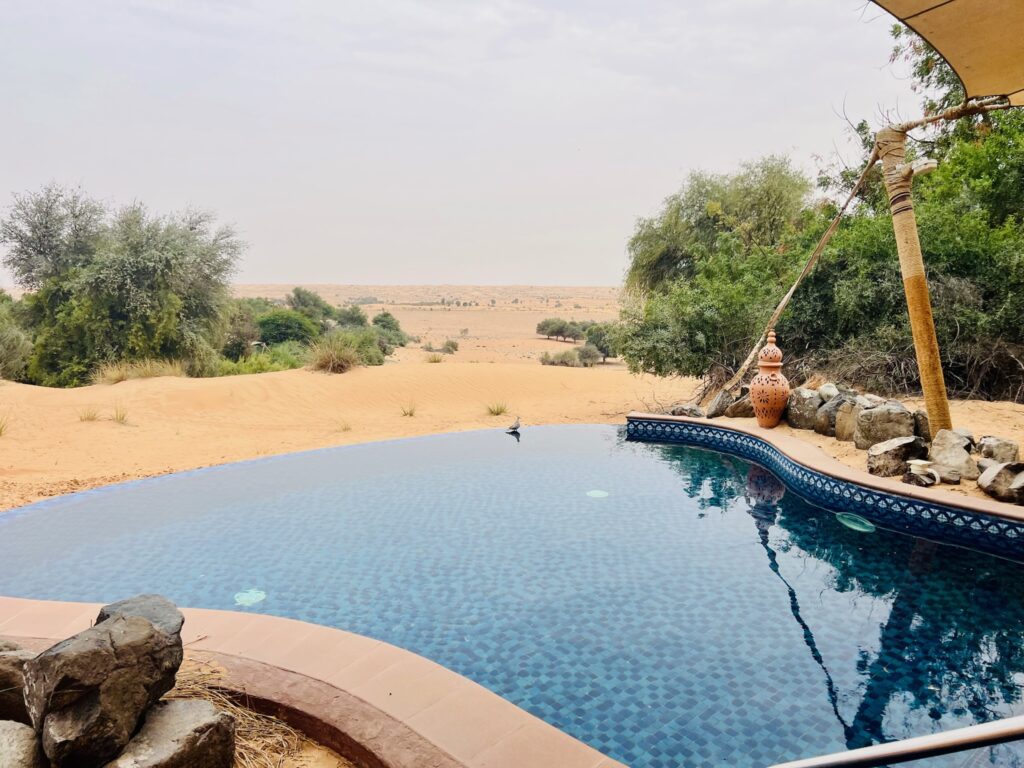
Eventually, I looked it up. Dubai. Of course — as far from the American Northeast as it is possible to get. And to tempt me further, the desert resort offered horseback riding. That sealed it. If I ever walked out of that chapter of my life, I had to find a way to go.
The photograph had always suggested something apart from the Dubai I knew from pictures — the city of endless skyscrapers and the world’s tallest building. This looked like somewhere the desert had simply been left alone. I filed it away again. Then Mission: Impossible – Dead Reckoning Part One starring Tom Cruise arrived in theaters, and there was Ethan Hunt galloping on horseback across desert terrain in the opening sequence, followed by those gleaming scenes at Abu Dhabi’s new airport. I took it as a sign.
Thirty-Six Years
I had friends and former teachers who had lived in the UAE — in Abu Dhabi, an hour and a half from Dubai — and I reached out to all of them. Were they still there? Was the trip worth making alone, as a woman? Was it safe? The replies came in: most had long since moved on, but every single one was emphatic. You must go.
Then, in the quietly serendipitous way that things sometimes arrange themselves, a childhood friend posted some family photos on social media. As I had done before with her posts, I liked them — and on an impulse, sent her a private message asking whether she still lived in Abu Dhabi, and that one day, I’d love to come and visit the UAE. After all, we hadn’t actually seen each other in 36 years. With a nine-hour time difference working against me, I sent the message and went to bed.
I woke up to a reply that began: “Yay!! Would love to see you!”
Over the following weeks, conversations grew into a rhythm. We talked about our school years, the friends we were still in touch with, the decades that had quietly passed. After three months we had settled on February. I sent over the dates — the best window I could find using airline miles and hotel points, without which the trip simply wouldn’t be possible — and waited. The reply arrived in under a minute. “This looks perfect!!” I secured the booking and messaged her immediately. Three months felt like a very long time to wait, but we both continued to check in with each other as the excitement grew and my departure date drew closer.
The Flight That Almost Wasn’t — and the One That Did
The first flight never left the ground.
Somewhere on the runway at Dulles, accelerating toward takeoff speed on a 14-hour flight to Dubai, the engines failed. The abort was violent and immediate — the kind of stop that takes a moment to understand, followed by the kind of silence that makes the understanding worse. We were taken back to the terminal. The flight, we were told, would not be departing that day.
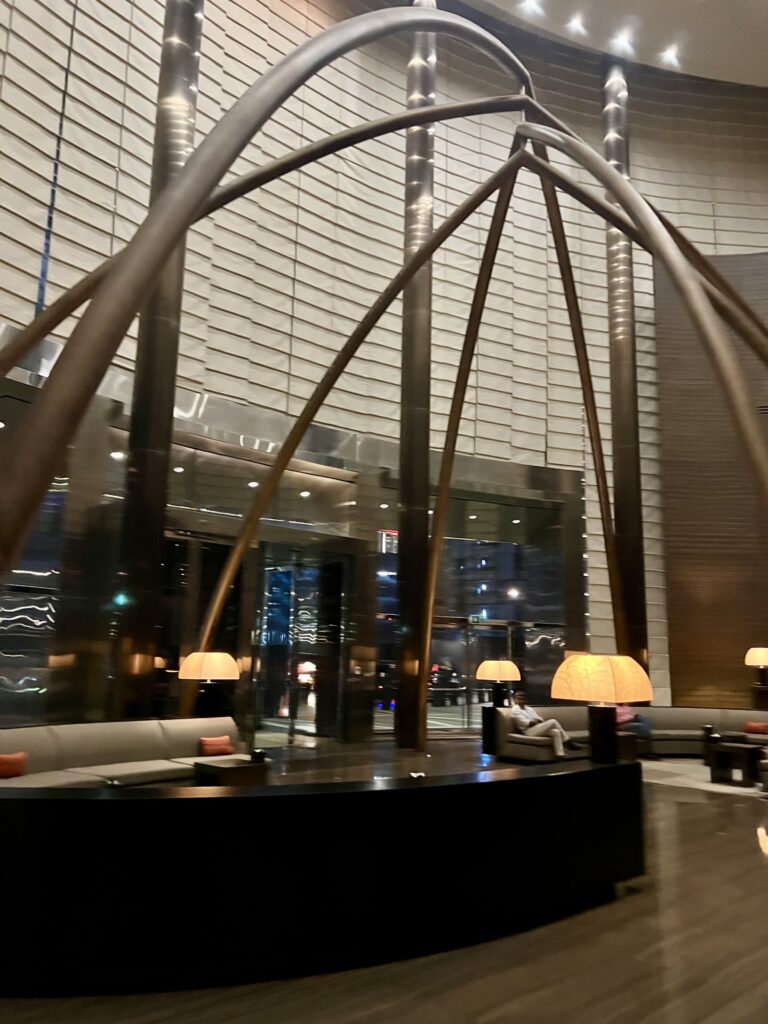
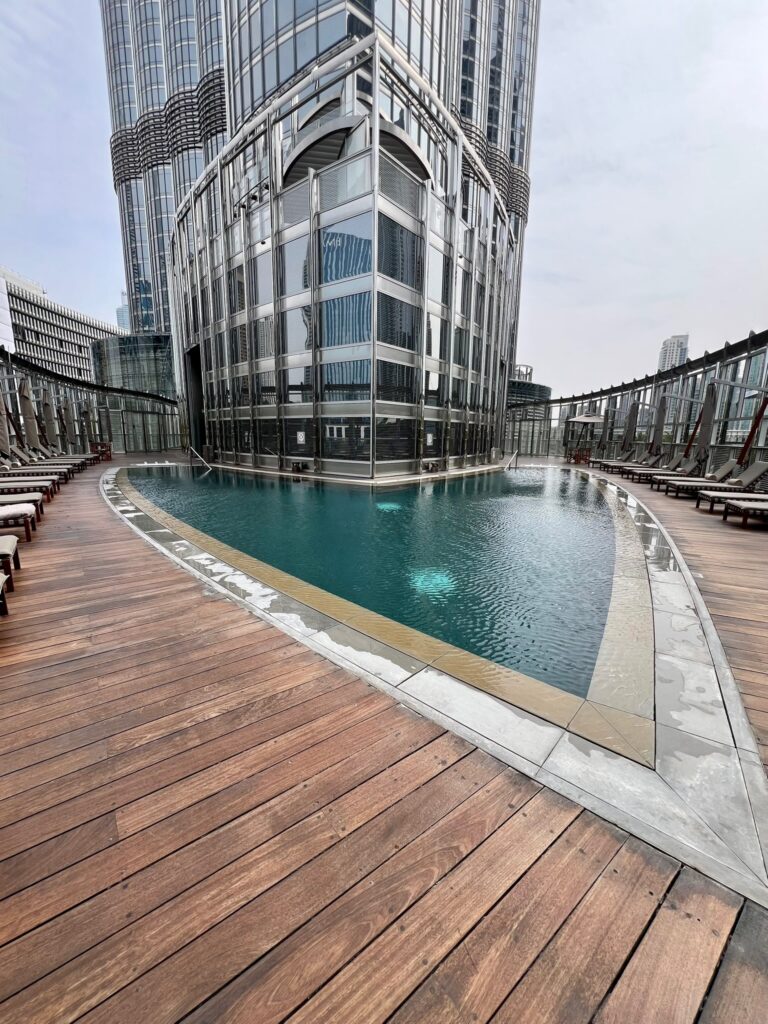
I sat in the terminal, shaken, already changed into my Emirates pajamas and not particularly caring what my fellow travelers thought about it, and did the only sensible thing I could think of. I got out my phone and changed my hotel booking. The Armani Hotel, inside the Burj Khalifa. Two nights, a spa treatment, and a private pool with the tallest building in the world rising directly above it — waiting for me at the other end of a 14-hour flight I hadn’t yet decided I was going to take. If I was going to get back on that plane, I needed to know something extraordinary was waiting on the other side.
Two days later, I got back on the plane.
There is something about a long-haul flight in Emirates Business Class that functions as a reset. The flat bed. The quiet. The food that arrives unhurried, as if 40,000 feet over the Gulf is an entirely reasonable place to be taking your time. Somewhere over Iran, I lay flat in the dark and thought I almost didn’t do this. The thought arrived without drama. I had done it. I was doing it.
Fourteen hours is a long time to sit with a decision. By the time Dubai appeared below us in the early morning light — this impossible city rising out of the desert, glittering and vertical and entirely sure of itself — I was ready for whatever came next.
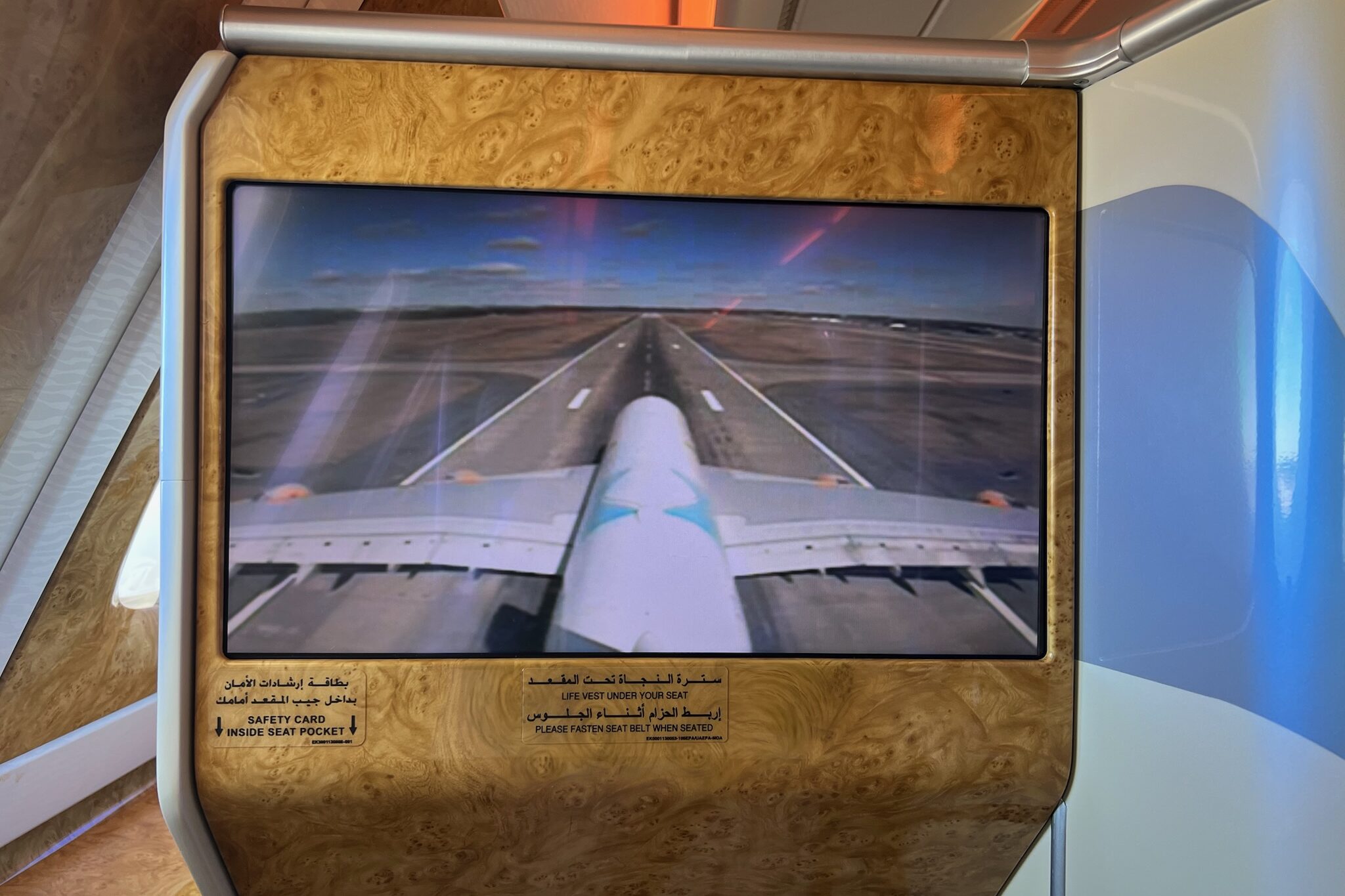
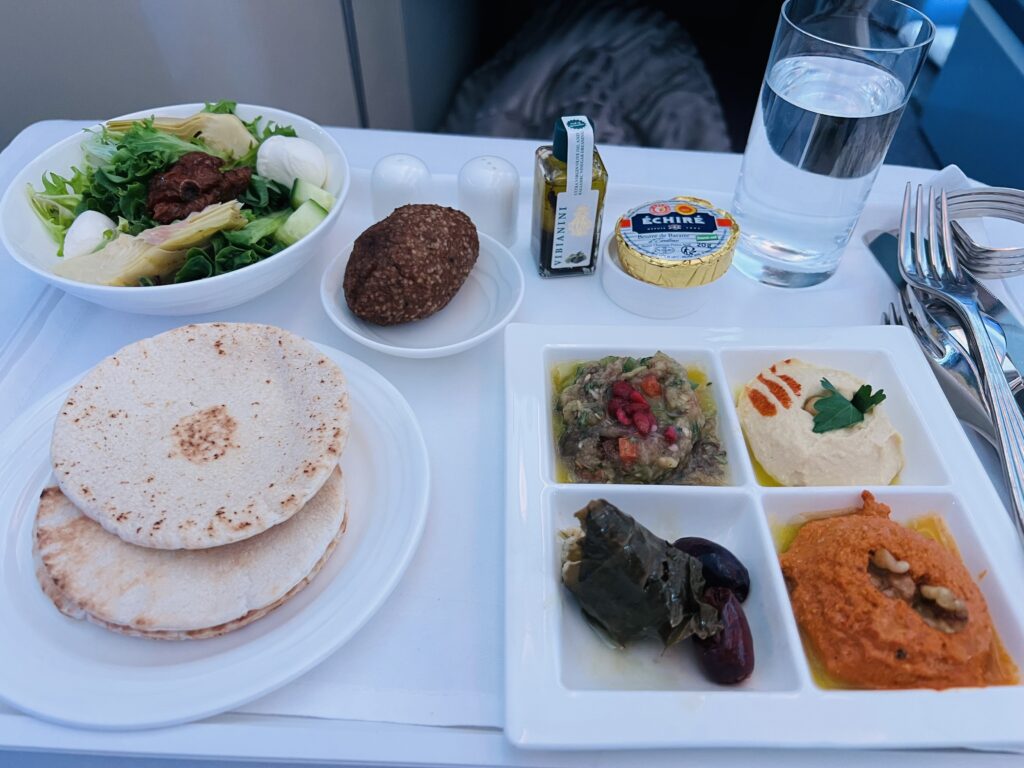
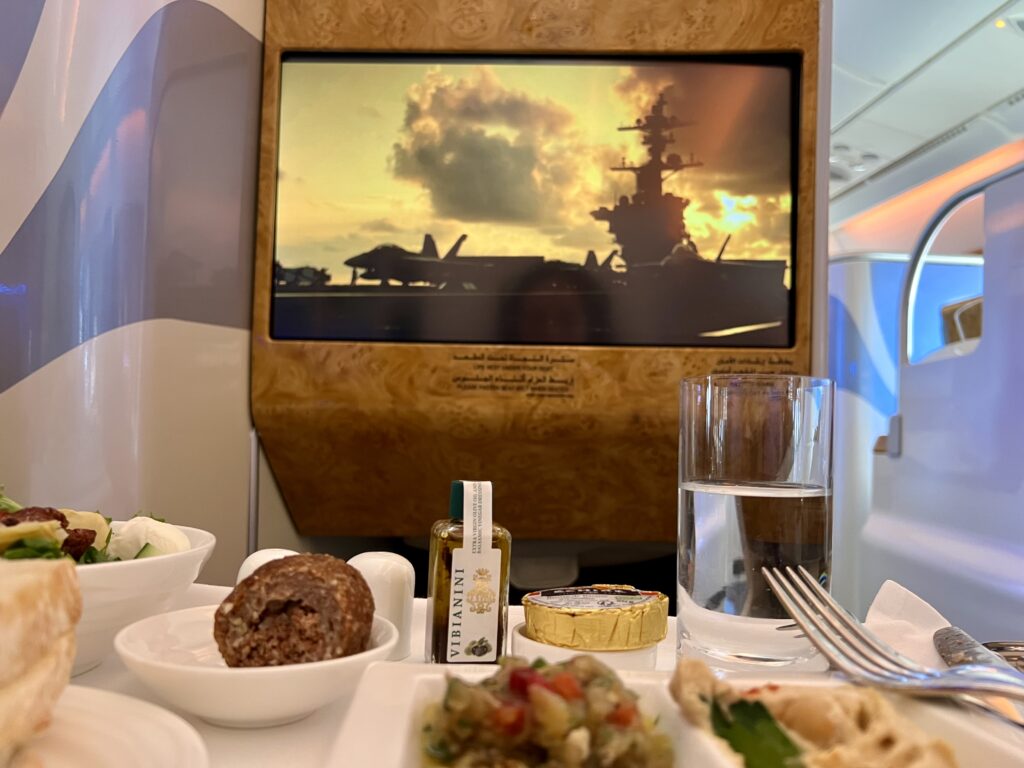
Emirates Business Class — the flight that made the decision feel worth it.
The Burj Khalifa
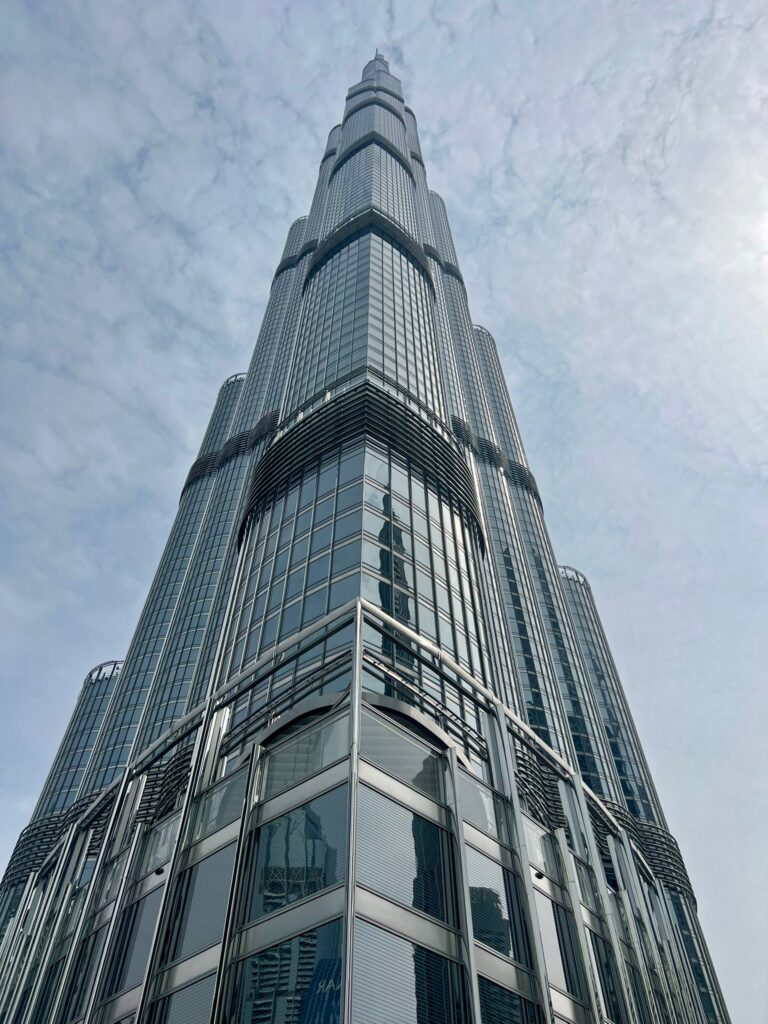
The Armani Hotel occupies the lower floors of the Burj Khalifa, and the effect of staying there is difficult to describe to anyone who hasn’t done it. Since I was now on my own mission impossible, it seemed only right to complete the circle and stay in the very building where Ethan Hunt had dangled 1,700 feet above Dubai in Mission: Impossible – Ghost Protocol — because if Tom Cruise does his own stunts, so will I. Getting back on a horse in the desert would be where I start. And after the runway at Dulles, I had earned every floor of it.
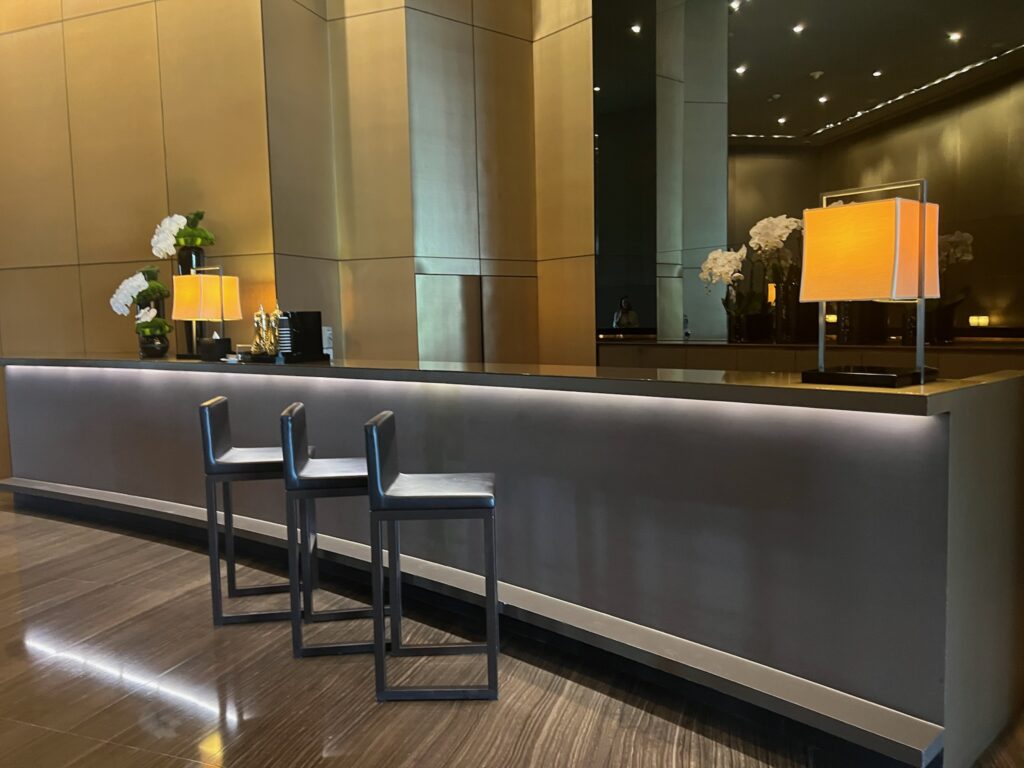
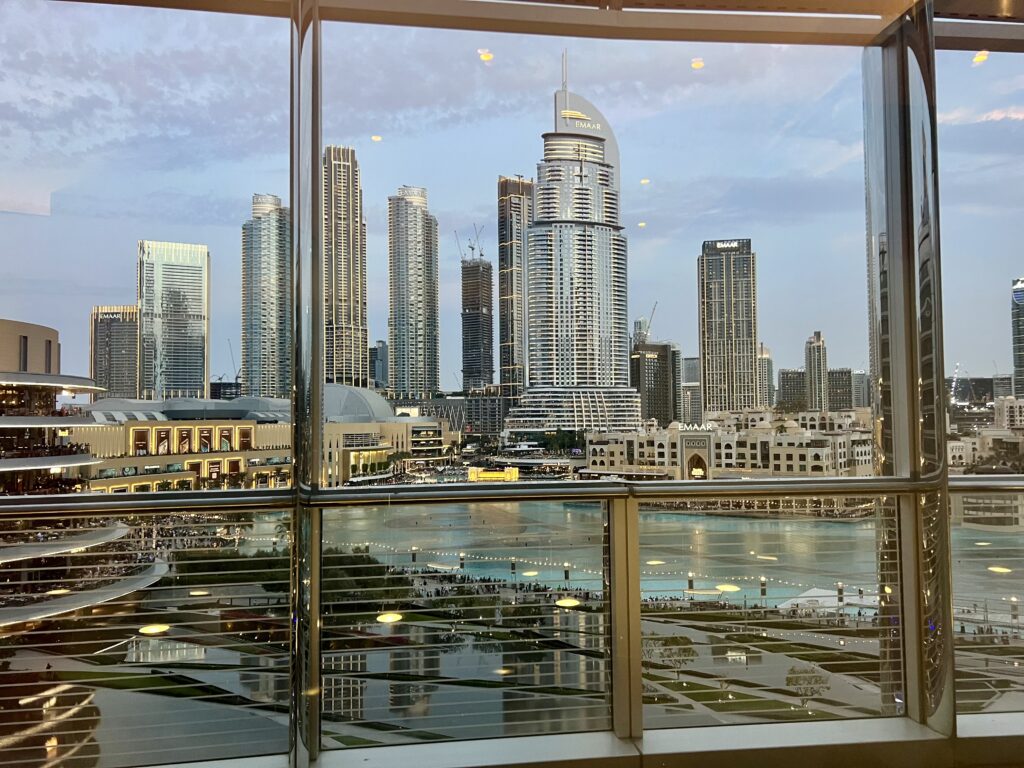
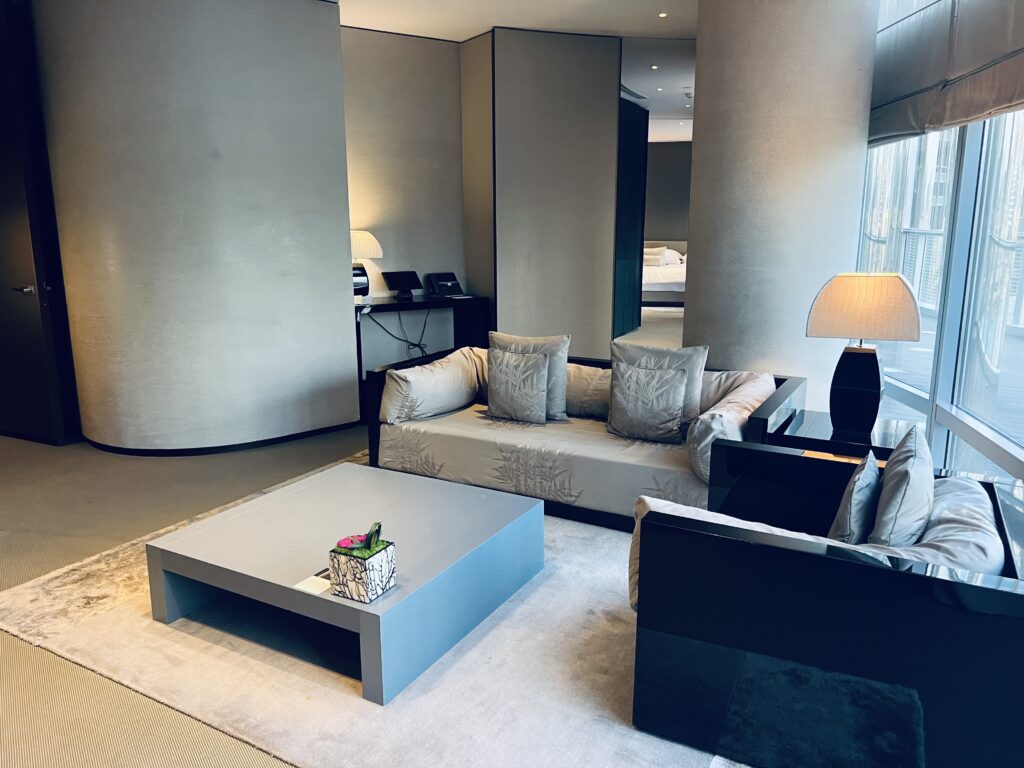
Two nights. A long spa treatment. An evening at the opera. The kind of deliberate, quiet indulgence that follows something frightening. I had promised myself this from a departure lounge in Washington, and here it was, delivering exactly what I’d needed it to. From the pool, the spa terrace, anywhere you stand outside — the building simply continues, floor after floor after floor, until it disappears into the sky. For most people, that means tilting their head back and looking up. Despite my unwillingness to accept impossibles, I couldn’t argue with my neck injuries — so I did the only thing I could: I floated on my back. Lying there in the water, arms out, looking straight up at 163 floors of steel and glass rising into the Dubai sky, I felt — for the first time since the runway at Dulles — genuinely all right.
The Reunion
She was waiting in the hotel lobby. We recognized each other immediately, thirty-six years dissolved in an instant, and we walked out into Dubai and didn’t stop talking.
The Museum of the Future first — extraordinary and slightly disorienting in the best way, the kind of place that makes you feel both behind the times and optimistic about them simultaneously. Lunch, stretched long over catching up. Then, against all medical orders and against the wishes of a now quite nervous friend who had suddenly realized she felt personally responsible for my safety 7,042 miles from Washington DC, I casually suggested we go skiing. Inside the Mall of the Emirates, at Ski Dubai. Having skied all my life, it seemed only natural to want the unique experience of doing it in the middle of the desert. My friend’s expression suggested she did not share this logic. That I had also packed leggings, gloves, ski socks, and a spine protector — the precise items Ski Dubai does not provide — was, of course, entirely coincidental. I survived.
The afternoon ended on Jumeirah Beach, the city’s skyline behind us, the Arabian Gulf ahead. We sat and talked until the light went. Thirty-six years, and we hadn’t run out of things to say. We hadn’t come close.
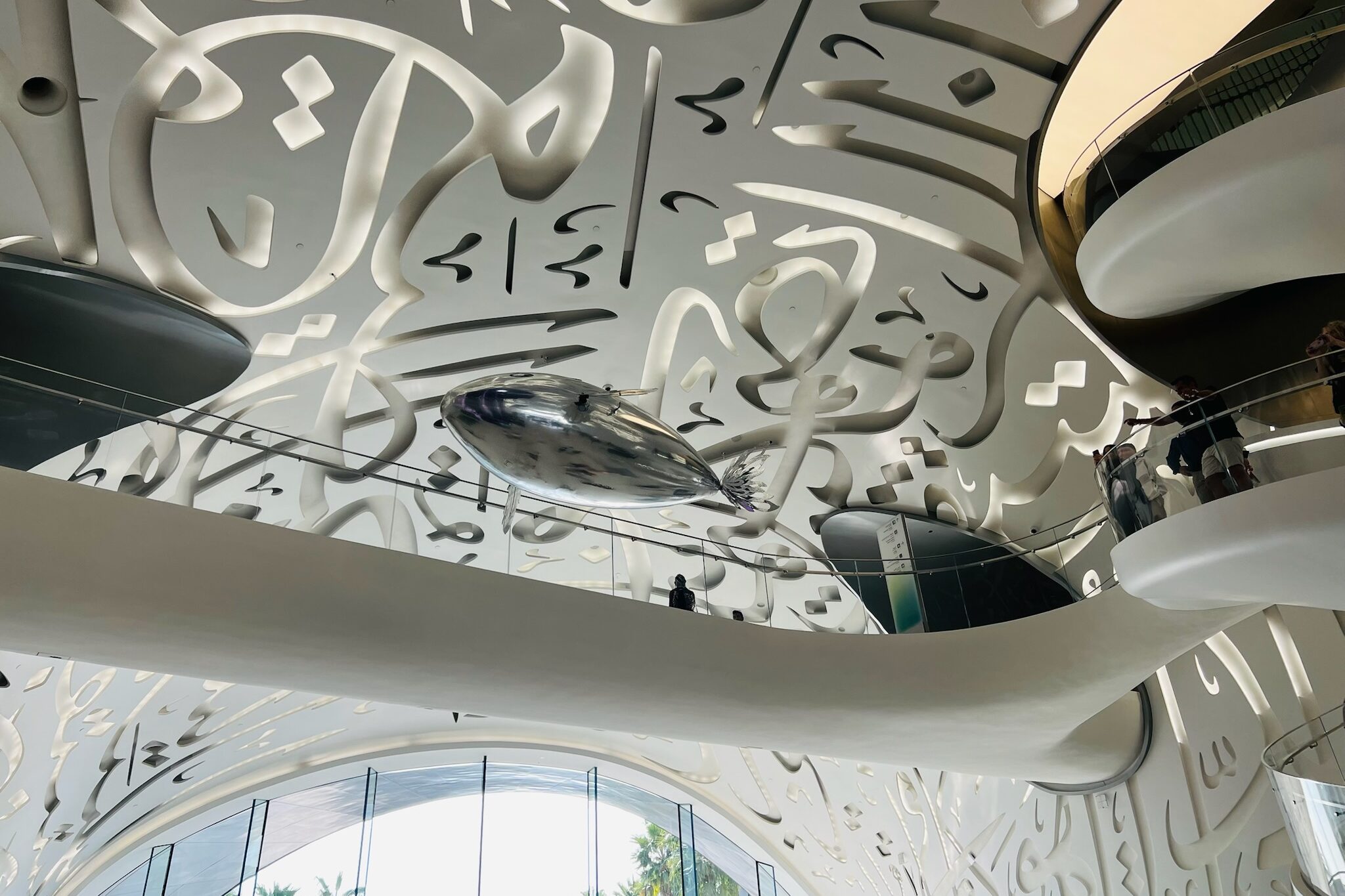
Museum of the Future
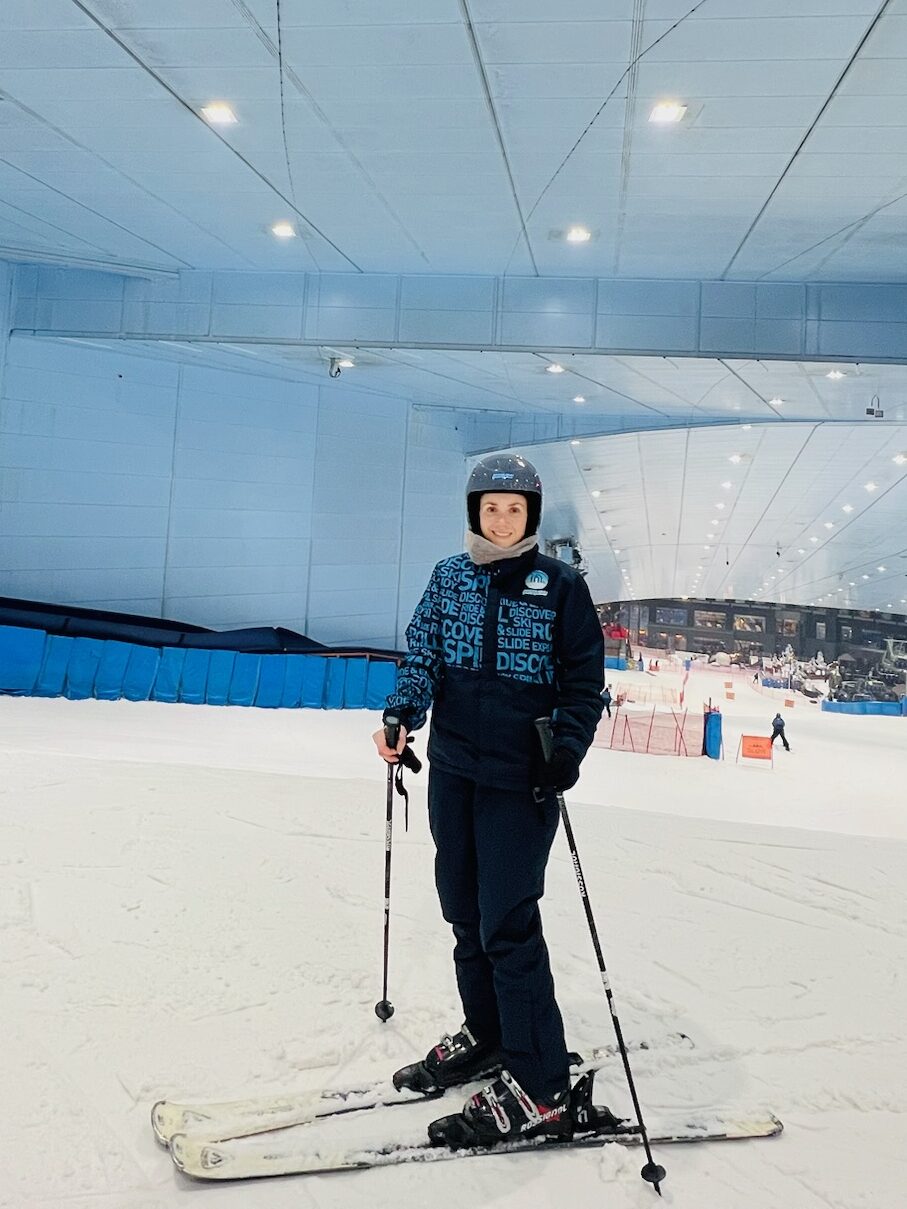
Mall of the Emirates
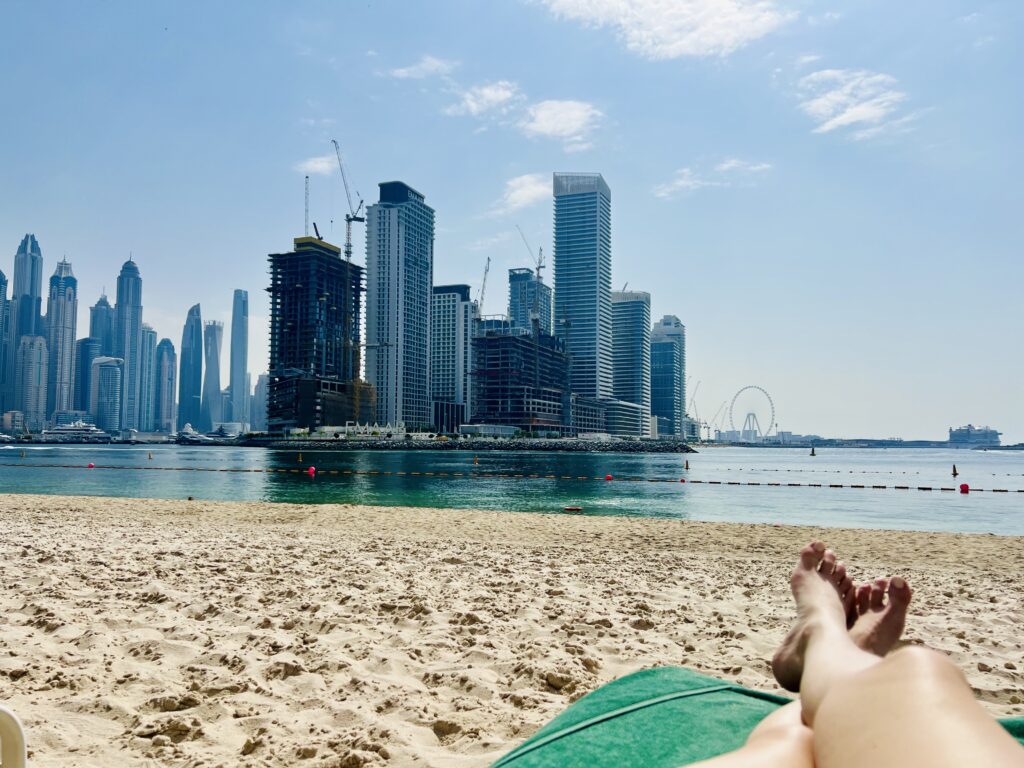
– 30 mins after skiing
Abu Dhabi
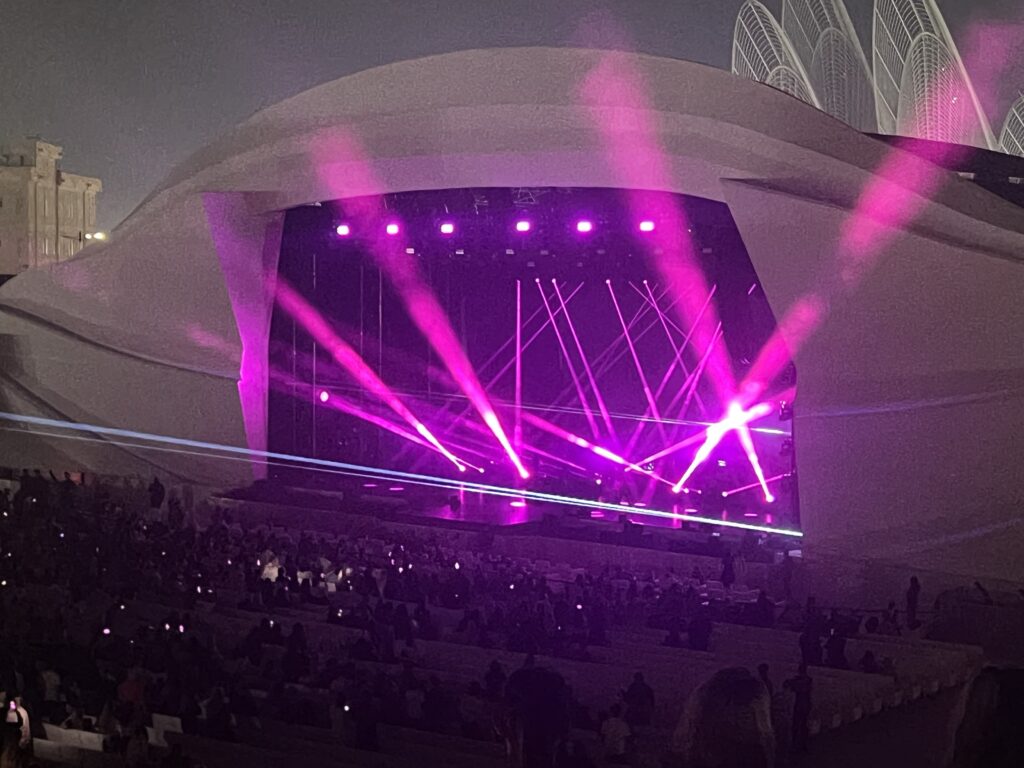
Abu Dhabi began with Gwen Stefani at Saadiyat Nights.
I recognize that sentence requires no further context for anyone who has traveled with a childhood friend. There are experiences that are absurd and joyful in equal measure, and a pop concert in the Middle East with someone you met in middle school, reunited after four decades, is precisely that kind of experience. We were not the youngest people there. We did not care.
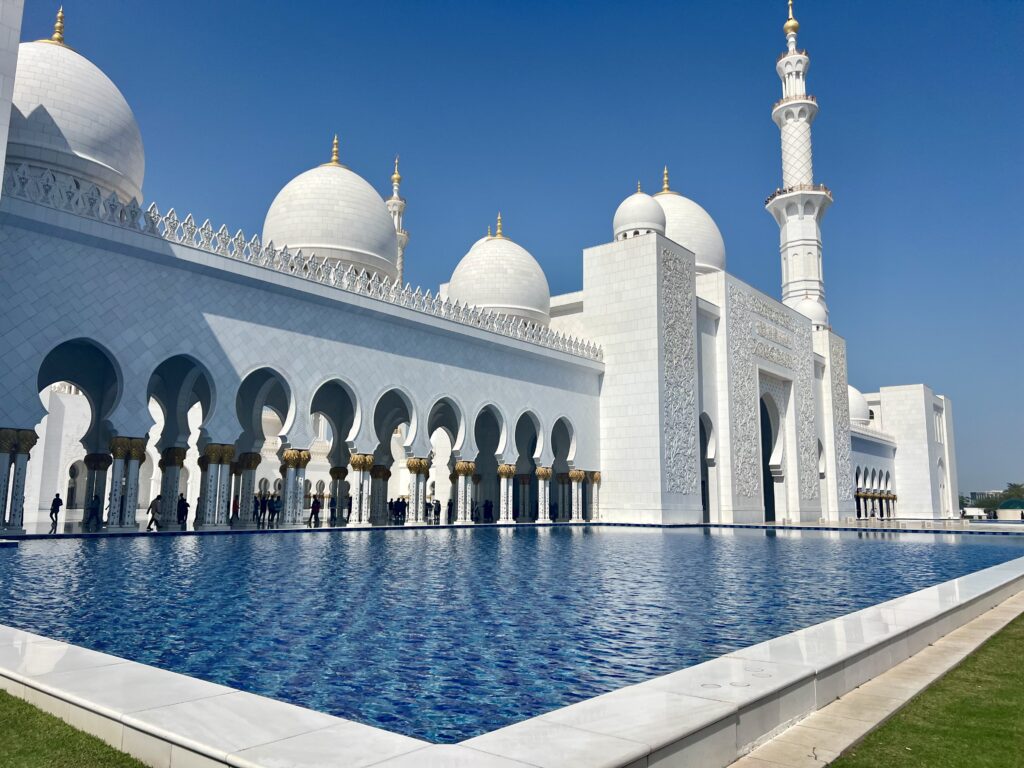
The morning after brought the Sheikh Zayed Grand Mosque — which is the correct antidote to a concert, as it turns out. One of the most breathtaking spaces I have ever stood inside. The scale of it, and the silence within that scale, recalibrates something.
The Louvre and Fouquet’s: A Paris Reunion in Abu Dhabi
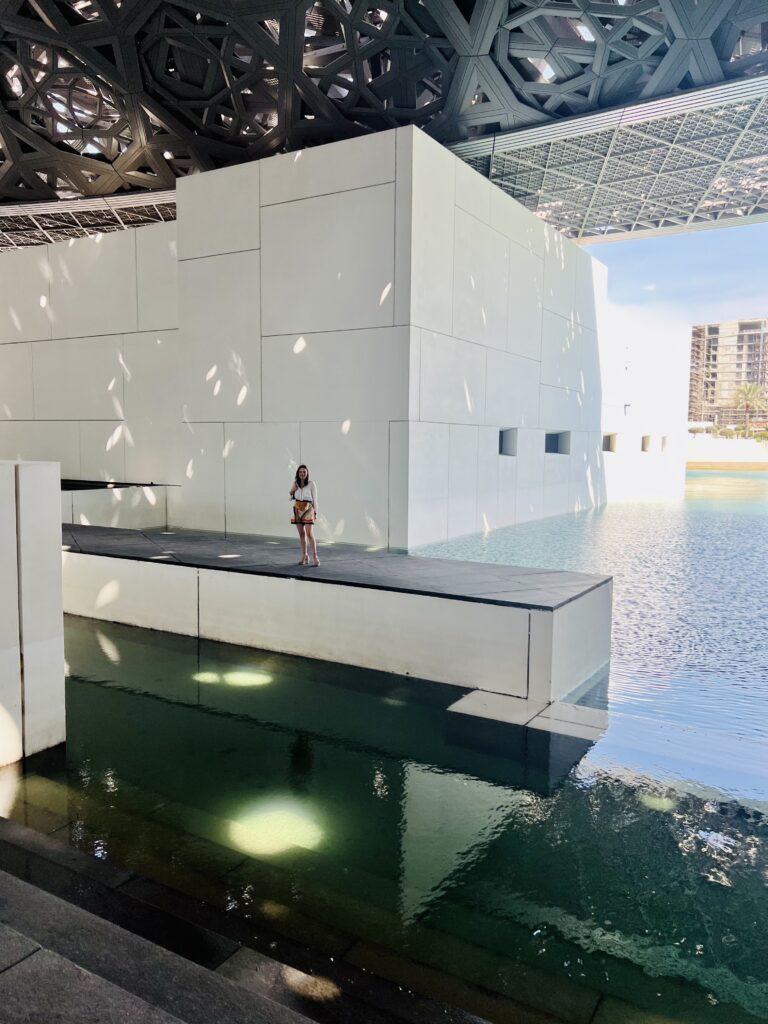
Then the Louvre Abu Dhabi, whose building alone — Jean Nouvel’s extraordinary perforated dome, light filtering through it in patterns onto the water — would justify a visit even without what’s inside.
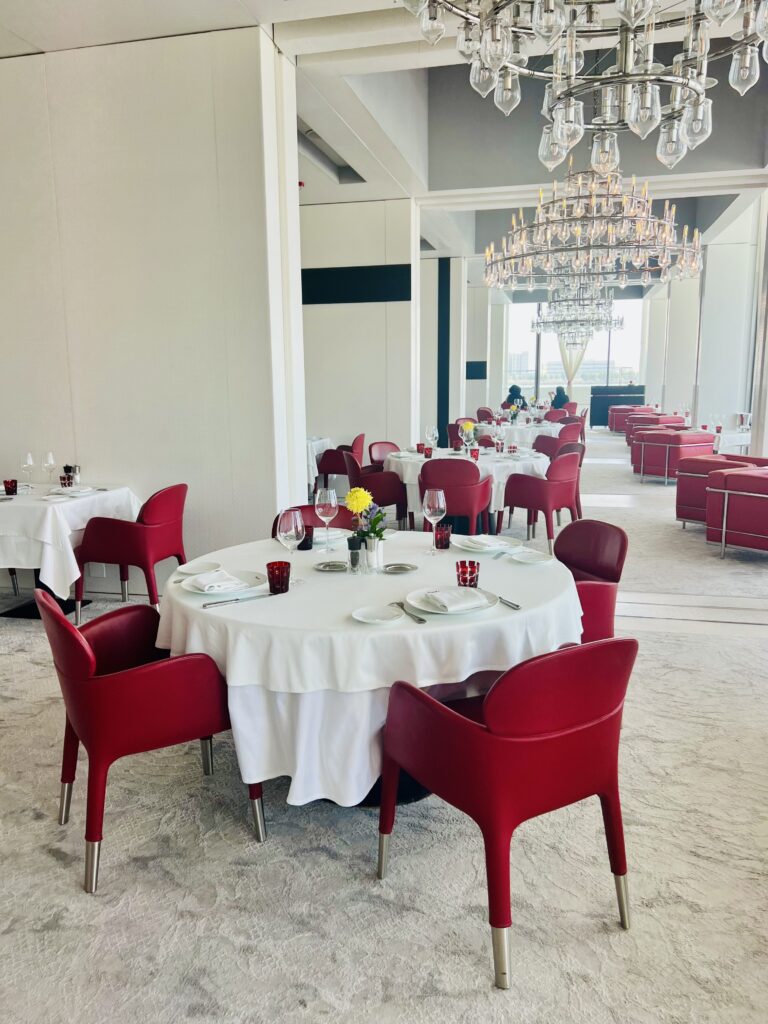
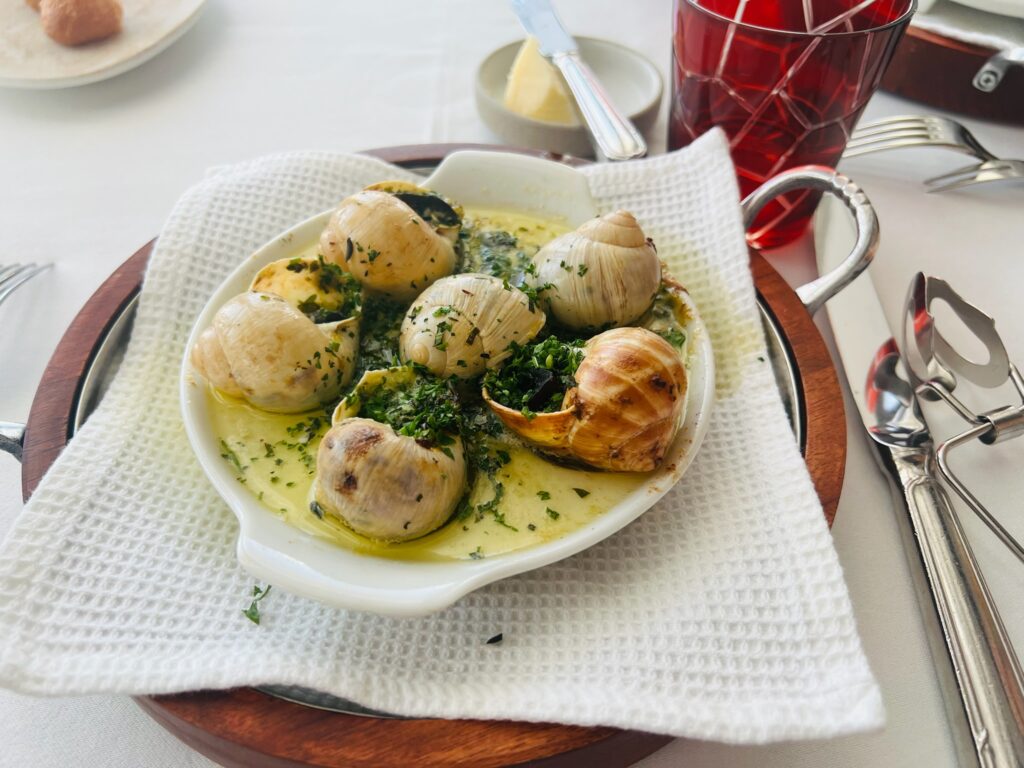
Fouquet’s on the Champs-Élysées had been beyond us when we were twelve — too young, too intimidated by a place that seemed to belong to a more grown-up world than the one we occupied. Decades later, two women who had met as girls in a city neither of them lived in anymore sat down at Fouquet’s Abu Dhabi and ordered lunch. We didn’t treat it like an Instagrammable moment. We were not there to be seen. Some things close a circle quietly, and this was one of them.
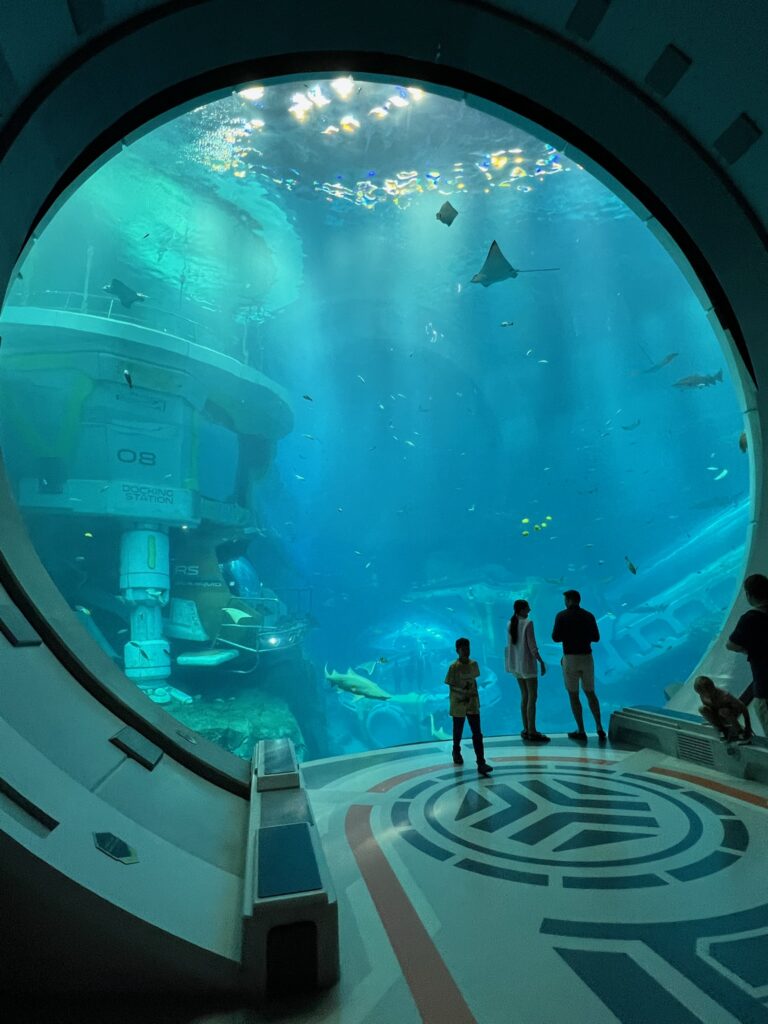
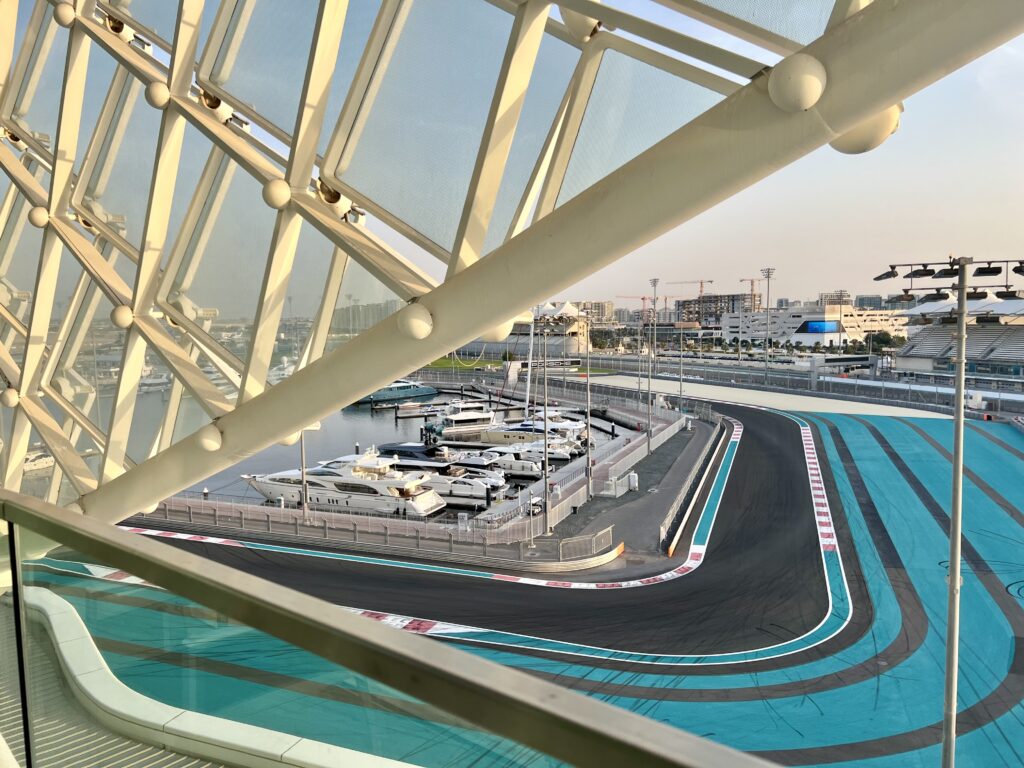
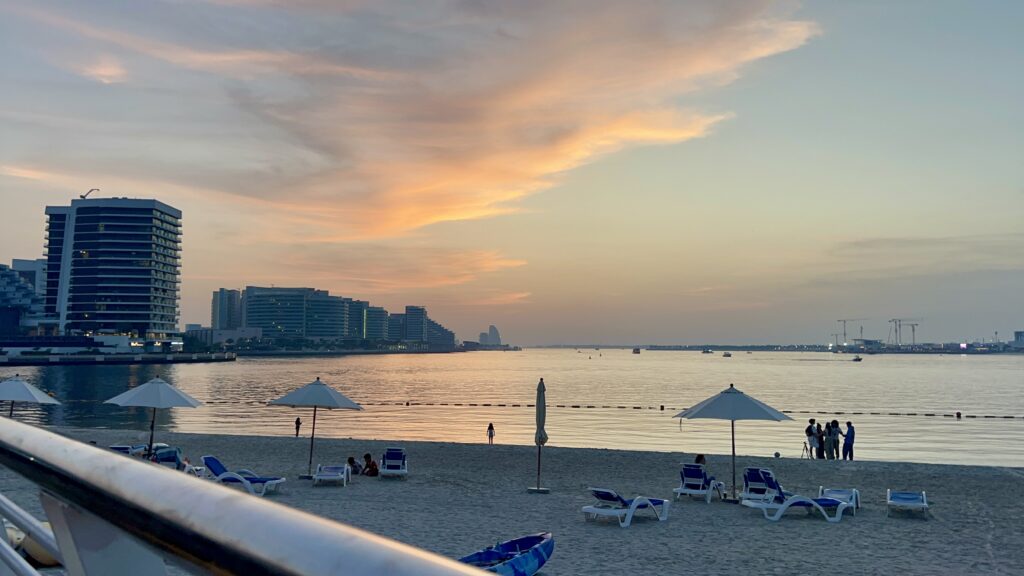
The days that followed moved at her pace — which is to say, generously and without agenda. A day at SeaWorld with her family. The Formula 1 circuit at Yas Marina, which even a non-motorsport person feels in the chest when you’re standing on it. Morning strolls along Yas Bay Waterfront after the children had gone off to school. Breakfasts in neighbourhood cafes. Being introduced to her circle of international friends, just as we had once been introduced to each other’s worlds as schoolgirls. Evening walks to Yas Beach watching the sun go down over the Arabian Gulf — neither of us wanting them to end. And leisurely dinners at her home, where 36 years of catching up happened across a table, unhurried, the way it should.
Into the Desert
On the last morning, she stood outside and waved as my private car pulled away. I watched the city recede through the window. Then the suburbs. Then the last of the road infrastructure. Then nothing — just desert, in every direction, the light on the sand shifting from gold to white as the sun climbed. I had been in noise and reunion and spectacle for ten days. The silence arrived like something I hadn’t known I needed.
The drive to Al Maha takes you deep into the Dubai Desert Conservation Reserve — 225 square kilometers of protected land where the only development is the resort itself. From the point you turn off the main road, it takes another fifteen minutes to reach the entrance. By the time the first buildings appeared, I was already somewhere else entirely.
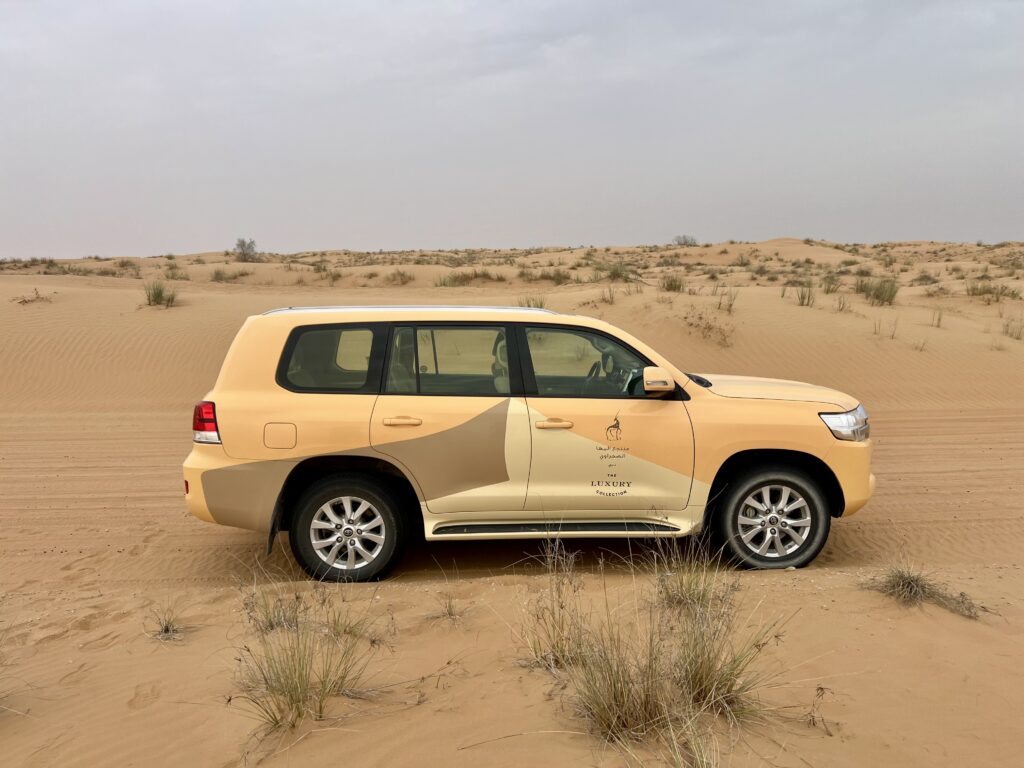
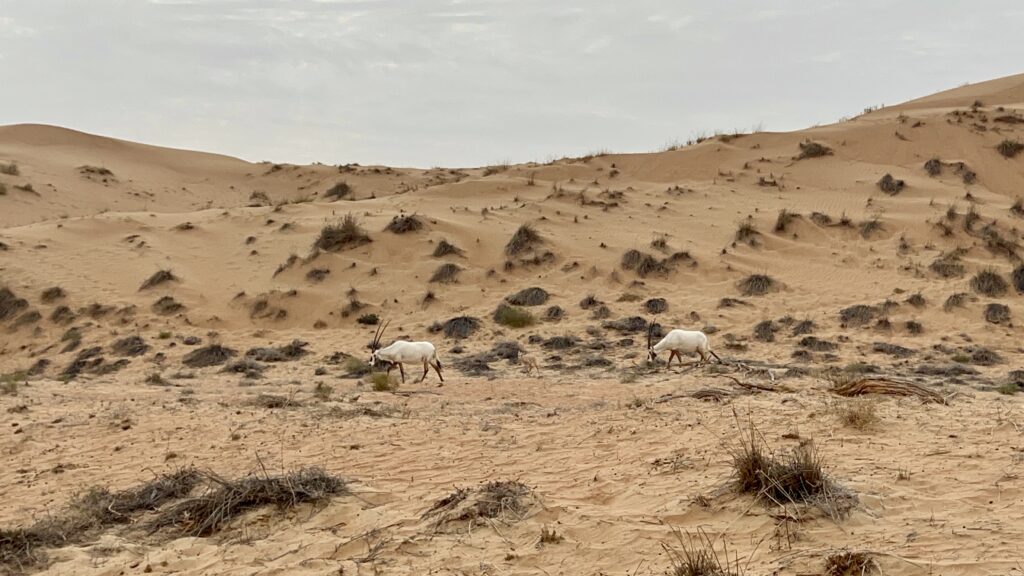
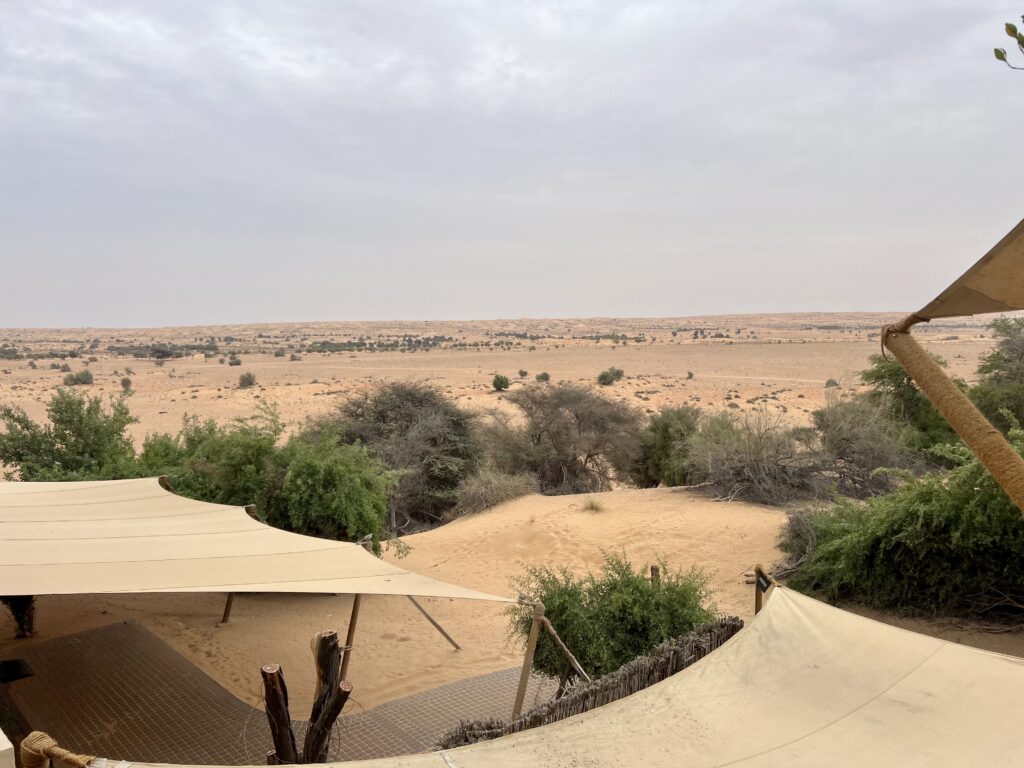
The Dubai Desert Conservation Reserve. Al Maha lies approximately 30 miles from the Omani border.
Stepping Into the Photograph
Winnie from guest relations was waiting. She led me to stand over a small bowl on a pedestal where different incense was burning — a ritual to mark the transition, she explained, from the pace of everything outside. It worked before she had finished explaining it.
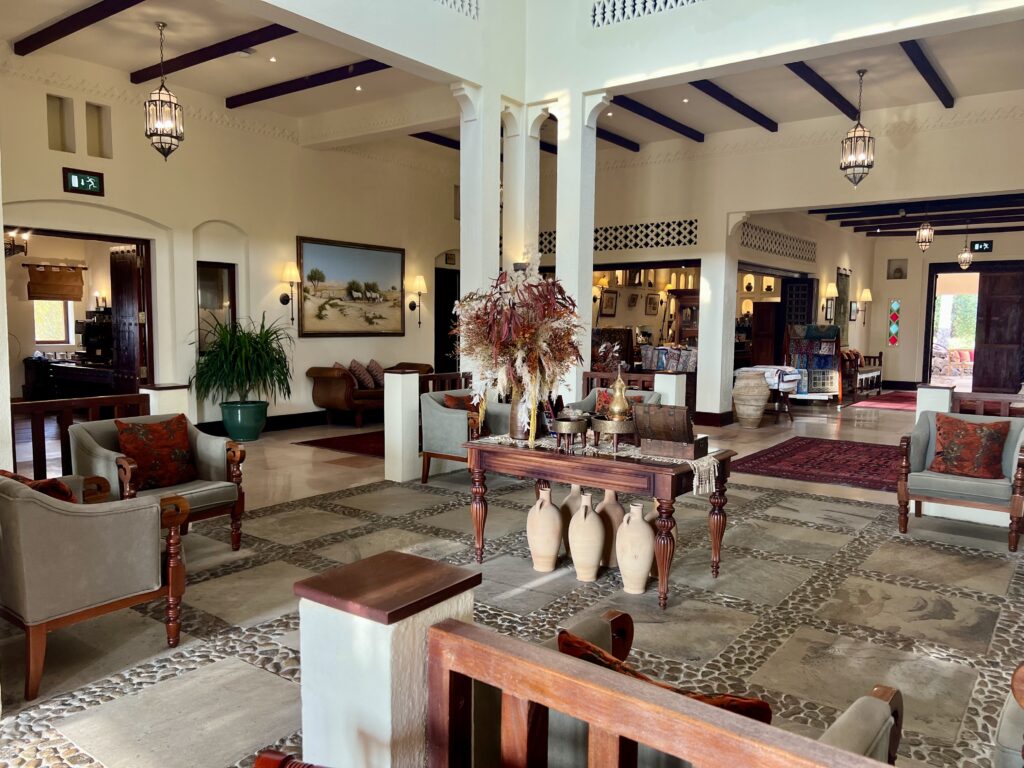
The lobby is more like a private home than a hotel reception: rugs, tapestries, Middle Eastern objects chosen rather than installed. I sat in a wingback chair in the study and was brought Arabic coffee and an afternoon spread of sweets while Winnie completed my check-in across the table. Then Carel, the Activities Director, came to talk horses.
The resort’s thirteen horses are all ex-racing Arabians — strong, willing, and carrying, as Carel put it, a hint of challenge in their personality. Every ride is private, tailored to the individual guest. He had read my form about riding experience and wanted to confirm the match himself. We agreed on a well-mannered Arabian for the following morning. I didn’t mention, yet, what the following morning would mean.
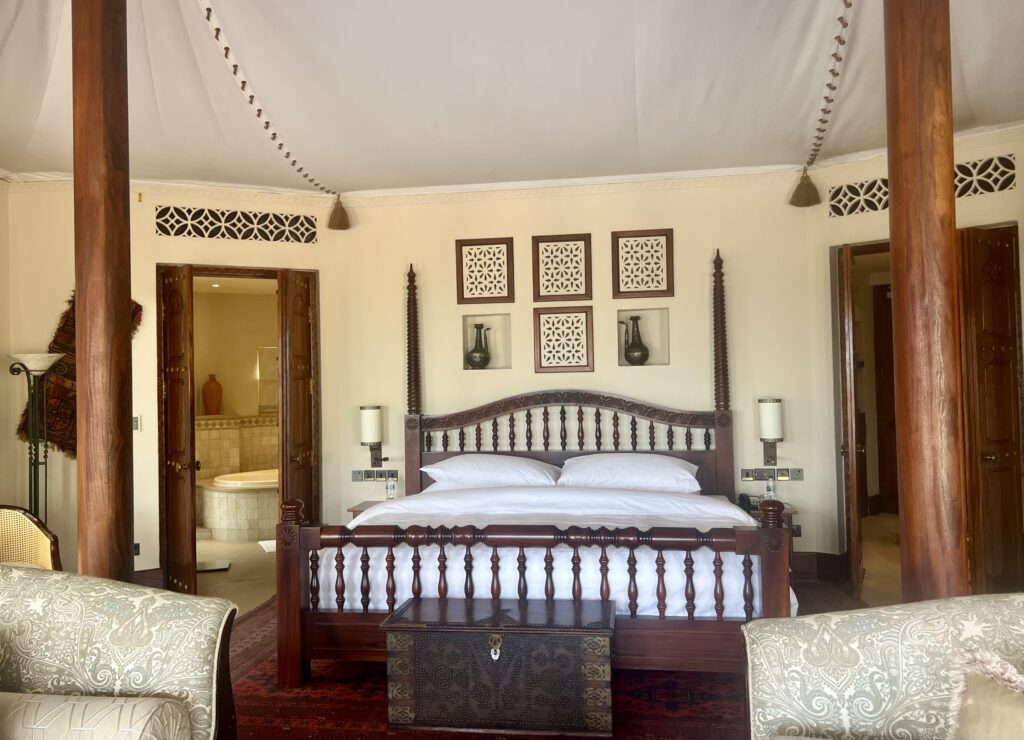
Then the golf cart, the path to the villa, the luggage already inside — and Winnie opening the French doors onto the patio.
I had been carrying a photograph in my mind for two years. I stepped into it.
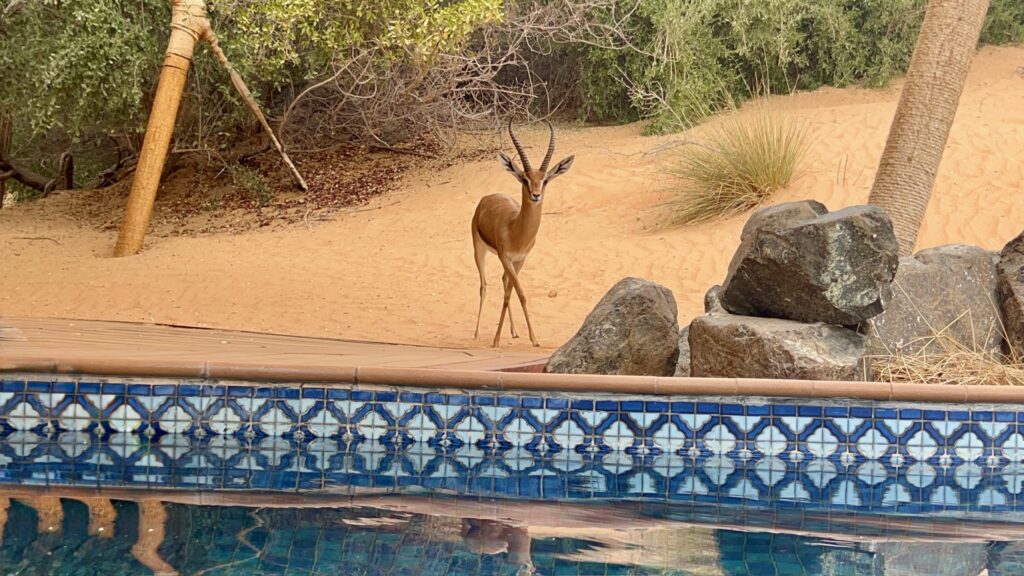
No image had prepared me for the sound. The birdsong. The quality of the silence underneath it. The gazelles standing just beyond the railing, watching me with exactly as much curiosity as I had for them. The plunge pool catching the afternoon light. In the distance, so perfectly timed it seemed staged, a string of camels and their handler crossed the dunes in front of my view and continued out of sight.
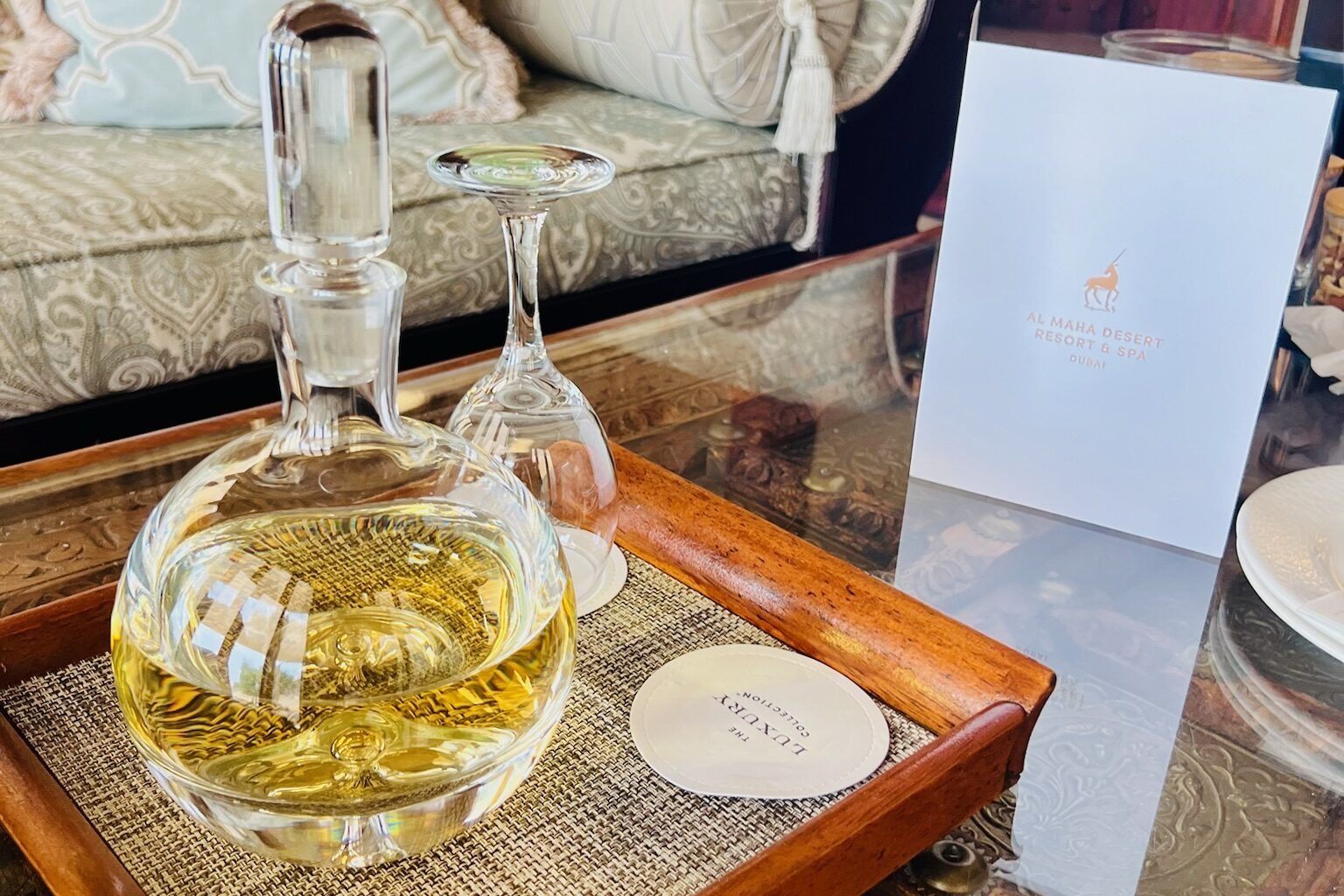
I poured a glass of Sherry from the decanter on the coffee table. I took out my phone to document the moment, looked at it, put it down. Sat at the edge of the pool with my feet in the water instead. Listened.
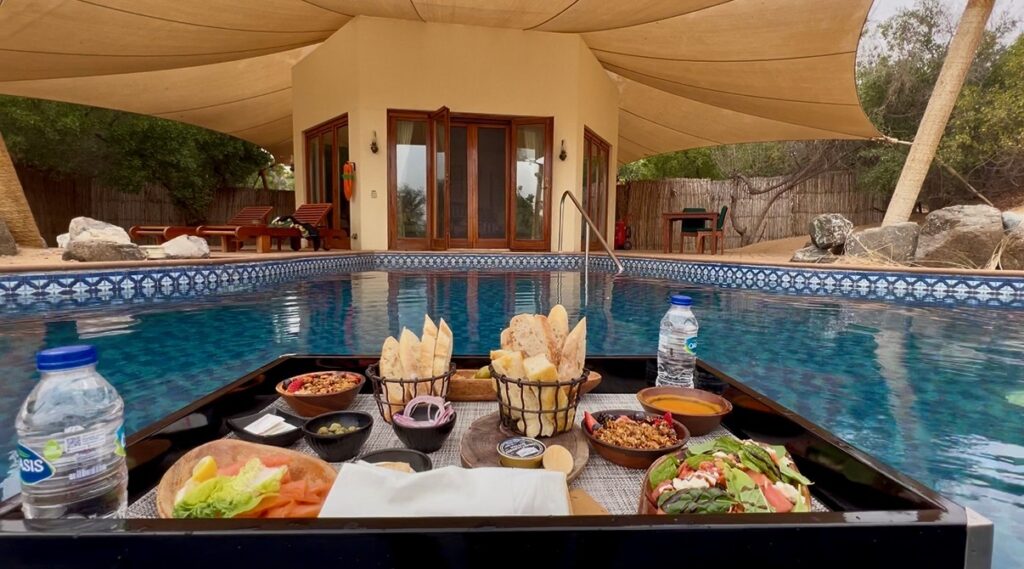
A young Arabian Gazelle — Gazella arabica, known locally as the Idmi, and listed as Vulnerable by the IUCN — made a tentative move toward the patio steps. I retreated inside rather quickly, somewhat alarmed by this small, delicate creature that weighs considerably less than my carry-on luggage. The irony was not lost on me: I had just flown 7,042 miles, survived an engine failure, skied in a desert mall against all medical advice, and was about to climb onto an ex-racing Arabian at dawn without a second thought — yet here I was, outwitted by a gazelle the size of a large house cat. I watched for a long while from behind the French doors, where I felt considerably safer — before venturing back outside, but it was the only way into the pool. Lunch arrived on a floating tray in the water — possibly the most civilised thing that has ever happened to me. Then a well earned bath and off to dinner.
Into the Dunes
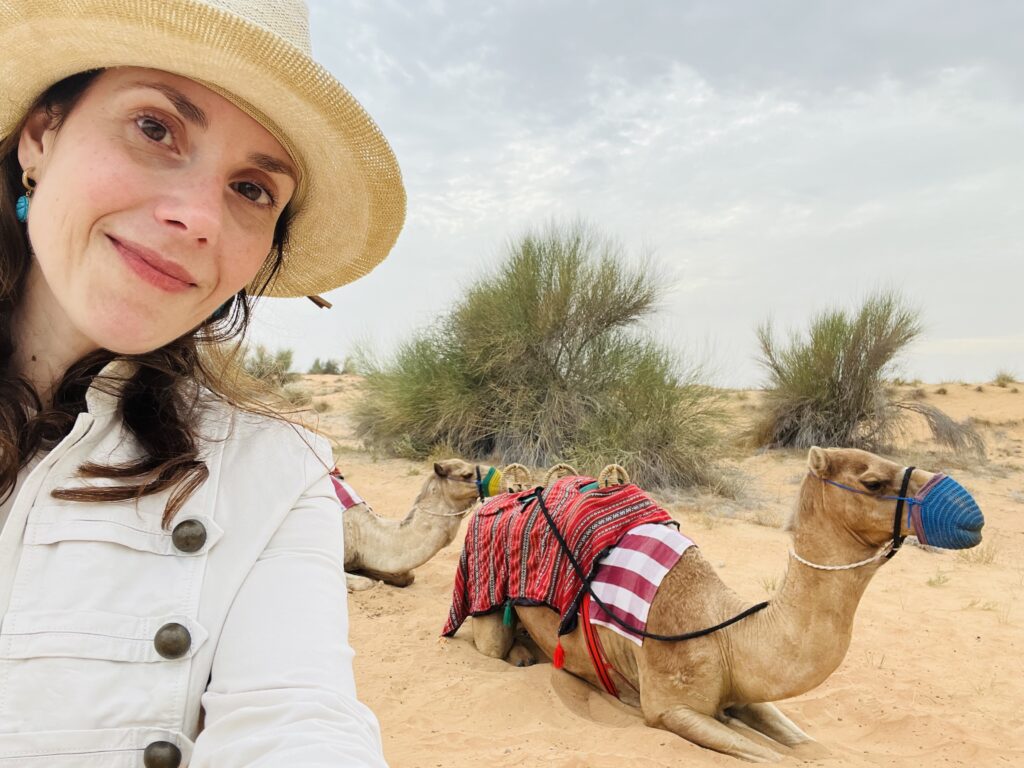
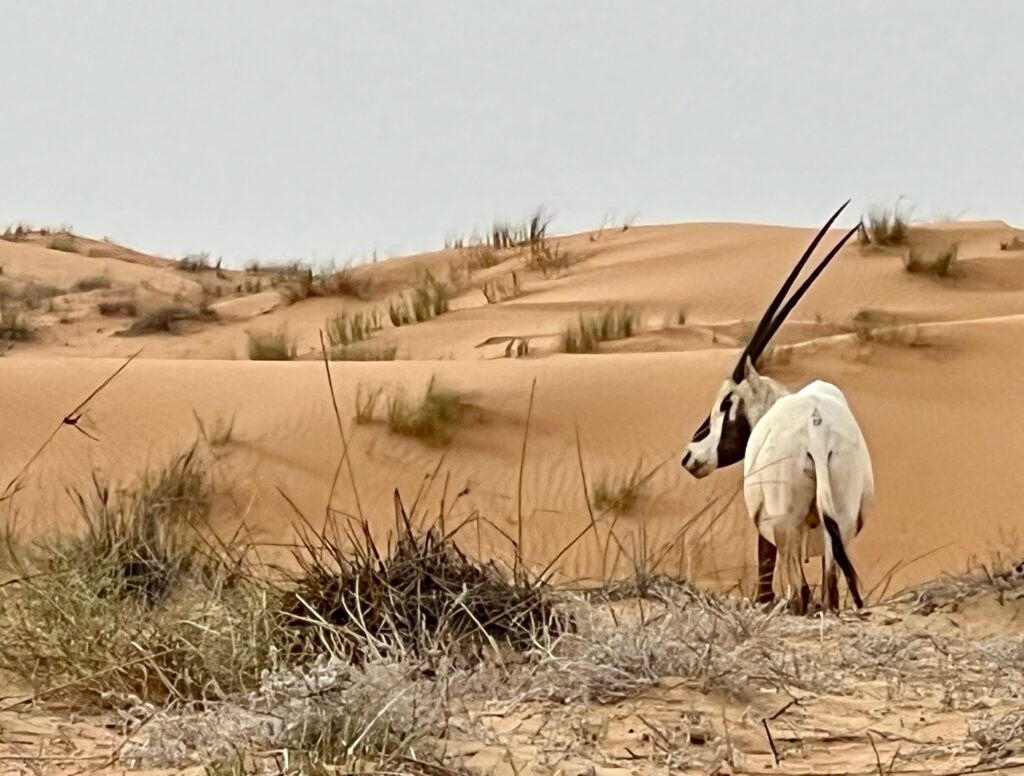
Each stay at Al Maha includes two complimentary desert activities per person per night. I chose the Dune Drive and the camel trek — both, as it turned out, excellent decisions, though for quite different reasons. The Dune Drive took us deep into the Conservation Reserve in one of the resort’s 4x4s, with a guide who knew every dune, every track, every animal movement across those 225 square kilometres. We spotted Arabian Oryx and gazelles roaming freely, learned about the camel herd maintained on the property, and were briefed, with some emphasis, on the sand-coloured vipers that also call the reserve home. I was quietly grateful not to see one. The camel trek came later, winding out into the desert as the light turned gold — and ending, as if from nowhere, at a Dom Pérignon Vintage sundowner set up among the dunes. Tables, chairs, chilled glasses, the desert going amber around us. Nobody had mentioned this was coming. It was exactly the kind of surprise that only works when the setting is already extraordinary.
I should note, for the sake of full disclosure, that a camel sits approximately twice as high off the ground as a horse. I am now prepared to admit that I had neither my helmet nor my Helite air vest with me for the camel trek. My safety precaution, in hindsight, was asking for the calmest camel available and assuming that would cover it. In retrospect, it was probably the single biggest risk I took on the entire trip — which is saying something, given that the trip also included an aborted takeoff, skiing against medical advice, and getting on an ex-racing Arabian at dawn. The camel, to its credit, was very calm.
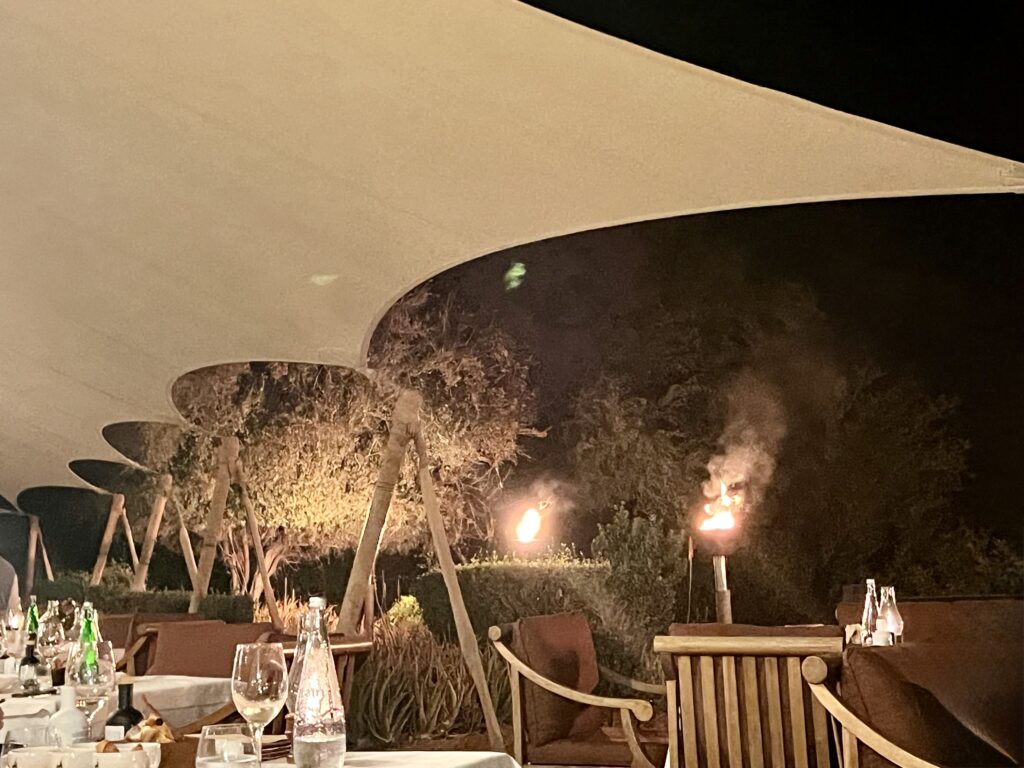
Dinner that evening was five quiet courses in the Al Diwaan Restaurant — guests seated on the terrace, close together in the way of desert camps, yet each table somehow entirely its own world, the Conservation Reserve stretching out beyond us in every direction and what felt like every star ever made visible overhead. There are dinners you remember for the food. This one I will remember for the sky.
The Conservation
Al Maha means “oryx” in Arabic, and the Dubai Desert Conservation Reserve it sits within — 225 square kilometres, nearly five percent of Dubai’s total landmass — exists in large part because of the Arabian Oryx itself. Hunted to the brink of extinction by the early 1970s, the last remaining animals were trans-located to the United States by the late Sheikh Rashid bin Saeed Al Maktoum. Sheikh Mohammed bin Rashid Al Maktoum funded the reintroduction, and in February 1999 the first 38 oryx were released into the protected area surrounding what would become Al Maha. The reserve was formally established by Emiri decree in 2002 under the chairmanship of Sheikh Ahmed bin Saeed Al Maktoum, Chairman of Emirates Airline. Today, over 400 oryx roam freely across the dunes — the largest such herd in the UAE. The Arabian Oryx is the only animal species in history to have been reclassified by the IUCN from “Extinct in the Wild” back to “Vulnerable.”
What makes the model quietly radical is that the resort funds the conservation — every stay at Al Maha directly supports the DDCR’s operation. Guests are, without particularly trying, participants in one of the most successful desert rewilding programmes in the world. The approximately 300 Arabian Gazelles and 100 Sand Gazelles that roam freely across the reserve include, on occasion, the ones that wander up to the villas. The young Idmi who approached my patio that first evening was not a tourist attraction. She was simply at home.
Fourteen and a Half Hours Home
The return flight was Emirates First Class.
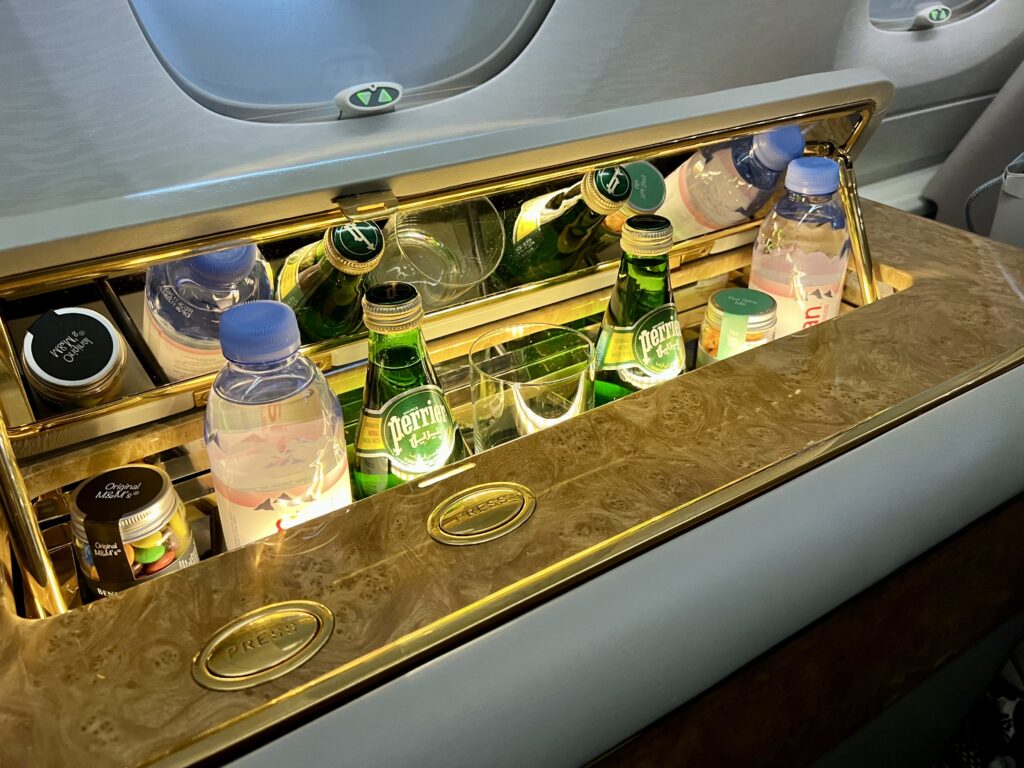
There is a moment, somewhere over Iran at 40,000 feet, when you are standing in a shower — an actual shower, in the sky — and you think: this is not a normal life. Dinner arrives whenever you wish it, whatever you desire, served to you in your private suite as the world moves silently past the window below. A glass of Dom Pérignon appears in your hand. And then, when you are ready, you are tucked into a full-size bed. In the sky. I thought all of it with complete gratitude and no guilt whatsoever. I had earned this. I knew the exact sequence of events that had led to it.

An engine failure on a runway in Washington. A hotel booking made from a departure lounge as an act of faith in myself. A friend who had been waiting 36 years to show me her city. A mosque at dawn. A full-circle lunch at Fouquet’s. A horse, and a desert, and four years of recovery finally arriving somewhere.
Fourteen and a half hours is a long time to consider what you do next.
I landed, and I started Equestrian Destinations.
Photo credits: Equestrian Destinations
A Note of Gratitude
To the friend who opened her home, her city, and her life to me after 36 years without hesitation — none of this happens without you. Thank you does not begin to cover it.
A sincere thank you to Visit Dubai and Visit Abu Dhabi, both of whom responded to the chaos of my aborted departure with the kind of efficiency that only makes you want to visit a place more. Every pre-purchased ticket I held — across attractions in both emirates — was transferred to my new dates without penalty and without question, all confirmed within hours of the flight cancellation. It is a small thing, perhaps, in the context of everything else. But when you are sitting in a departure lounge in your Emirates pyjamas trying to decide whether to get back on a plane, it matters more than anyone in a tourism office probably realises.
And then there is Emirates. What some travelers might consider a significant inconvenience — the cancellation of a 14-hour flight — Emirates handled as what it actually was: a safety decision, made without hesitation, and followed through with a level of service that I am still thinking about. Within one hour of the cancellation, a significant number of Emirates Skywards miles had been deposited into my account. Within the same day, I was rebooked onto a flight two days later. My trip was extended at no charge. My return was rescheduled without penalty. And through all of it — outbound in Business Class, home in First — both cabin categories were honoured exactly as originally booked. Not a single upgrade lost. Not a single apology that wasn’t backed by action. Safety came first, and then everything else was taken care of. That is not nothing. That is, in fact, everything. Thank you, Emirates.
I should mention, by way of full disclosure, that I had already started planning my return before this trip was over. The UAE has more horses and more culture than any single visit can contain — and I look forward to sharing more with you. Stay tuned.
— Caroline, Equestrian Destinations