

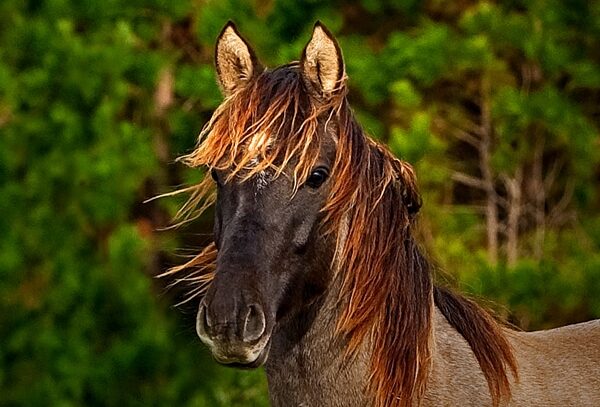
In 1846, naturalist John James Audubon wrote that the Marsh Tacky is as “tough as a Pine knot.” Indigenous to the marshy coastal islands of the Lowcountry region of South Carolina, these living legends of Colonial Spanish descent have survived over the last 500 years by adapting to the environment. With their built-in “wood sense,” the Marsh Tacky thrives in swampy conditions, relying on an intuitive sense of self-preservation. Unlike most horses, which react to unfamiliar situations with panic and flight, the Marsh Tacky is known for its thoughtful approach to new situations and navigating difficult terrain.
David Grant is one of the founders of the Carolina Marsh Tacky Association, whose mission is “to Preserve and Promote the History and Heritage of the Marsh Tacky Horse of South Carolina.” David is also an activist working to save the breed, and owns and breeds Marsh Tackies himself. As David notes, “the Marsh Tackies have played a significant role in South Carolina’s history. During the American Revolution, Marsh Tackies were used by many of the troops of the famous Swamp Fox, Francis Marion, during their campaigns against the British. British troops mounted on larger European breeds may have been at a disadvantage trying to maneuver in the dense and wild swamps of the lowlands.”
Historical data has also traced use of the Marsh Tacky back to Native American tribes’ deerskin trade. “Spanish horses were acquired at the St. Augustine Spanish settlement and were used as pack animals for the Native American trade routes of the Chickasaw, Creek, and Southeastern Choctaw tribes,” says David.
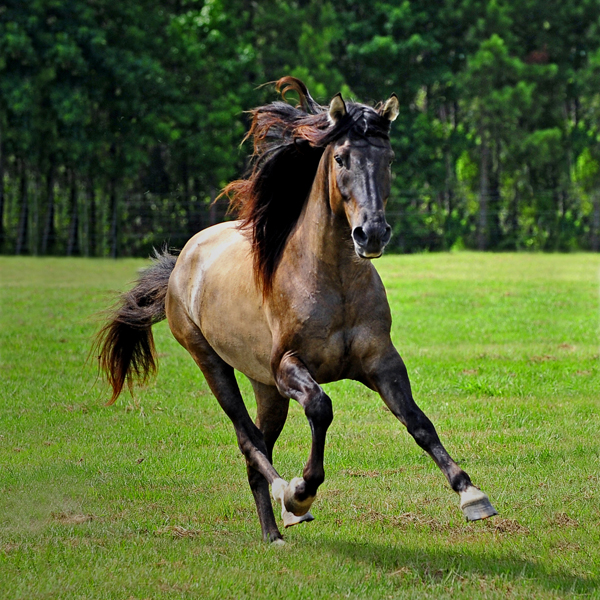
These Spanish horses were sold upon reaching Charleston and populated the lowlands and coastal islands of South Carolina and Georgia, where they remained isolated. There, these Colonial Spanish horses developed into the Marsh Tackies we know today.
Frank Lloyd Wright designed a plantation that included stables sized specifically for Marsh Tackies. In David Gilson De Long’s book Auldbrass: Frank Lloyd Wright’s Southern Plantation, he writes, “The adjacent stables for horses were small, and with low roofs, sized for small horses known as Marsh Tackies…”
The Marsh Tacky was once thought to be nearly extinct. The efforts of a small number of dedicated enthusiasts have ensured that it has survived — and today, the numbers are trending the right way. Current estimates put the documented population at 400 to 500 Marsh Tackies, up from historic lows near 200 in the early 2000s. It remains a critically endangered breed, but a genuinely recovering one.
Breed Description
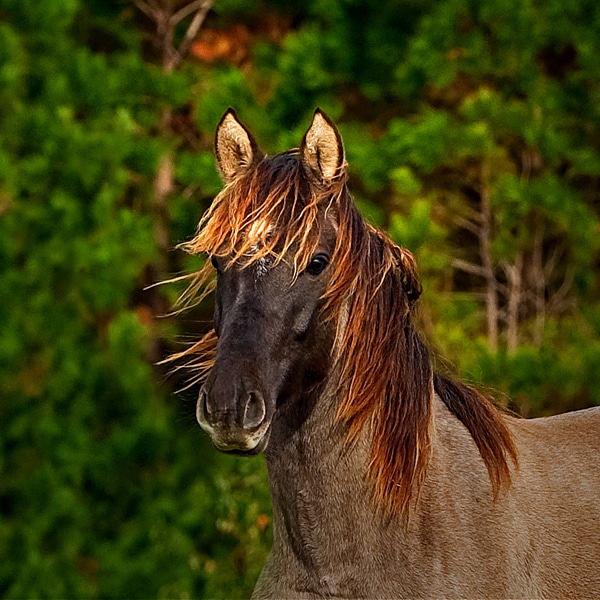
The Marsh Tacky is sturdy and balanced, standing around 14 hands. The Lowcountry shaped this relatively small horse into a breed capable of the work and strength normally found in much larger horses. The Marsh Tacky is muscular and “an easy keeping horse with a sharp mind.” Most Marsh Tackies are roans, bays, and solid in color. At first glance, the Marsh Tacky may look like an ordinary horse — its abilities astound many.
Gait
Different horses have different gaits, or ways of moving. A horse with a special way of moving is said to be gaited, like the Tennessee Walking Horse, known for its smooth gait. After many stories noting the extreme comfort and unusual smoothness of the Marsh Tacky, people wondered whether it was a gaited breed. A scientific study through the Gaited Locomotive Research Program at Mississippi State University and the American Livestock Breeds Conservancy (now The Livestock Conservancy) concluded that the Marsh Tacky is indeed gaited. Its movement has been studied closely, and researchers have found the gait itself is like no other in the world, with only a slight similarity to the Marchador of Brazil. This gait is expected to eventually be named and recognized as unique to the Marsh Tacky.
Sources
David is one of the few remaining Marsh Tacky breeders in the country. In his breeding program, he strives for quality over quantity, with only around 10 foals born in recent years. He wants to ensure the breed carries on for generations to come.
Jennette Beranger is the Research & Technical Programs Manager for The Livestock Conservancy (formerly the American Livestock Breeds Conservancy). Their mission is to ensure the future of agriculture through genetic conservation and the promotion of endangered breeds. She has spent years researching the Marsh Tacky and succeeded in completing a studbook, documenting the horse through DNA samples from nearly 100 Tackies for authenticity. These DNA samples have shown that Marsh Tackies are related to other Colonial Spanish strains, including the Florida Cracker, Spanish Mustang, Spanish Barb, Sulphur, and Choctaw horses, among others.
Dr. Phil Sponenberg, a professor of genetics at Virginia Tech University, is a leading authority on horse genetics and, in particular, Colonial Spanish horses. According to Dr. Sponenberg, “Colonial Spanish Horses are of great historic importance in the New World. They descend from horses introduced from Spain during the age of the conquest of the New World. They are a direct remnant of the horses of the Golden Age of Spain, and that type is mostly or wholly extinct now in Spain. Our Colonial Spanish horses are therefore a treasure chest of genetic wealth from a time long gone.”
There are believed to be only 8 or 9 strains of Colonial Spanish horses left in the U.S., and the Marsh Tacky is documented as one of them. The studbook has been a great benefit in securing the breed’s status, and The Livestock Conservancy continues working to secure its remaining bloodlines.
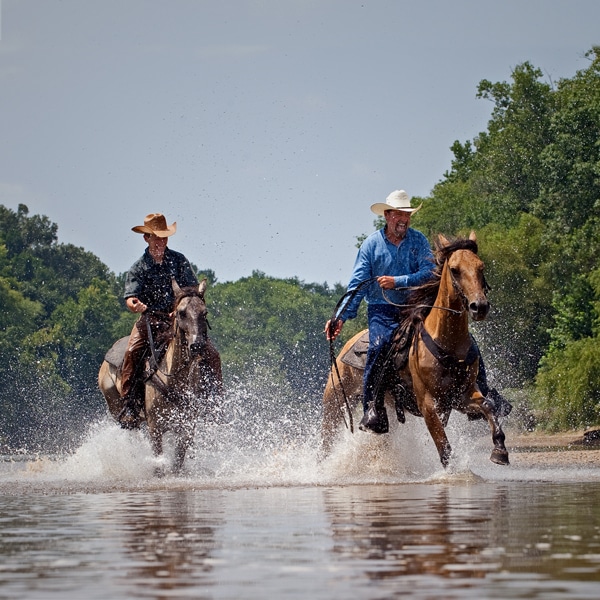
As I interviewed David and Jeannette, I realized this was more than just a horse we were discussing. The Marsh Tacky represents a connection to the land and culture for South Carolinians — a way of living, surviving, and adapting to conditions that ultimately became home. Even today, the Marsh Tacky is used to traverse the swamps and rough terrain for hunting and trail riding, continuing to work and live as it has for the last 500 years.
ARTICLE UPDATE: Since this article was first published, the Marsh Tacky has been officially named South Carolina’s State Heritage Horse, signed into law by Governor Mark Sanford on June 11, 2010.