

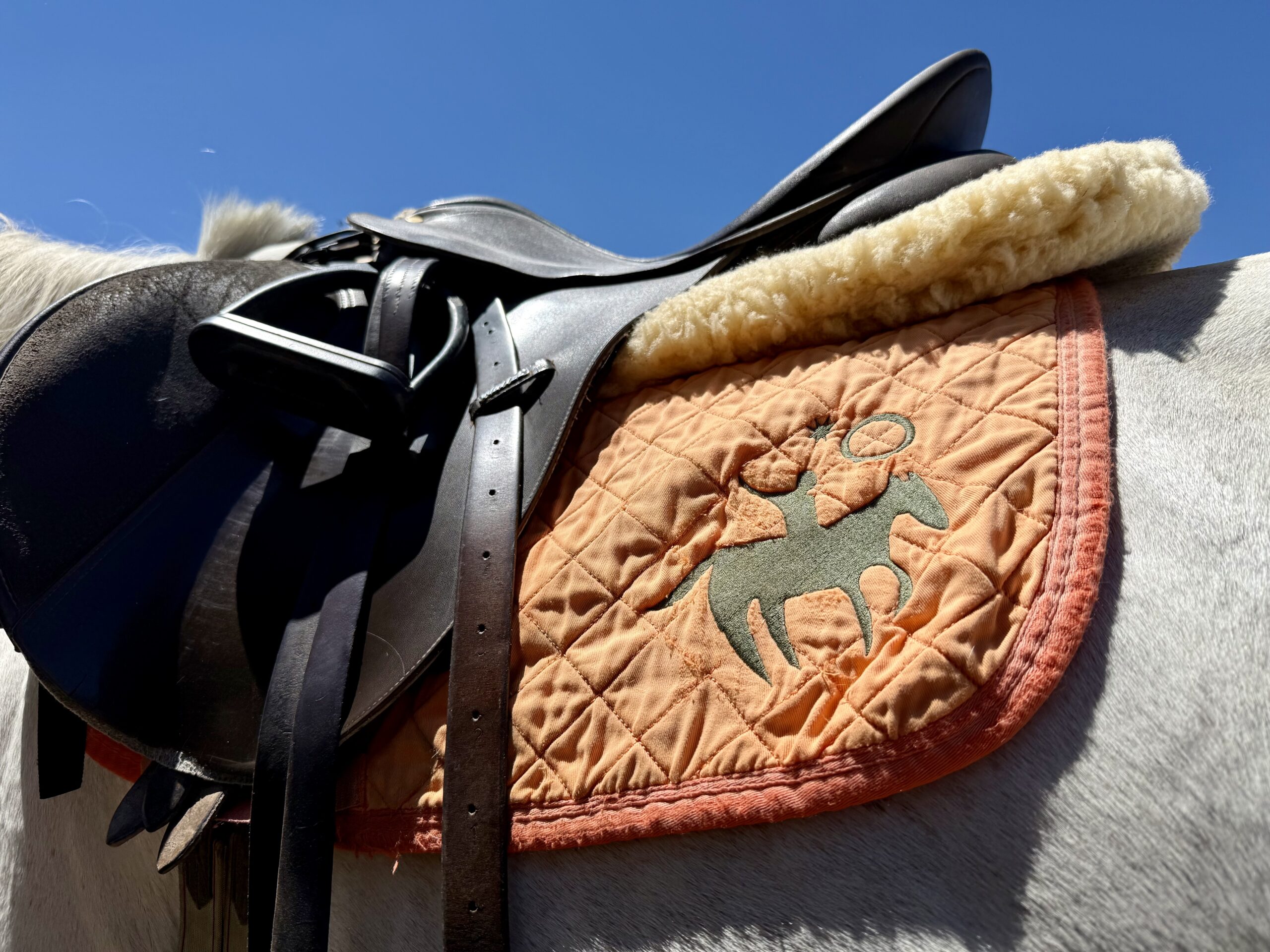
Most people who visit Spain never see it.
They see Madrid’s museums, the beaches of the Costa Brava, perhaps a long weekend in Seville. What they miss — what a plane window and a rental car will never show you — is the Spain of the interior. The Meseta. The great high plateau that occupies the heart of the Iberian Peninsula, vast and golden and largely untouched, where the sky feels twice as large as anywhere else and the silence is something you can actually feel.
I came to Castilla y León on horseback, for six days in the saddle and no particular agenda beyond riding through two of its provinces — Ávila and Segovia — with Equiberia, one of Spain’s most respected equestrian holiday companies. What I found was not one Spain but two, laid side by side in the same week: one ancient and wild, one ancient and storied. Both, it turned out, were best understood from a saddle.
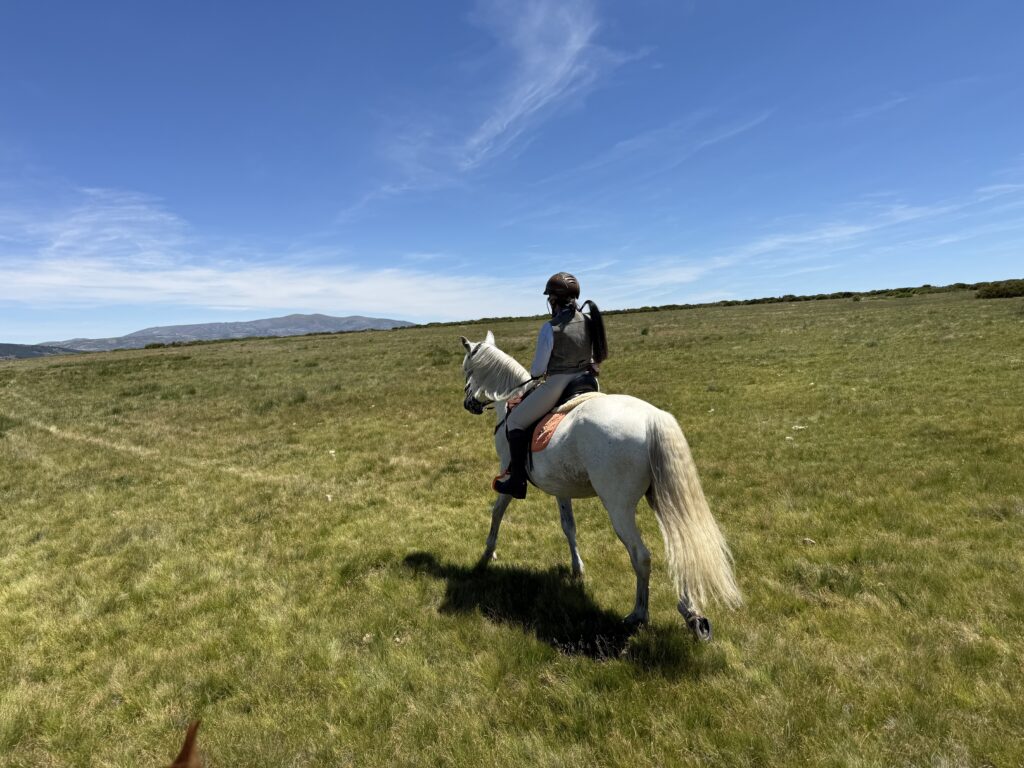
First Spain: The Sierra de Gredos
The drive west from Madrid toward the Sierra de Gredos was itself a kind of education. The landscape emptied of everything modern — billboards, suburbs, the visual noise of the 21st century — until what remained was just the land and the light, the latter being something I was not prepared for. The light in this part of Spain is extraordinary: clear and golden and somehow both warm and sharp at once, the kind that makes you understand why Velázquez painted the way he did.
The drive made a brief detour into Ávila to collect a fellow rider — and an hour inside the ancient walled city turned out to be exactly the right introduction to the region: stone, silence, and a sense of time moving at a different pace. We arrived in Gredos as the light was beginning to soften. The Parador appeared at the top of the hill, sitting at the foot of the Sierra — the very first Parador established in Spain, built in 1928 as a royal hunting lodge for King Alfonso XIII. It felt like the correct way to begin.
Waking up there on the first morning, with the breathtaking view of the mountains visible from my window, a familiar sound caught my attention as I moved closer to open it. In the pasture just below, a herd of horses and their foals grazed gently, as if they were the only creatures for miles.
Equiberia’s stables were just a short drive down the road. What I was not fully prepared for was the quality of the horses that greeted us. Equiberia’s care philosophy goes well beyond what most riding operators offer: the training, feeding, and veterinary attention happens year-round, not just when a ride is scheduled. You could feel it immediately — in the way a horse stood when you approached, in the softness of its response, in the uncomplicated trust it extended to a rider it had never met. They were, in the most literal sense, happy horses. Familiar with what a working stable should look and feel like, I was also immediately comforted by the busy but unhurried movement from the staff.
Behind it all is María Elena Dendaluce, the founder and owner of Equiberia, who leads the Gredos rides personally and has become something of a legend among riders who have passed through her care. A former marketing professional who worked across four continents — France, Argentina, Australia, Botswana — she left the corporate world to follow her passion for horses and, in doing so, created something that could not have been invented by anyone who hadn’t truly lived it. She is an accomplished horsewoman, a deeply knowledgeable guide, a talented storyteller, and fluent in English and French. But what sets her apart is rarer than any of that: the ability to make a group of strangers feel, within hours of arriving, that they have known her for years.
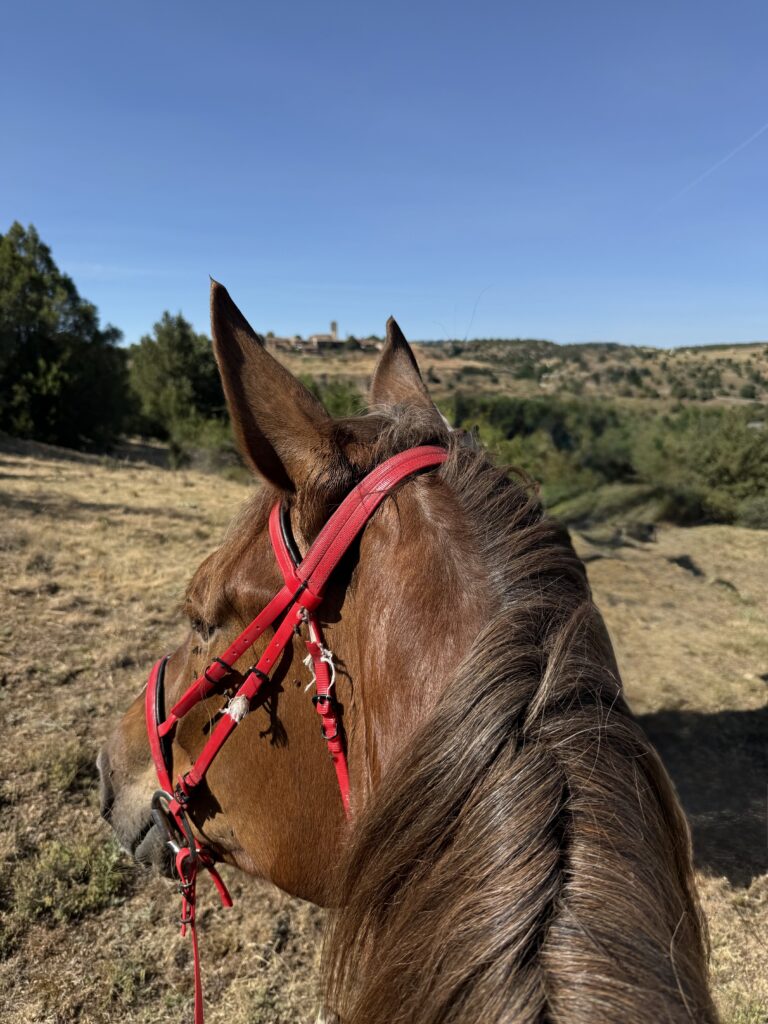
One detail caught my eye immediately: each horse wore a mosquero on its bridle — the traditional handmade fringe of knotted cord that has adorned Spanish working horses for centuries, designed to keep mountain flies from the face. Practical, beautiful, and entirely of this place.
Paired with a beautiful 15-hand chestnut Arabian named Carmelo — I felt the trust settle beneath me and looked forward to spending the next three days with this beautiful horse.
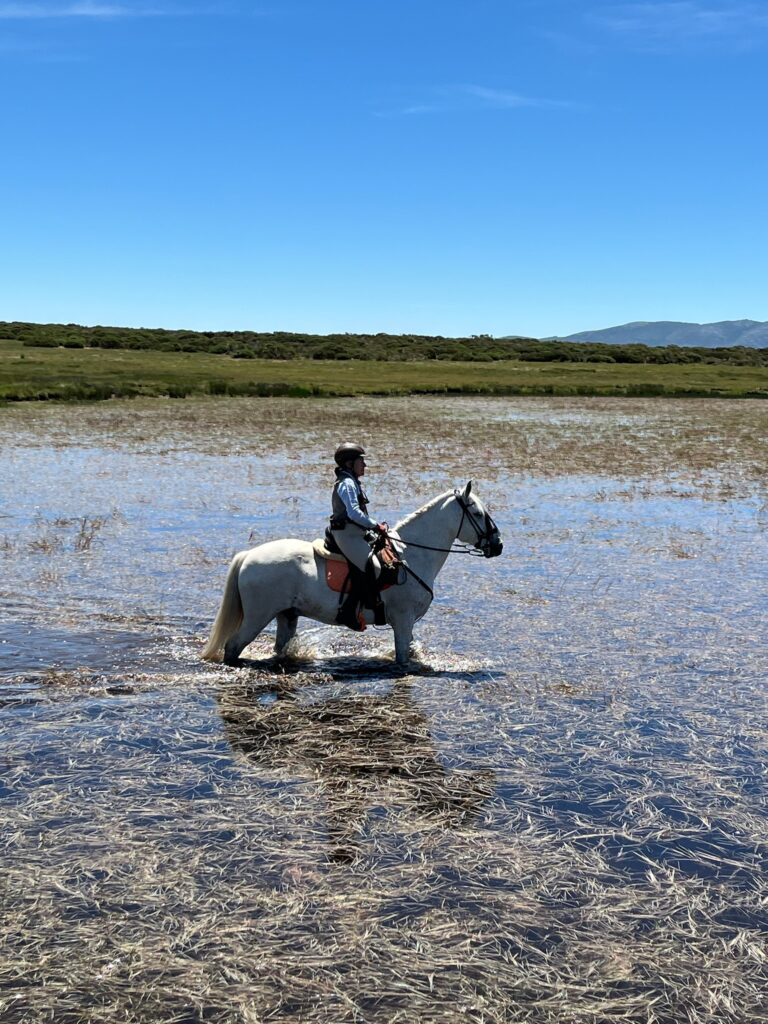
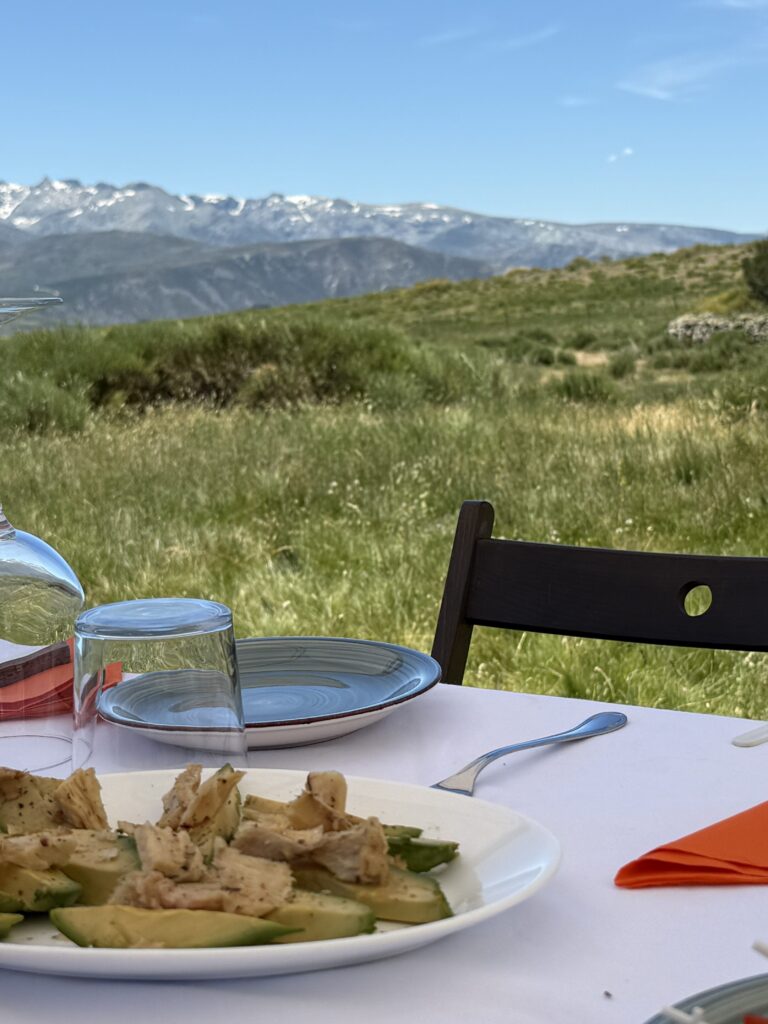
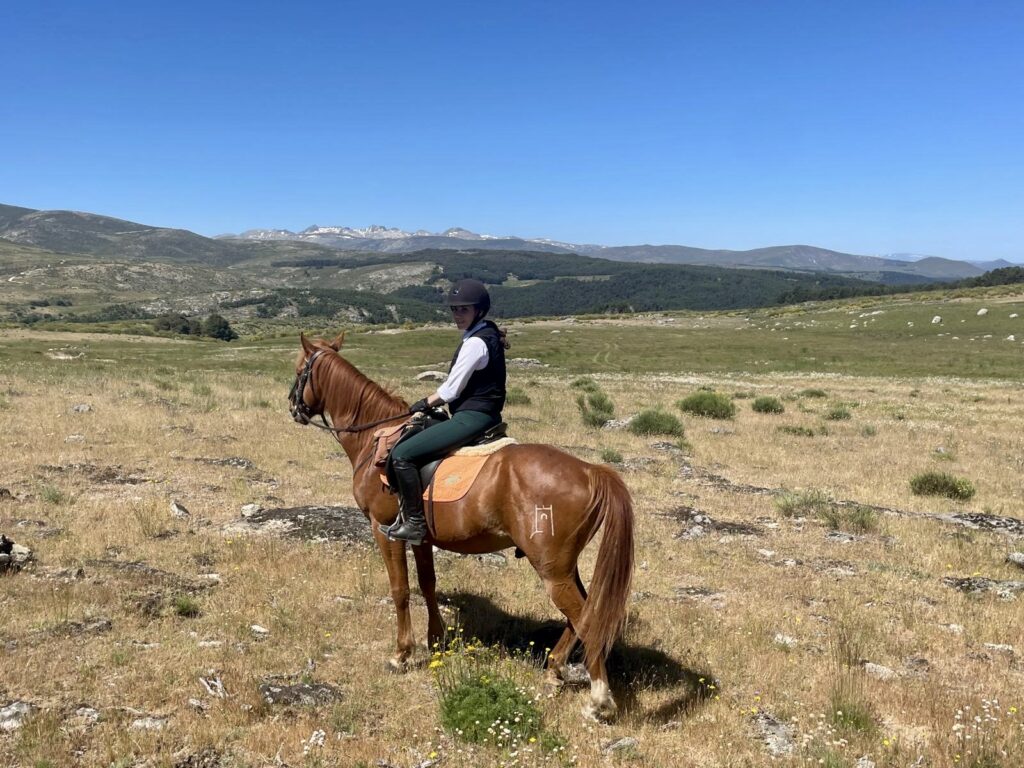
The Sierra de Gredos is genuinely rural Spain. Its economy is rooted in free-range cattle breeding; its villages are small and architecturally honest, shaped entirely by the landscape around them rather than any idea of what a village should look like. The trails themselves were a revelation — ancient mountain paths threading through valleys carpeted in wildflowers, the air scented with wild thyme and broom, the kind of landscape that makes you understand why people have been riding through these mountains for a thousand years. Riding through these villages, you had the strange and pleasing sensation of having arrived somewhere that had no particular interest in being discovered.
Each of the first three days opened onto more dramatic scenery than the last. The early trails followed the course of rivers through pine forests and open mountain pastures, with canters across common land where the only other movement was cattle on distant hillsides. Day 2 brought us down into the gorge of Barbellido — a dramatic cleft of glacial rock and cold rushing water, wild and completely untouched, the kind of place that makes you feel the mountains have kept a secret and you have stumbled into it. By Day 3, we were climbing to the high alpine pastures above Navarredonda, where the terrain became something altogether more dramatic — glacial granite left behind by retreating ice sheets ten thousand years ago, enormous and smooth and silent. My guide called it el techo del mundo. The top of the world. Looking in every direction at that altitude, I was not inclined to argue.
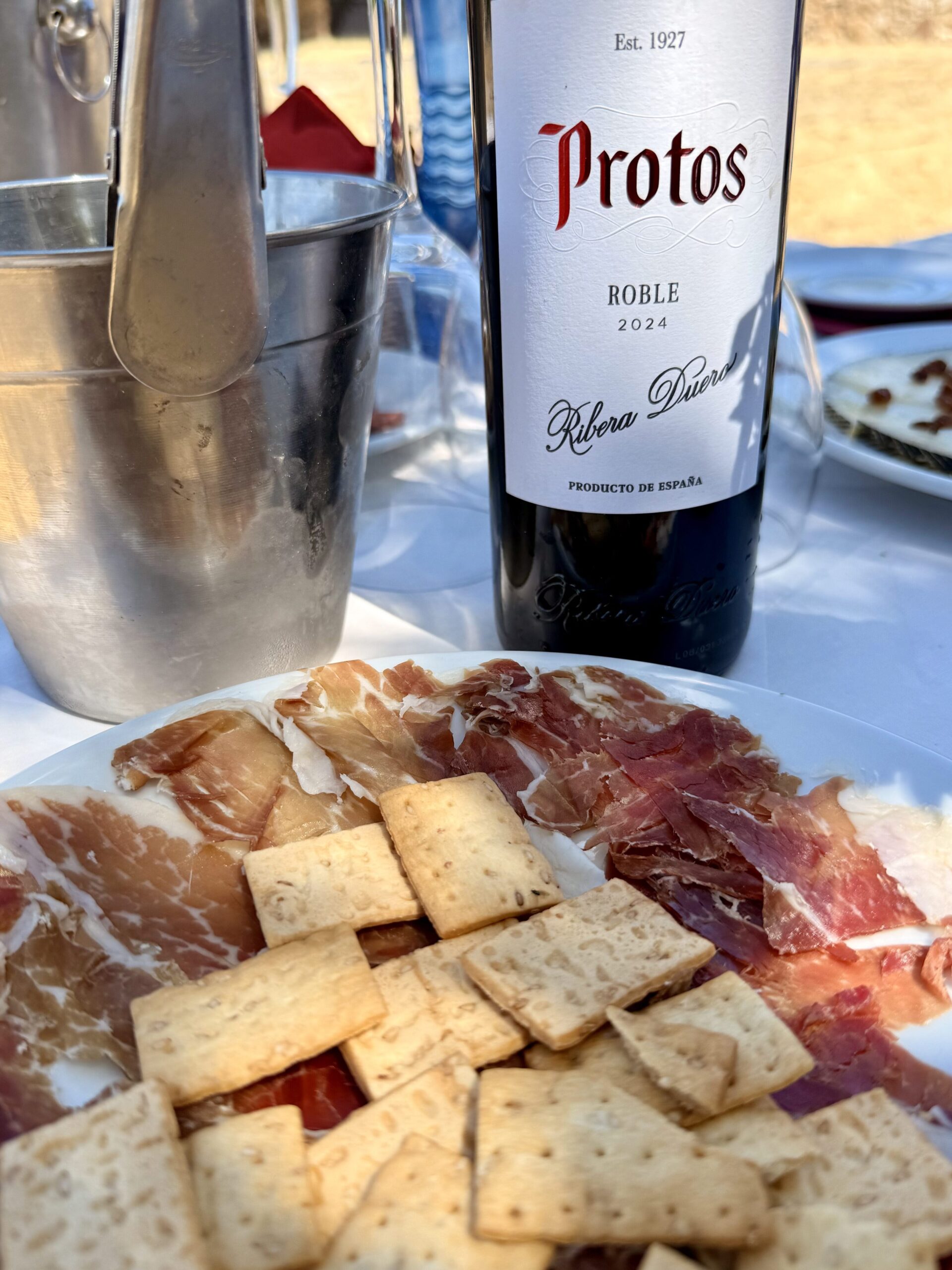
Each and every day in Gredos, a late-morning stop for aperitivos was set up beautifully by a small team that had gone ahead. We rested our horses, letting them graze and drink while we too took nourishment for the next leg of the journey. Lunch deserves its own mention. Set out in the open air in the middle of a landscape that looked unchanged since the Middle Ages — local meats, excellent wine, the Spanish genius for making a meal feel like an occasion — an unforgettable memory. You eat differently when a horse brought you there. This was not just one day but every day, each offering local cuisine as if cooked in a Michelin-starred kitchen. From a Mar y Tierra paella — that classic Catalan marriage of land and sea — to grilled dorada (a local sea bream) and duck, we ate like the kings who had once traveled these roads before us.
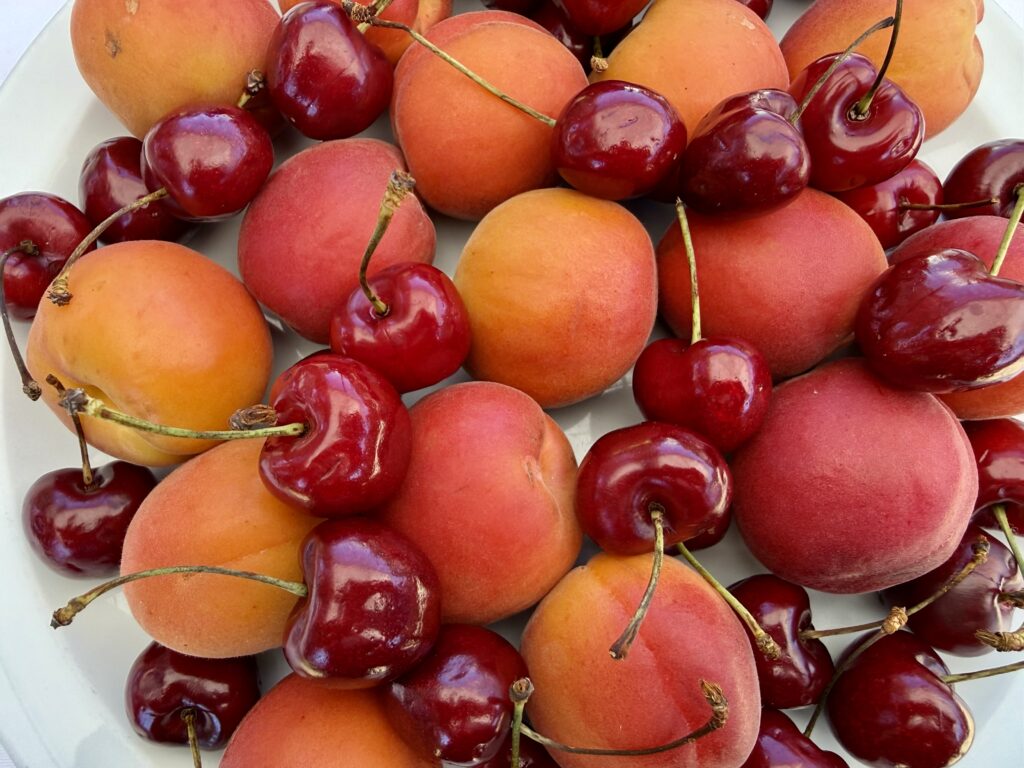
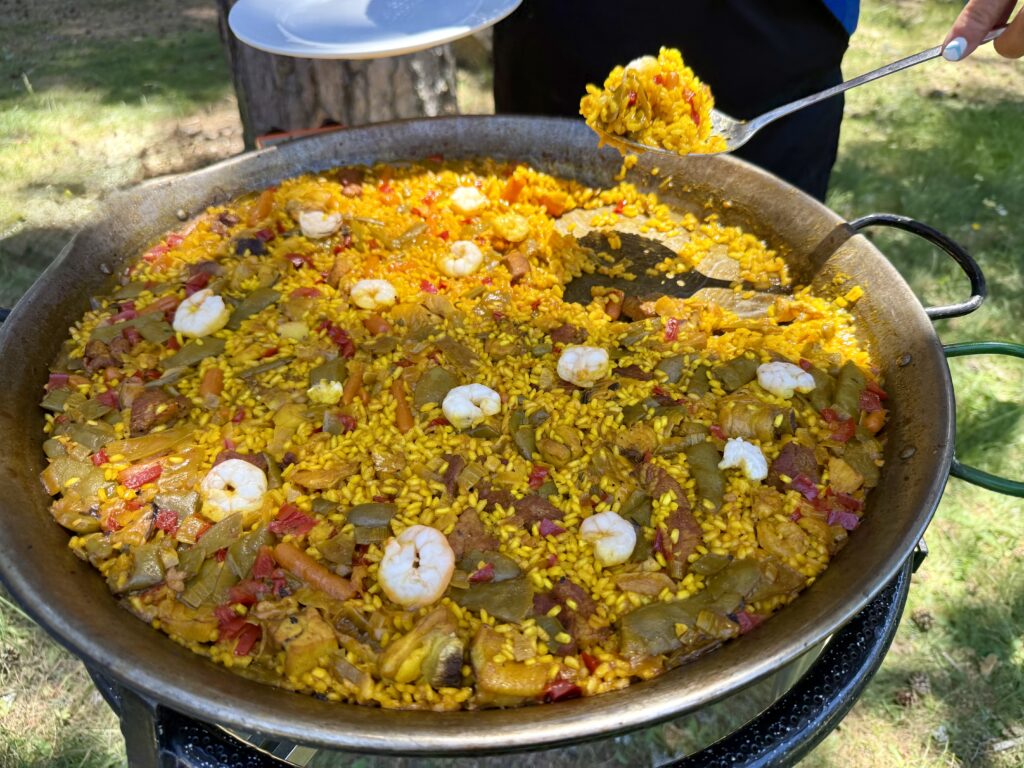
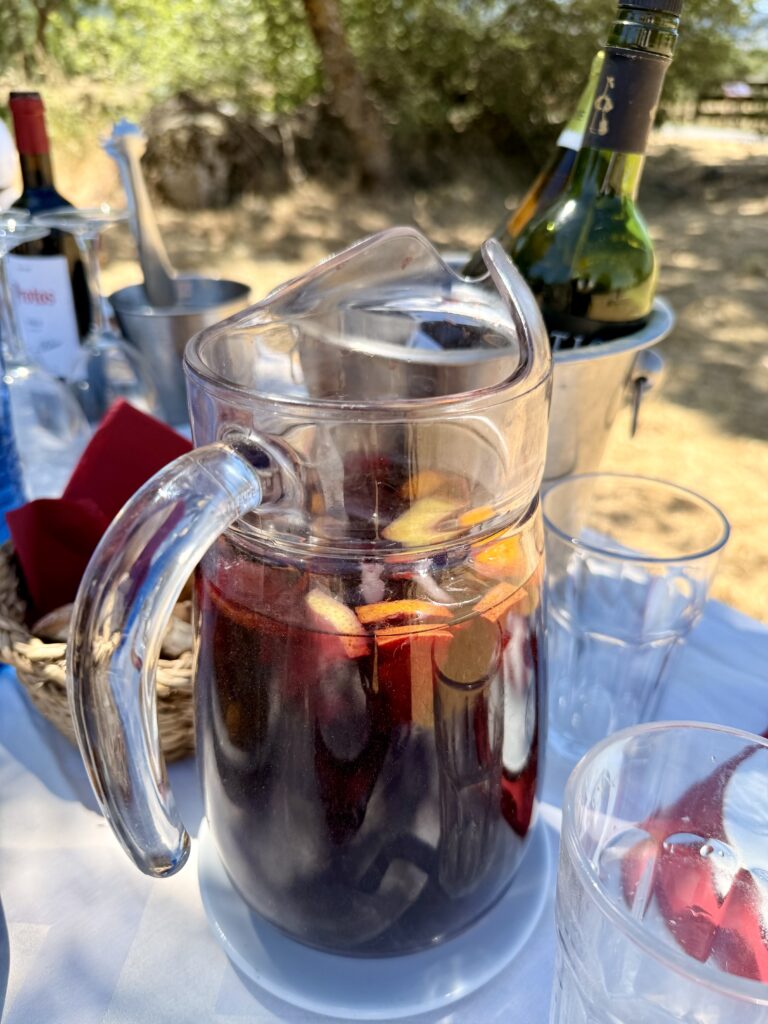
A swim in the ice-cold waters of the Tormes River was the perfect ending to one of the riding days, the cold a welcome shock after hours in the mountain sun. On another afternoon, finishing a ride through one of the villages, we stopped at a small local tack shop — the kind of place that exists to serve working horsemen, not tourists. It was there that I asked after a mosquero. The owner disappeared into the back and returned with one made that very morning, on request, knotted by hand in the traditional way. I bought it without hesitation. It now hangs at home as one of the best souvenirs I have ever brought back from anywhere. Friendships started to form as if we had been traveling together for a month — likely, in hindsight, because Equiberia’s team treated us like family from the moment they met us. As soon as we had fallen in love with Gredos, it was time to move on to the next part of the journey. Perhaps intentionally kept short, so that you start planning your return. Something more than 50% of Equiberia’s riders do: come back.
The Transfer
The move from Gredos to La Granja de San Ildefonso — the Royal Site that marks the beginning of the Segovia province — was also a shift in register. The wildness fell away and something more layered took its place: a landscape dense with human history, where almost every hill had a church on it and every village had been inhabited, in one form or another, for a thousand years.
The transfer also brought a change of horse. Equiberia draws on two separate stables — one rooted in Gredos, one in Segovia — matching the horses to their home terrain. There was something fitting about this. The Gredos horses were built for mountains; the Segovia horses knew the open plain.
A beautiful night at the Parador La Granja, preceded by a lovely dinner on the terrace, was when and where we met Ana, our guide for the next three days. Over dinner we discussed our riding experience and, in a fun and almost game-like way, Ana paired each of us with the perfect horse from her stable in what seemed like no time at all. She is someone who knew her horses inside out, and more importantly, which type of horse would be best suit for each ride.
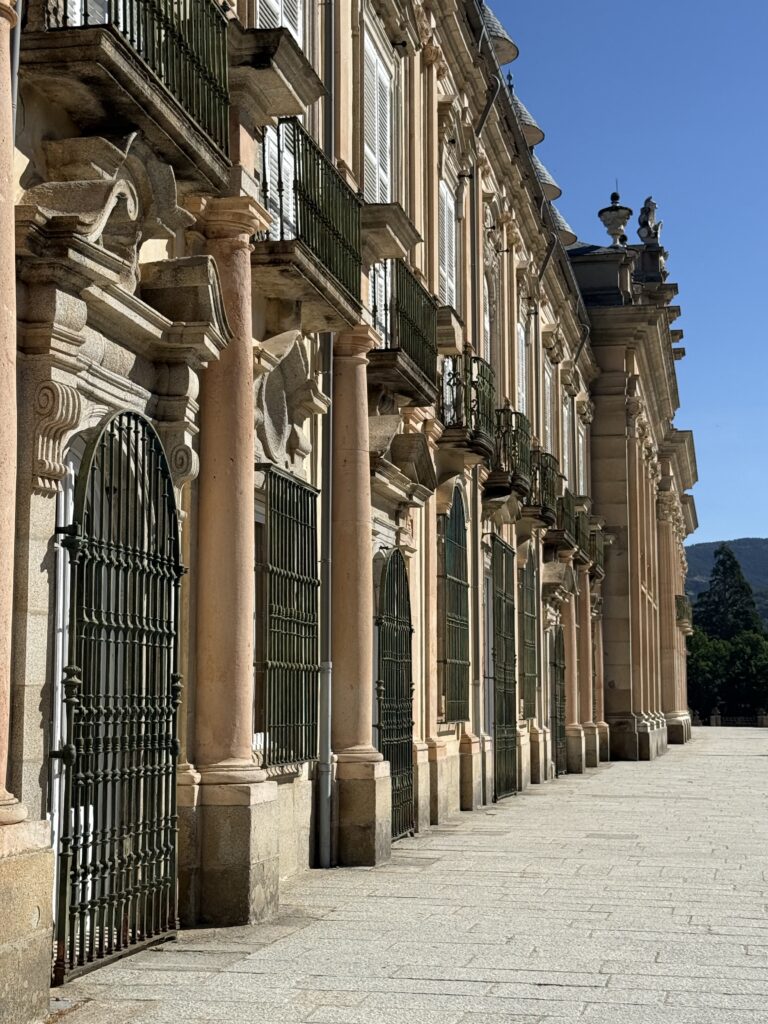
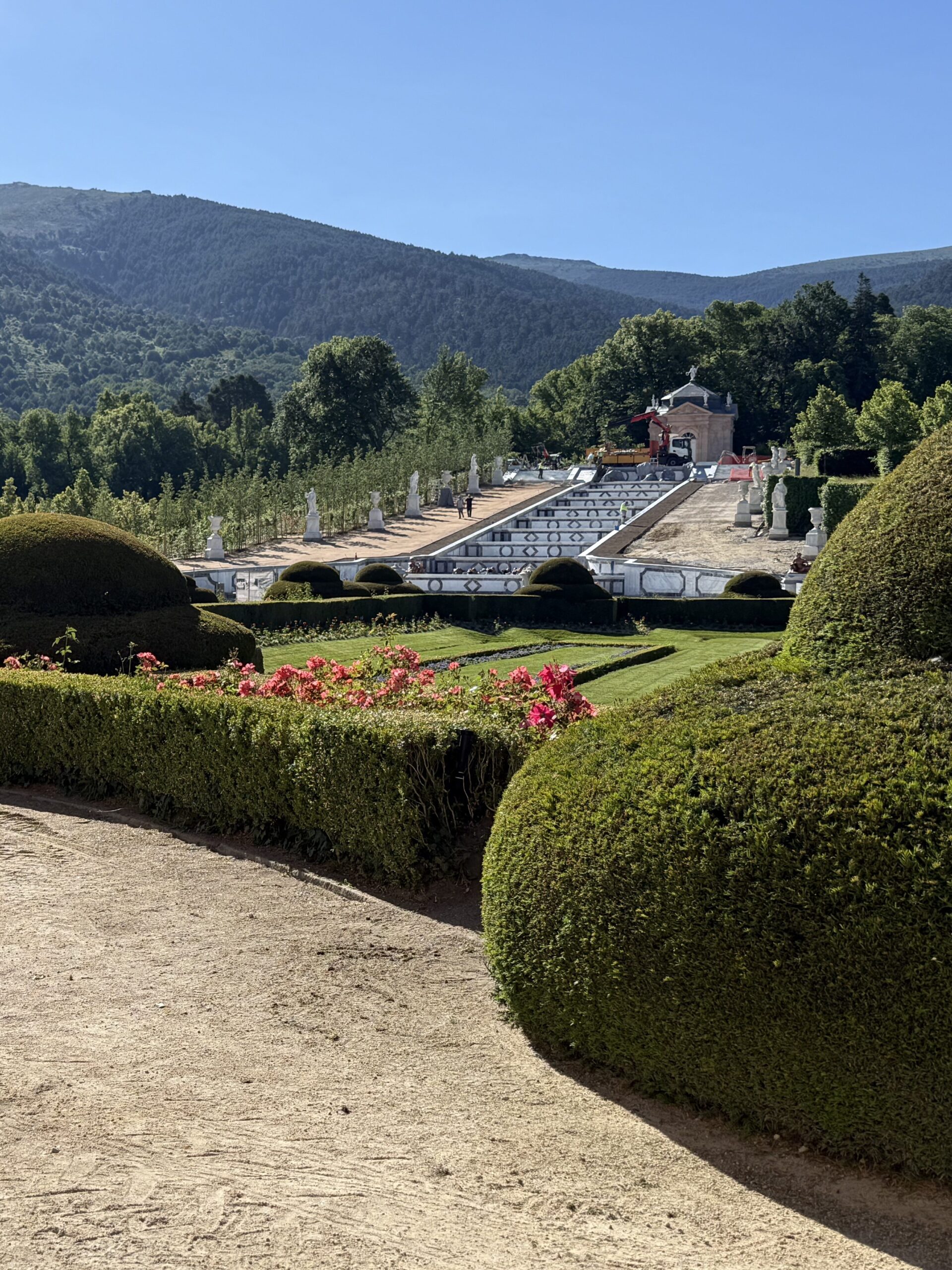
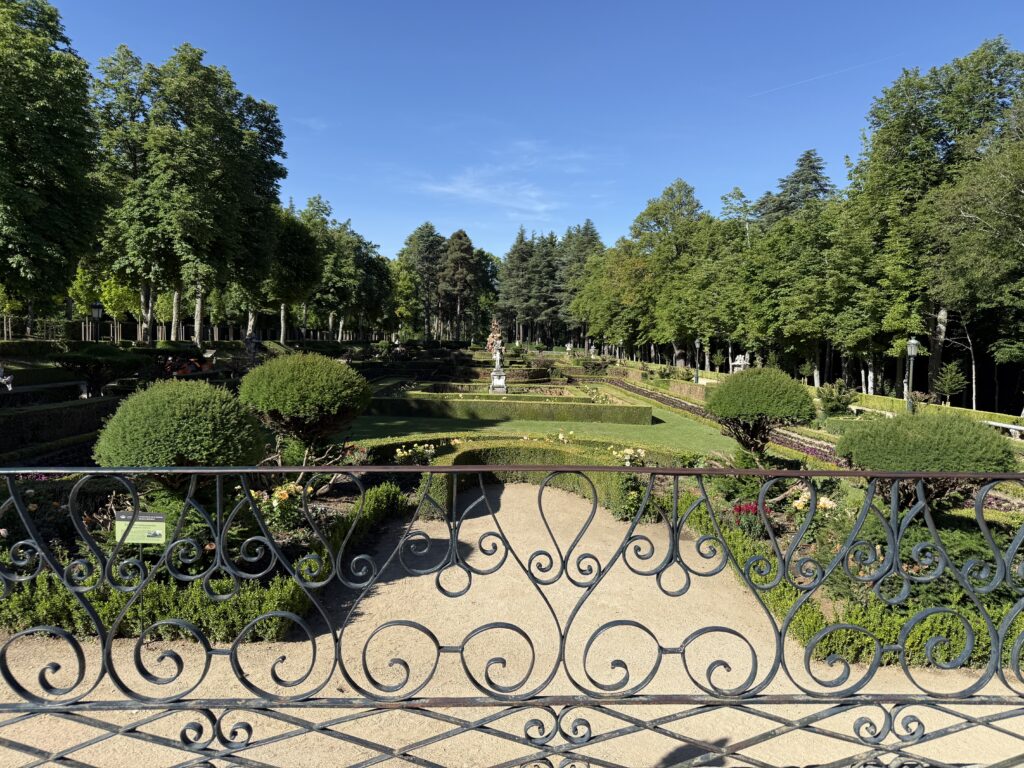
La Granja de San Ildefonso itself is a baroque palace built by Philip V in the early 18th century, modeled on Versailles, where he was born and raised. Its formal gardens are extraordinary — tiered fountains, sculpted hedgerows, gilded ironwork, all set against the backdrop of the Sierra de Guadarrama — a piece of French court grandeur dropped without apology into the heart of Castile. Before our journey on horseback began in this second Spain, we had an up-close glimpse, strolling those manicured gardens on foot in full equestrian attire, as everyone should. A short distance away, we stopped on the outskirts of town, each of us meeting a new mount in the open countryside. Mounting up with three days of riding still ahead felt less like a handover and more like an introduction.
Second Spain: The Province of Segovia
La Granja to Segovia was the part you’d talk about for years.
The morning out of La Granja offered long, open canters across the Castilian countryside — the kind of riding that reminded you what horses were actually made for. We followed the Cega River, crossed the Cañada Real (one of the great ancient droving roads of Spain, used for centuries to move livestock between summer and winter pastures), and climbed into the foothills of the Sierra de Guadarrama.
Then Pedraza.
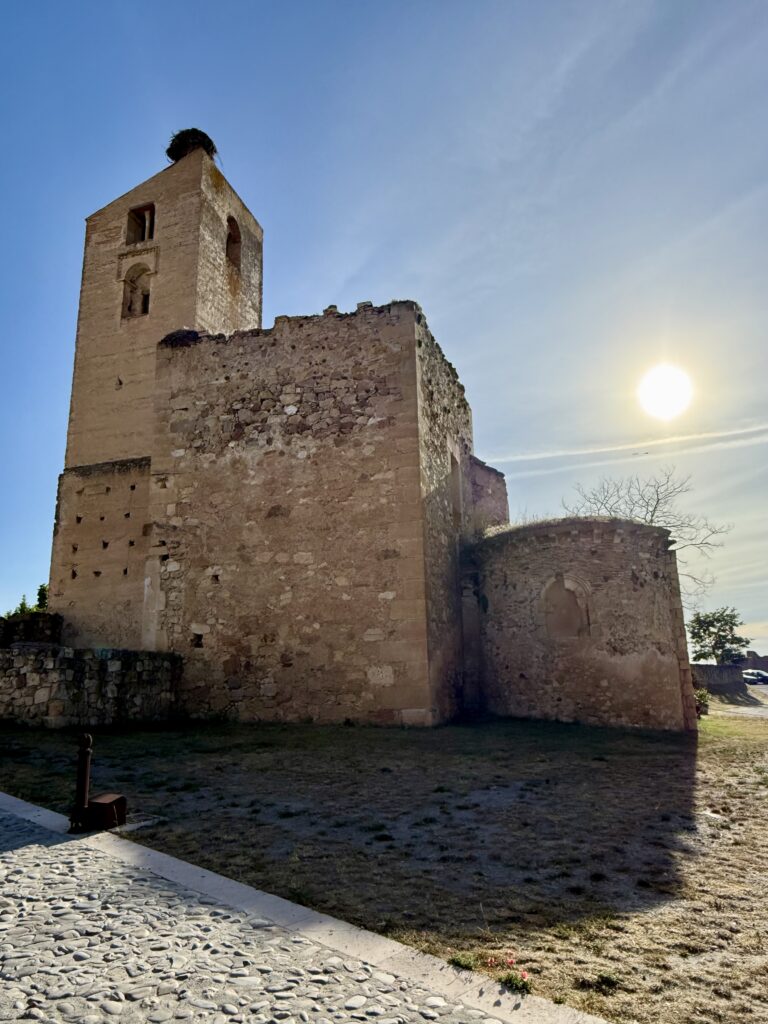
Arriving on horseback, as travelers have arrived at Pedraza for seven hundred years, was not a small thing. Following the wall at the base, we hugged the city, passed under an aqueduct, and into a small pasture. This was where the horses would sleep for the night — much as one imagines centuries past, when a passing traveler would stable his horse while seeking rest within the walled city above.
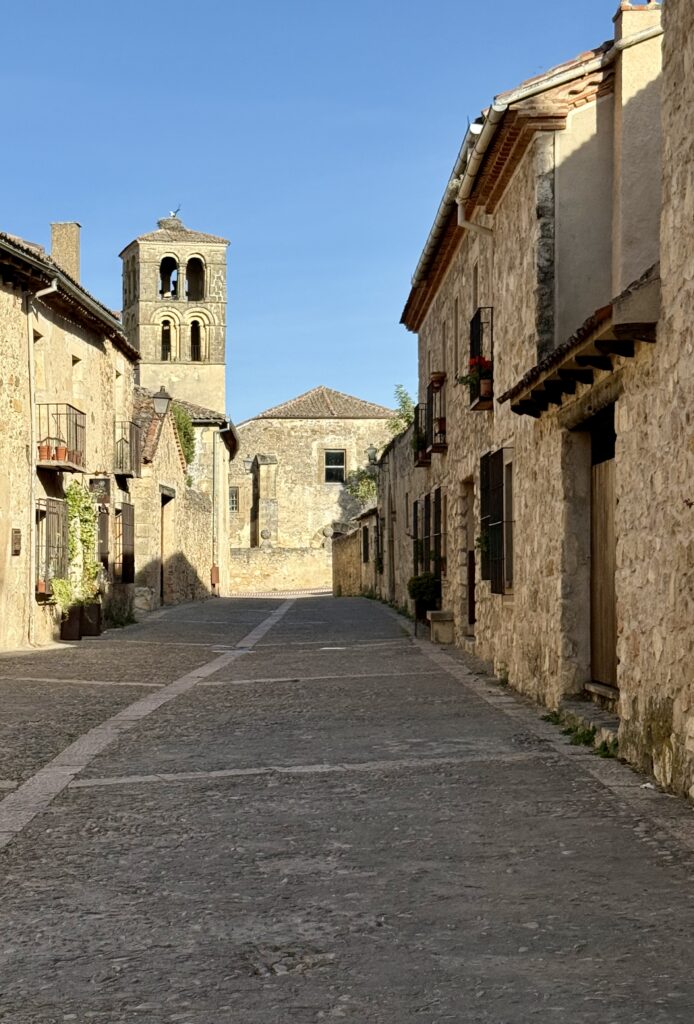
After the horses were untacked, fed, and had a good roll in the fresh hay laid out for them, we proceeded through the city’s gate. The cobblestones rang beneath us, the streets narrowed, and the whole city seemed to lean in slightly, as if acknowledging our arrival. I have traveled a great deal and I can count on one hand the moments when a place has felt genuinely, unexpectedly perfect. Arriving on horseback into Pedraza is one of them.
After a quick turn-around to clean up, we walked the narrow streets until a plaza appeared — alive and full of people. Where had they all come from? From babies out well past their bedtime to elderly matriarchs who had earned their place at the table, we pulled up chairs and ordered tinto de veranos, wines, and gin and tonics that seemed universally appropriate.
As if on cue, a local friend of Ana’s joined the table. A horse breeder from Pedraza. Also a world traveler, with perfect English from a medieval village barely on the modern map. A singer, as we would discover later that evening, who should be a household name but keeps his extraordinary voice for only the lucky few in the right place at the right time. After dinner, we had a private concert by happy accident as Enrique sang Mexican folk songs about horses. As the wine flowed and the perfect pitch filled the air, I wasn’t sure how we were going to ride out of Pedraza in the morning — but we somehow managed. A magical medieval city, a night of laughter and growing friendships, Enrique, a man of the world, a talented horse breeder and singer, will forever be Pedraza to those of us who were there that night — the gems of exploration and adventure travel that fall into your lap if you let them.
The Road to Segovia
The final days wound south through ancient bridle paths past the Romanesque church of San Juan Bautista, through timber-framed villages and along the Eresma River. The last half-day ride brought us to Sotosalbos — a Moorish-Romanesque church of remarkable beauty, where a beautiful lunch waited under shading trees — and then on toward Segovia itself. Whenever Ana called out, “Shall we go for a canter?”, off we went. Controlling our pace and leading the way, the horses behaved beautifully.
Having enjoyed the company of my mare Acebeda — or “Juniper” — for two days through Segovia, Ana suggested that for the final day I should have a little more horse beneath me. Having ridden conservatively for five days, I agreed without hesitation. And so it was that I found myself matched with a chestnut named Cobra, leaving from and returning to Ana’s stable for the last day’s riding. It turns out that Equiberia’s stable manager in Gredos owned Cobra’s mother and raised the foal until Cobra moved to Segovia’s team at age five — a nice thread between the two halves of the trip.
Segovia
We spent our last two nights at the Hotel Paradores on the outskirts of Segovia. With an outdoor pool and panoramic views of the city below, there could not have been a better way to conclude the trip.
It was the morning of our last ride. I was up and mounted and had clipped in my Helite vest before I let her name sink in. Only then did I remember why I had agreed to take out a stronger horse named Cobra.
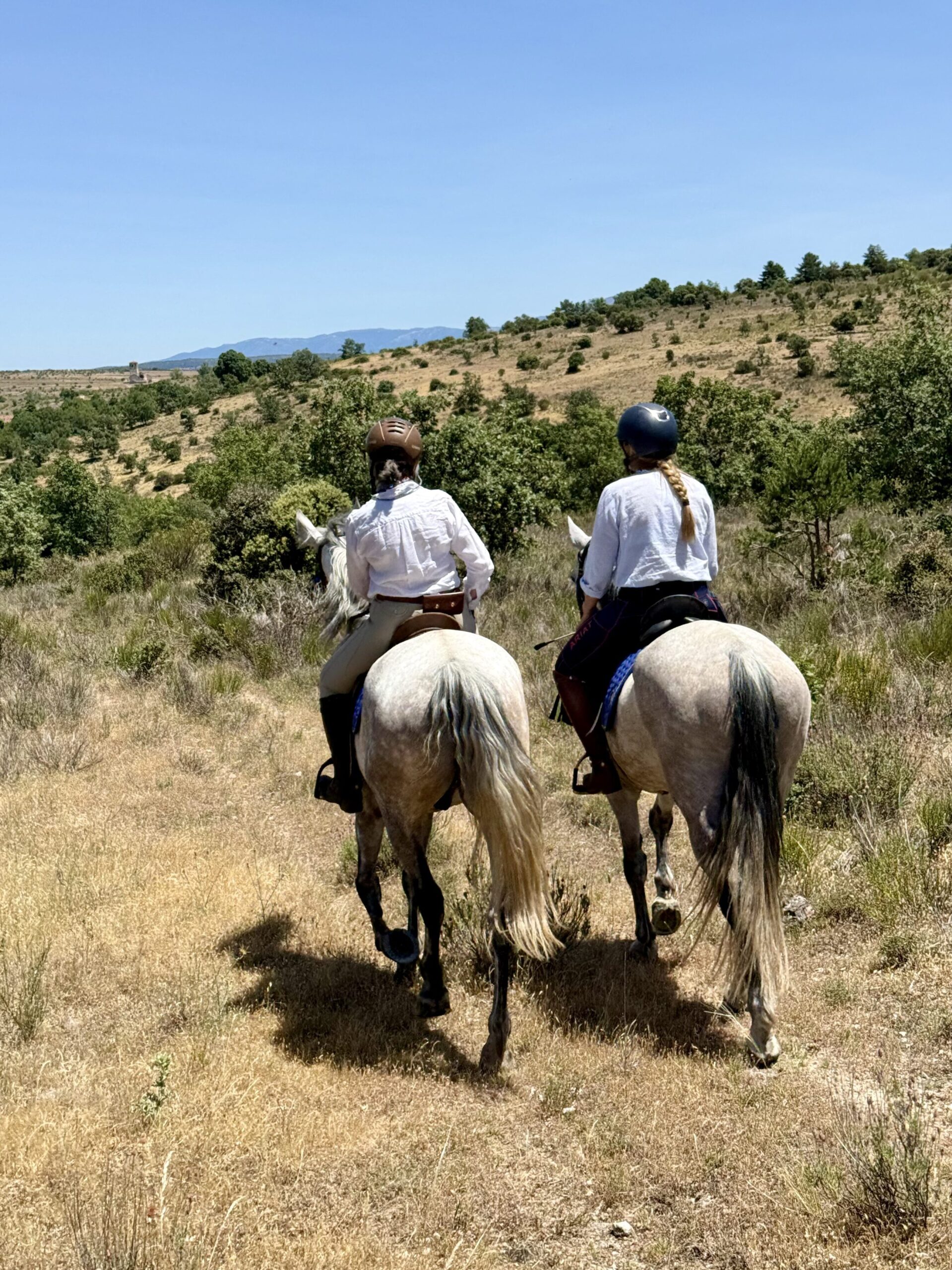
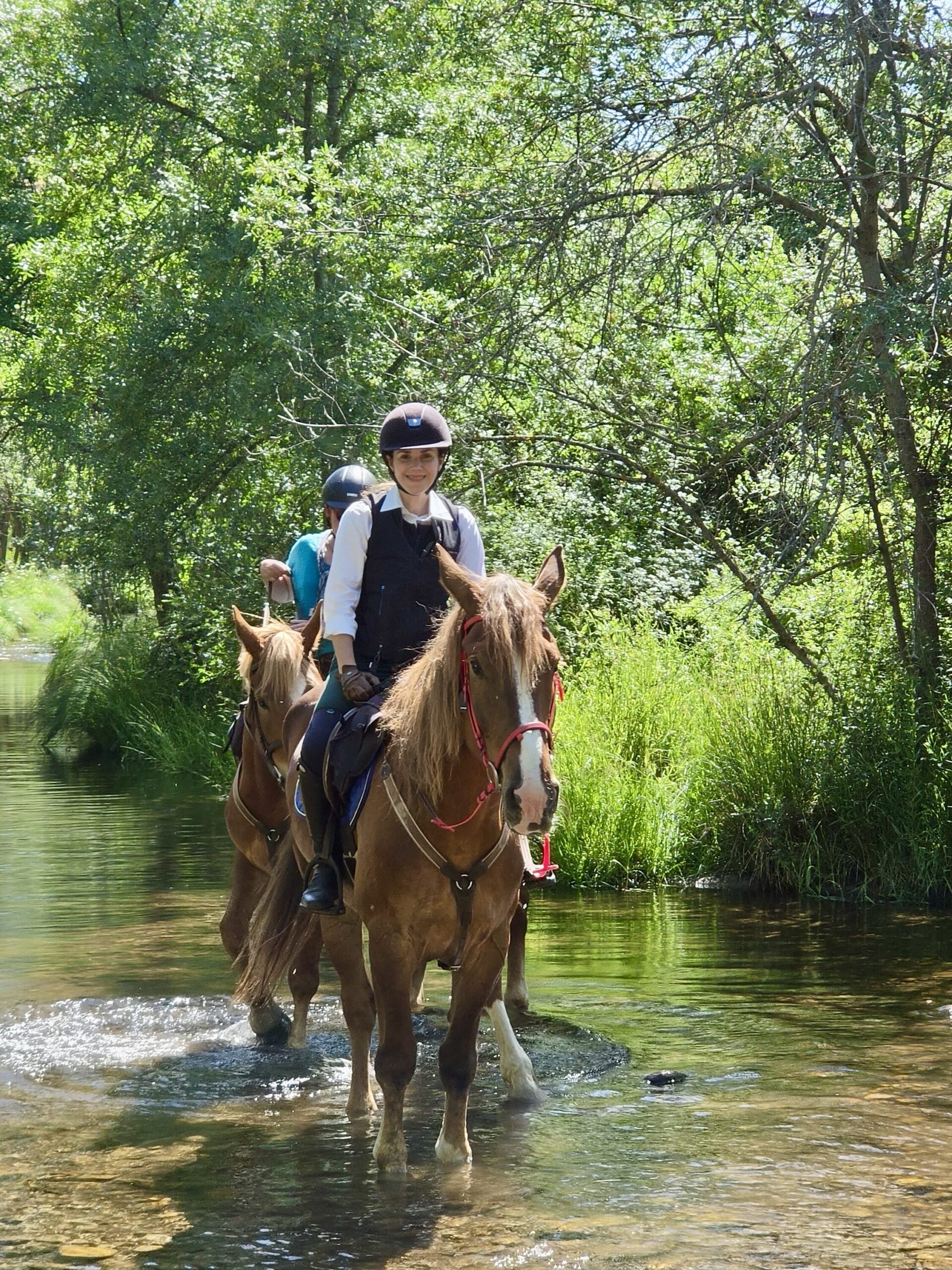
Not every Gredos/Segovia trip ends with the last day we were lucky enough to get. Instead of another circular path near Segovia, today we would circle the city itself. This didn’t seem like anything out of the ordinary until it was. Leaving the stables, we wove under highway passes and across train tracks, which seemed odd at first given the vast landscape we had at our fingertips. With no city in sight, we came across a brand-new landscape that one could only compare to a miniature Grand Canyon — breathtaking and surprising, seemingly out of place.
Following the edge of the canyon led to a path that looked as though it might carry medieval horse carts but not a modern car. Ana promptly announced we were going to trot — but all we could focus on was what lay ahead. At the end of this path was a tunnel. We were sure we would turn off before reaching it, that there would be another path, but just as we were all trying to work out where the turn was, Ana looked back and said, “Shall we canter?” At that point, I think we all knew exactly what was going to happen.
All the horses broke into a canter. Equally exhilarating and terrifying, we entered the dark tunnel still at pace. There was no time to think about the darkness as the sound of five sets of hooves echoed off the walls and back again. Second behind Ana, I was laser-focused on keeping up with her horse, keeping her in sight. I knew those behind me were doing the same with me. It seemed to go on forever, yet it ended as quickly as it had begun. As we came out of the tunnel and Ana motioned for us to walk, nobody could quite believe what we had just done. A cantering charge through a narrow, pitch-black tunnel.
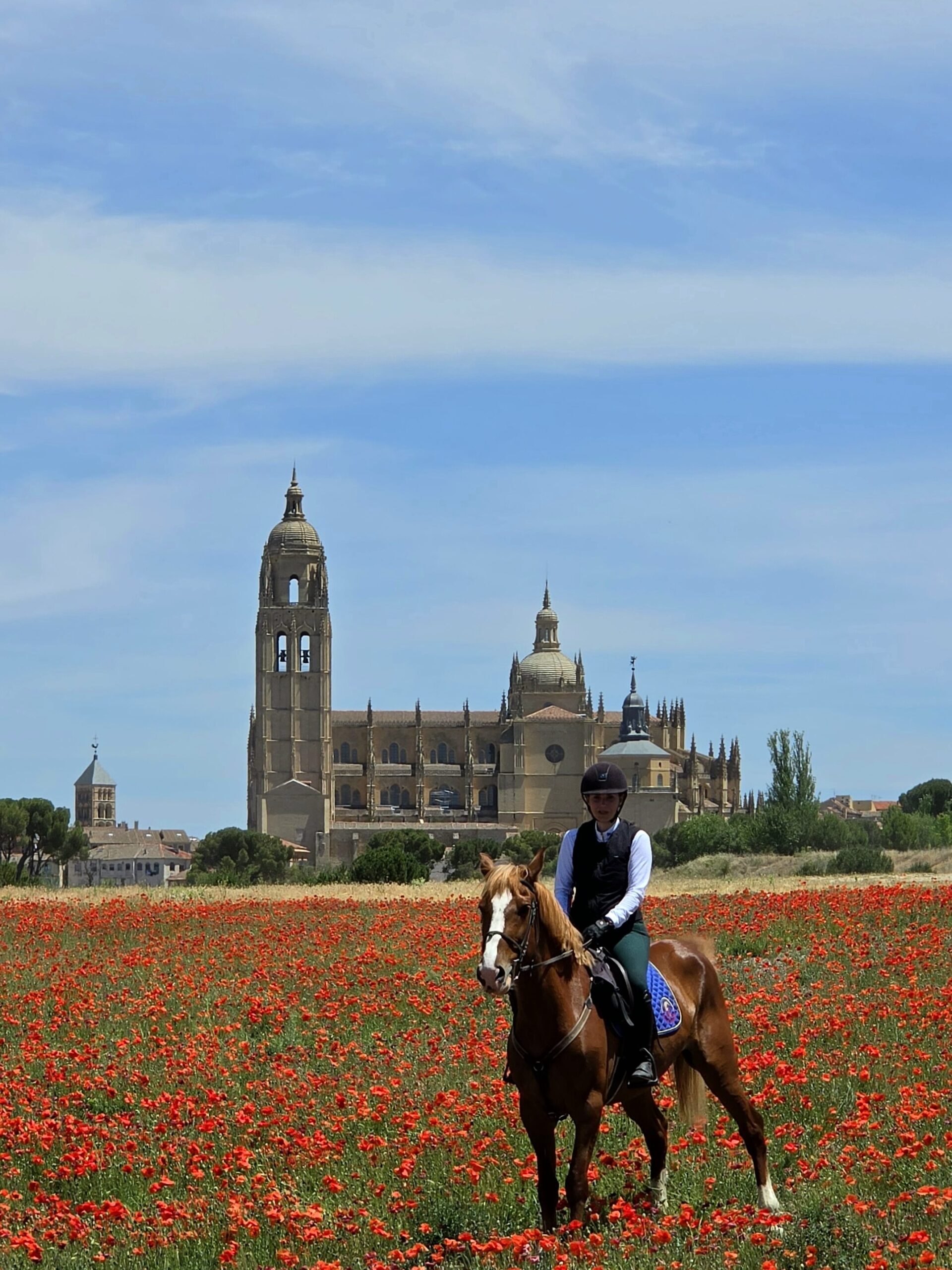
Still speechless from the experience, we moved forward — and then, as if out of nowhere, the cathedral of Segovia rose up in the distance, followed by the Alcázar, its silhouette unmistakable against the sky. As we headed toward them, fields of gold swayed in the wind and poppies as far as the eye could see waited for our arrival before ending their season. A moment that demanded cameras, not just memory.
The Alcázar of Segovia is one of the most distinctive castles in Spain — a fortress whose origins date to the 12th century, built on a rocky crag above the confluence of two rivers and inhabited by Castilian kings for centuries. It served at various times as a royal palace, a state prison, and a Royal Artillery College. Its fairy-tale silhouette — soaring towers and slate-blue spires rising improbably from the rock — is widely credited as the inspiration for Snow White’s castle in Walt Disney’s 1937 animated film, the image that introduced the world to the Disney fairy tale.
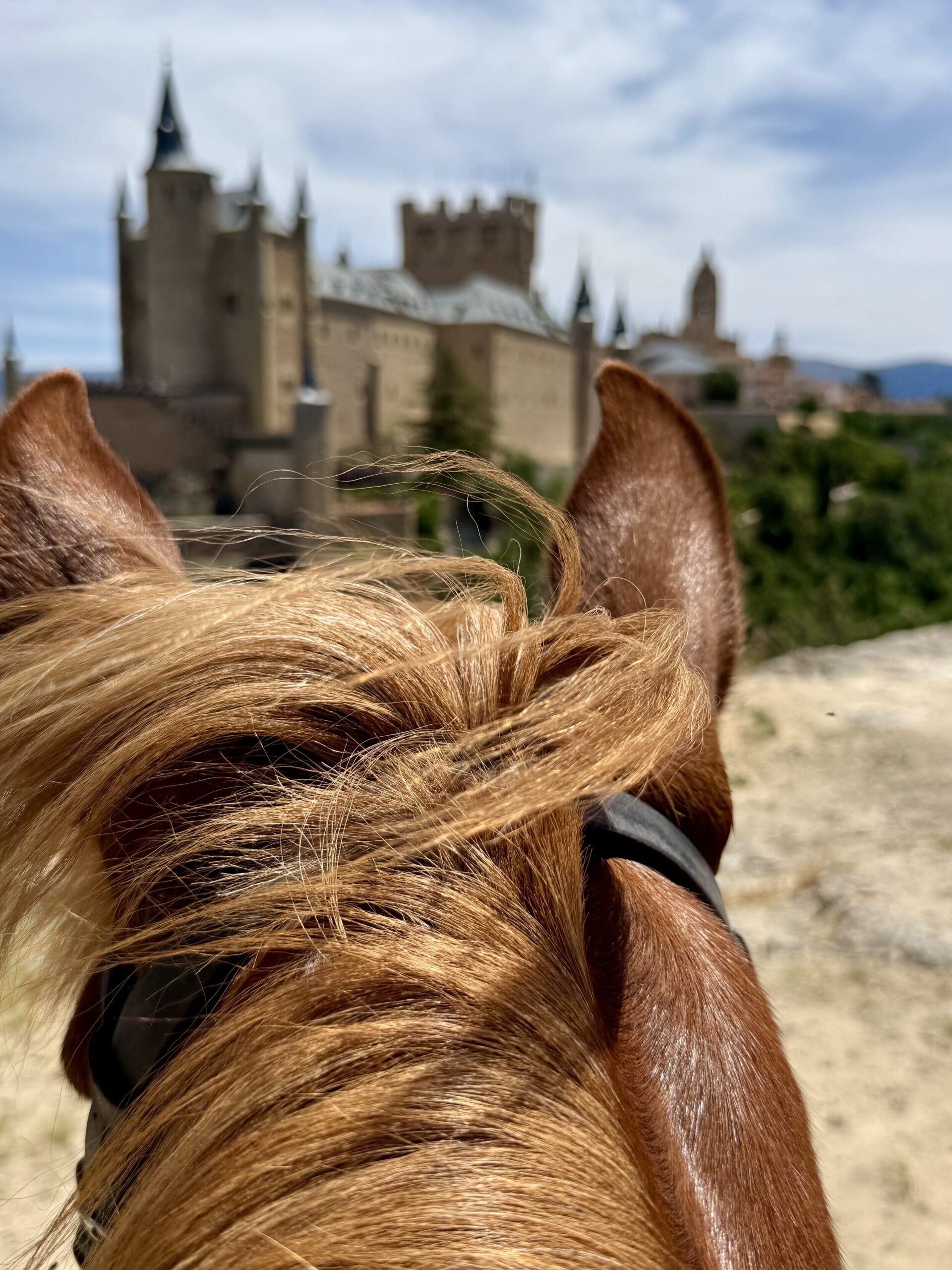
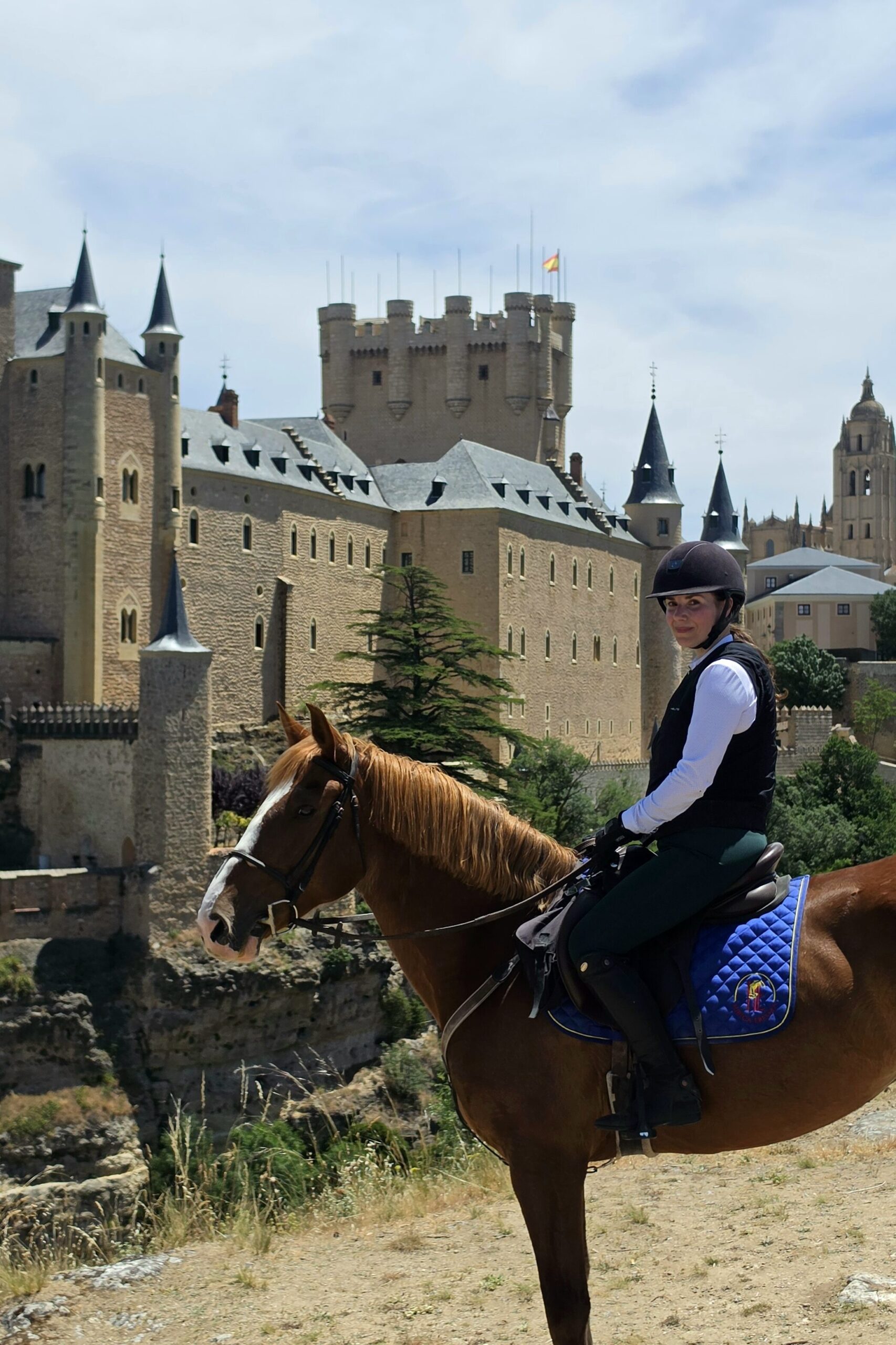
Heading around to the other side of the city, we needed to make our way down to the river to head back toward Ana’s stables. What appeared at first to be a wrong turn turned out to be entirely intentional: a long cascade of stone stairs. Our instructions were simply to let the horses choose their own path. And so we walked them down the stairs, one careful step at a time. Absolutely surreal. After all that excitement and adrenaline, the sight of our picnic lunch set up in the distance was very welcome. Had anyone described the day in advance — a brand-new horse, a horse named Cobra at that, a pitch-black tunnel at a canter, and a descent down cascading stone steps — I might not have accepted the challenge so willingly. But Segovia’s horses were an equal match of perfection in every way, and the day ended as perfectly as any day on horseback possibly could.
The Aqueduct
Our last dinner in Segovia closed the trip the correct way: receiving a city at eye level with its stones, after six days on horseback. The Roman aqueduct — 728 metres long, built in the 1st century AD, its granite blocks mortarless and standing still — one must simply stand in front of it for a while. Two thousand years. The same granite the horses had been picking their way across in the mountains above Gredos. That connection — between the ancient stones of the Sierra and the ancient stones of the city, all of it traversed across 160 kilometres of open country at a horse’s pace — is what this journey gives you that no other kind of travel can.
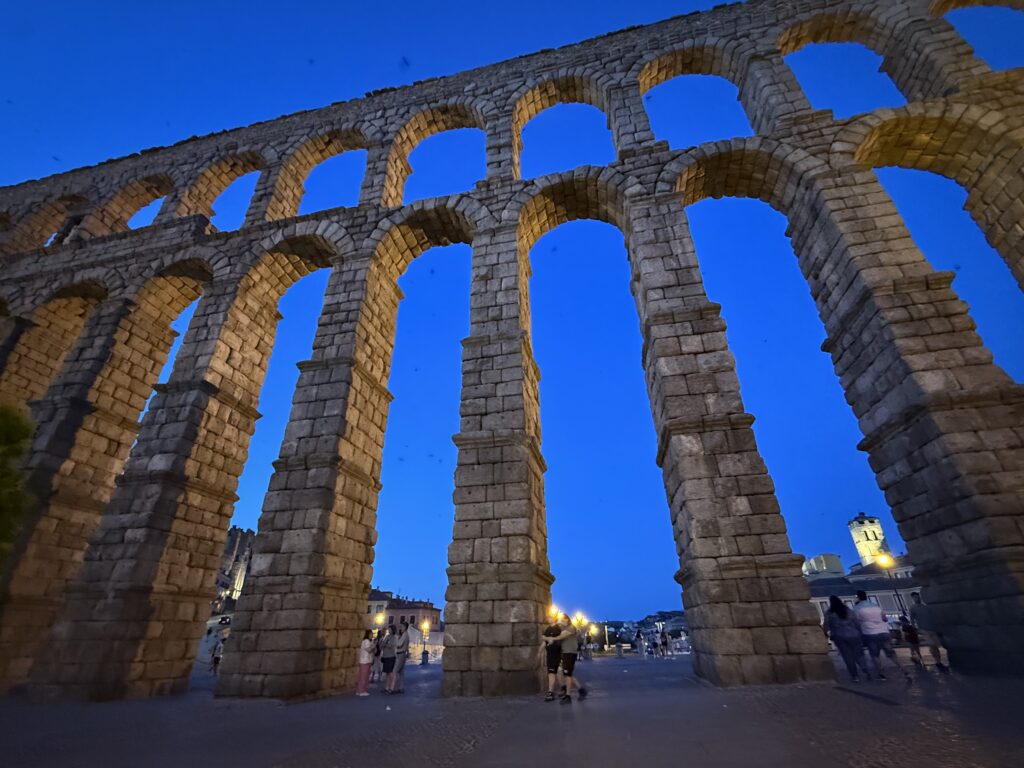
You arrive at the aqueduct having earned it, having traveled the landscape on its own terms.
That is the Spain most people miss. It is waiting, unhurried, for anyone willing to arrive on horseback.
Hidden beyond the roads, above the treeline, where Roman trails dissolve into alpine pastures and the Gredos mountains stretch out in every direction — this is what Equiberia offers. Six days in the saddle through two of Spain’s most extraordinary landscapes: the wildflower valleys of the Sierra de Gredos and the medieval heartland of Segovia, riding past castles, Roman aqueducts, and centuries-old transhumance trails. Gourmet picnic lunches in the middle of nowhere. Andalusian horses that know every path.
How to Go
Equiberia offers this classic 6-day itinerary combining three centre-based riding days in the Sierra de Gredos with a three-day inn-to-inn progressive ride through Segovia province. Total distance is approximately 160km (100 miles), averaging six hours in the saddle each day, with a mid-morning aperitivo break and an unhurried al fresco lunch built into every ride. The trip departs and returns from Madrid and can include an add-on visit to the UNESCO World Heritage city of Ávila on arrival day.
Suitable for confident intermediate to advanced riders. Variations of the Gredos–Segovia ride include a wine ride, a castles ride, the Valleys of Gredos, and Segovia and its surroundings as a standalone.