

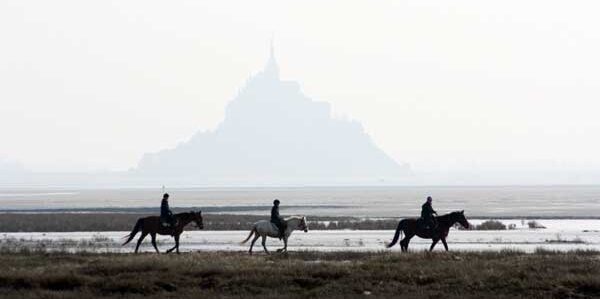
Part 1 of 3: Cheval-Plaisir, Normandy
Arrival at Cheval-Plaisir
My teenaged daughter and I arrived by train in Avranches, just a few hours from Paris, where our hosts met us at the station. We drove about 15 minutes to their 200-year-old farmhouse where we would stay for the weekend to ride the Bay of Mont-St-Michel. Cheval-Plaisir offers equestrian vacations that take riders around and across the Bay.
Jean-Pierre and Annette Jouvin purchased a 200-year-old country farm château 35 years ago when Jean-Pierre decided to leave the business world. This working farm, complete with geese, rabbits, roosters, and horses, is now the family business run with their daughter, Catherine. Cheval Plaisir is a lesson barn, pony club, and — most exciting for us — offers 1 to 5 day guided horseback riding vacations in the Normandy area surrounding the Bay of Mont St. Michel.
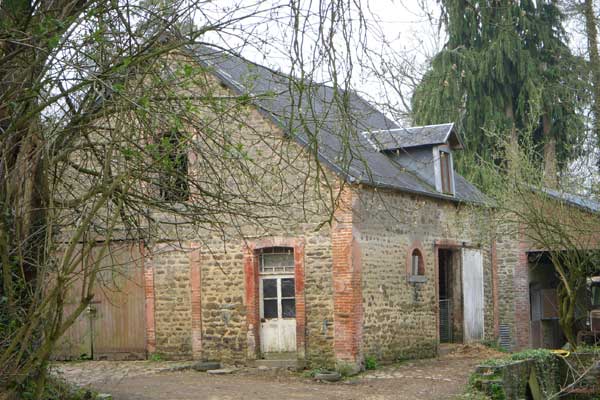
During a tour of the house and grounds, we were taken to the stables in back where we met Catherine, the couple’s youngest daughter, a certified guide of the bay and riding instructor at the family’s riding school.
The stable at Cheval-Plaisir.
She was finishing up an afternoon of lessons, and we later learned some of her students had just completed their first horse show. A few stayed to help bathe Chloe, the Connemara pony Alexis was to ride the next day. Because Chloe is a grey pony (white-colored horses and ponies are called greys), Catherine and her students wanted to make sure she was clean and presentable for us.
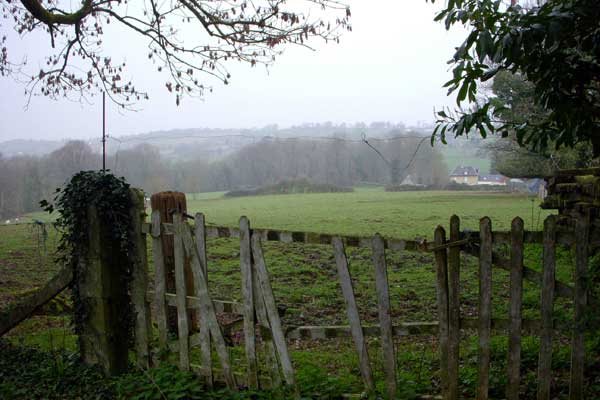
The view from Cheval-Plaisir’s grounds.
While Alexis was caught up in the romance and mystique of the château, I was reflecting on my first conversation with Jean-Pierre. When I’d contacted him to ask if my daughter and I could come experience their ride of the bay, he was very happy to welcome us — though he warned we were a few weeks early for the start of their season (normally April to October). Since I was confined to my daughter’s spring break, he agreed to tailor the ride to meet our needs with one day in the saddle.
We agreed to ride the northern side of the bay, though we’d miss one special part of the trip — actually crossing the bay at low tide, normally a highlight of this riding vacation. We were simply too early in the season.
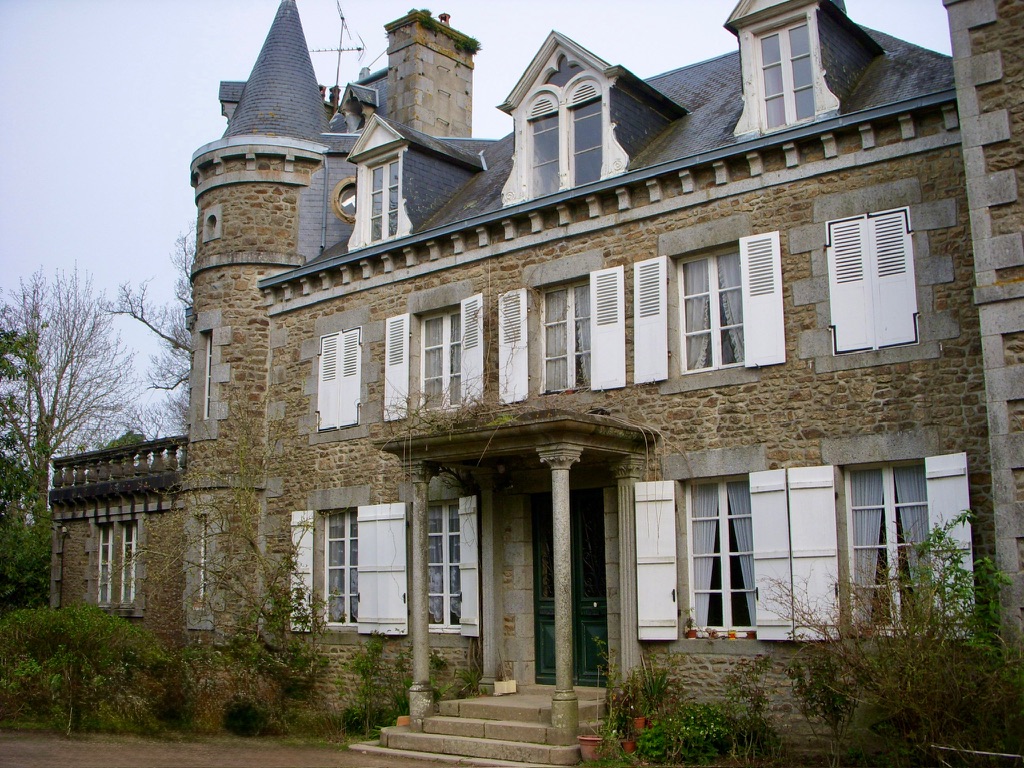
Cheval-Plaisir’s 200-year-old farmhouse.
Jean-Pierre had one more thing to tell us, though: during this particular weekend, the bay was set to see its highest, rarest tide of the year, driven by the Earth’s position and a full moon — in fact, the very reason conditions were too dangerous to cross.
We were shown to our room, on the château’s third floor, up several flights of creaking, winding stairs — adding to the expected atmosphere of a 200-year-old French countryside farmhouse. With each turn and ascending step, my daughter’s grip on my arm grew a little tighter.
A Night in a 200-Year-Old Farmhouse
I asked about the history of the house and learned that about 100 years ago, it had been the weekend summer retreat of the Dior family, known today for their perfume and couture house, Dior. Annette said her family had yet to find any secret perfume formula hidden in the house, but that we might be the lucky guests to find something — one never knows!
I was fascinated by the story; my daughter was having second thoughts. Once alone, Alexis insisted she was not to be left by herself in the house — caught up in tales of the Dior family and the antique ambience of the château, she was positive there were ghosts around her.
We freshened up for dinner around 8:30, sitting down with Jean-Pierre in the Grande Salle to a beautifully presented homemade meal: pâté with eggs, tomatoes, and capers to start, followed by pork cooked in traditional Norman style with apples in a cream sauce. Red wine and local cider, four kinds of local cheese, a tart for dessert, and coffee to finish.
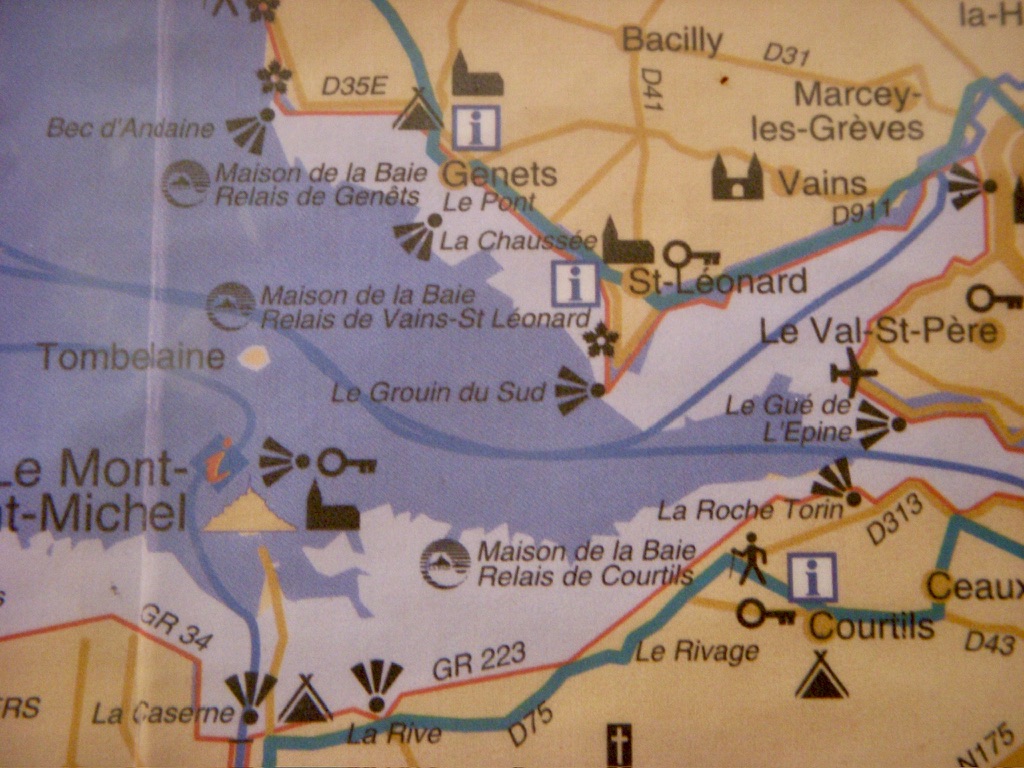
We traded travel stories and tall, exciting horse tales over dinner, all in French — my rusty French complemented by Alexis’s more polished school French, with giggles at my expense along the way. As we discussed the next day’s itinerary over a map of the bay, we saw just how widely the water levels shift with each stage of the tide. With the fortnight bringing a full moon, this weekend would be the highest tide of the year — there wouldn’t be one nearly as high again until August.
A tide chart of the Bay of Mont St. Michel.
Having lived in a 100-year-old house myself, I expected the occasional spider or other visitor from the bug world. Alexis, fearing all creepy-crawlies, was on the lookout and was pleasantly surprised to find only ladybugs.
As we turned out the light, both of our charging iPhones started chiming uncontrollably. I unplugged and powered them off, unsure what was happening. Alexis sat bolt upright, now certain she’d been right about the house all along. We both slept in the same bed. (The culprit, I later learned, was just a power surge — it happened again days later in Paris.) Despite the excitement, we both slept well, and I woke to a lovely surprise: a black Shetland pony grazing in the pasture just below our window.
Morning on the Farm
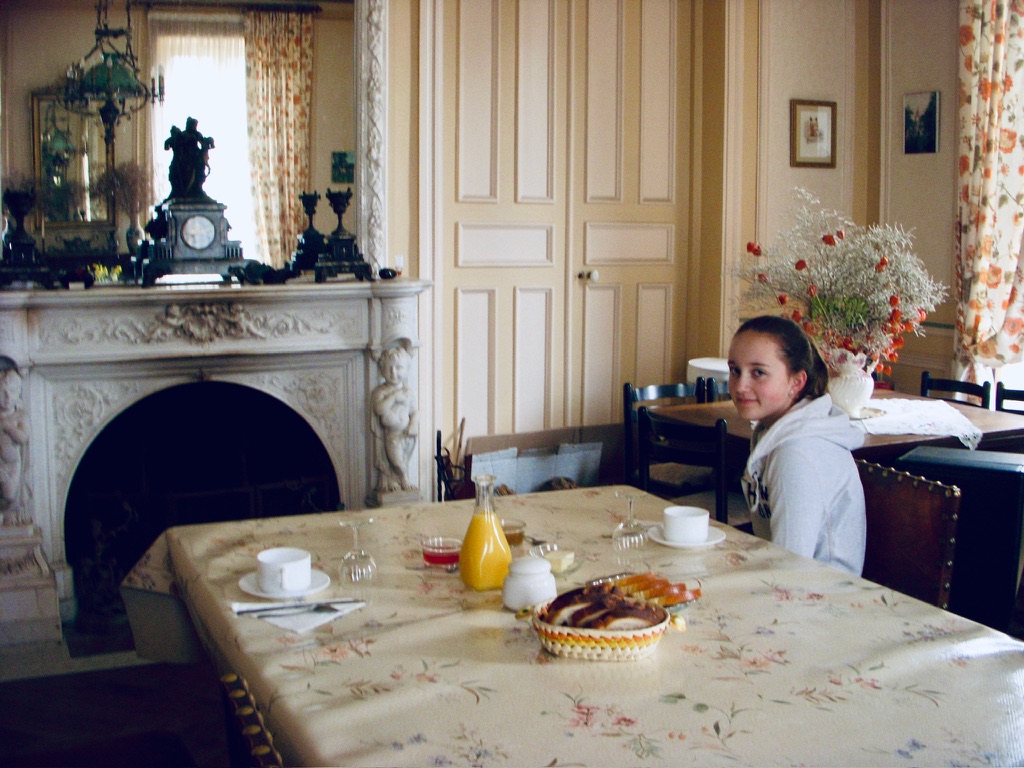
We dressed in our riding attire and met downstairs for a lovely breakfast of hot chocolate, coffee, croissants, homemade jams, and breads.
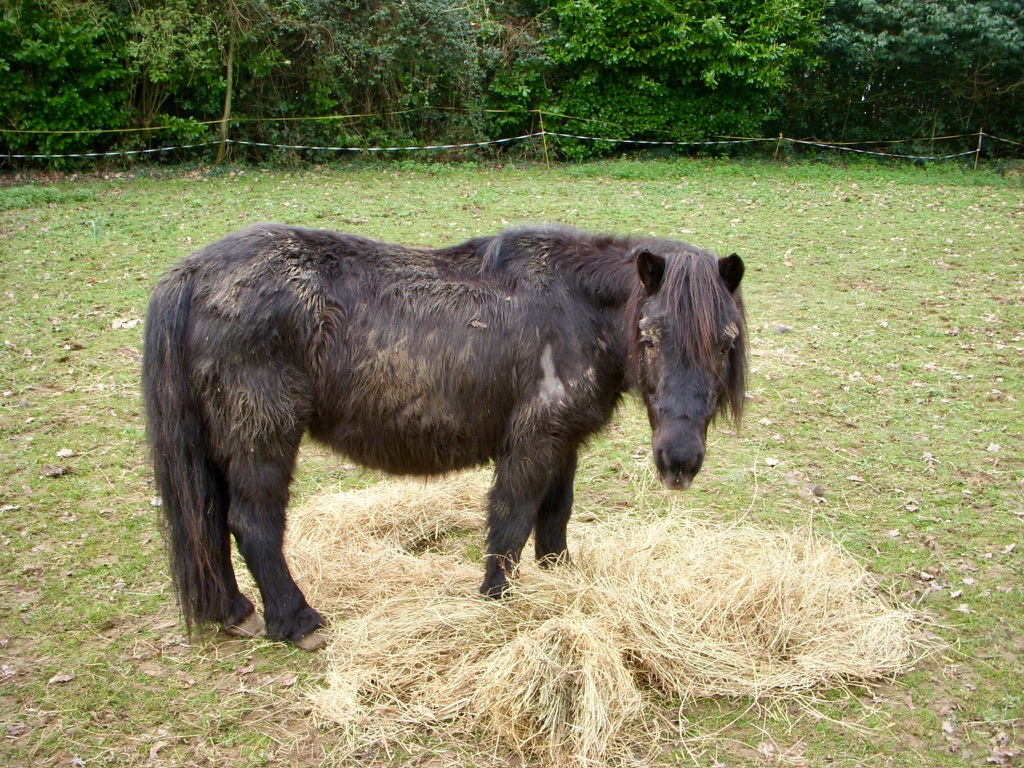
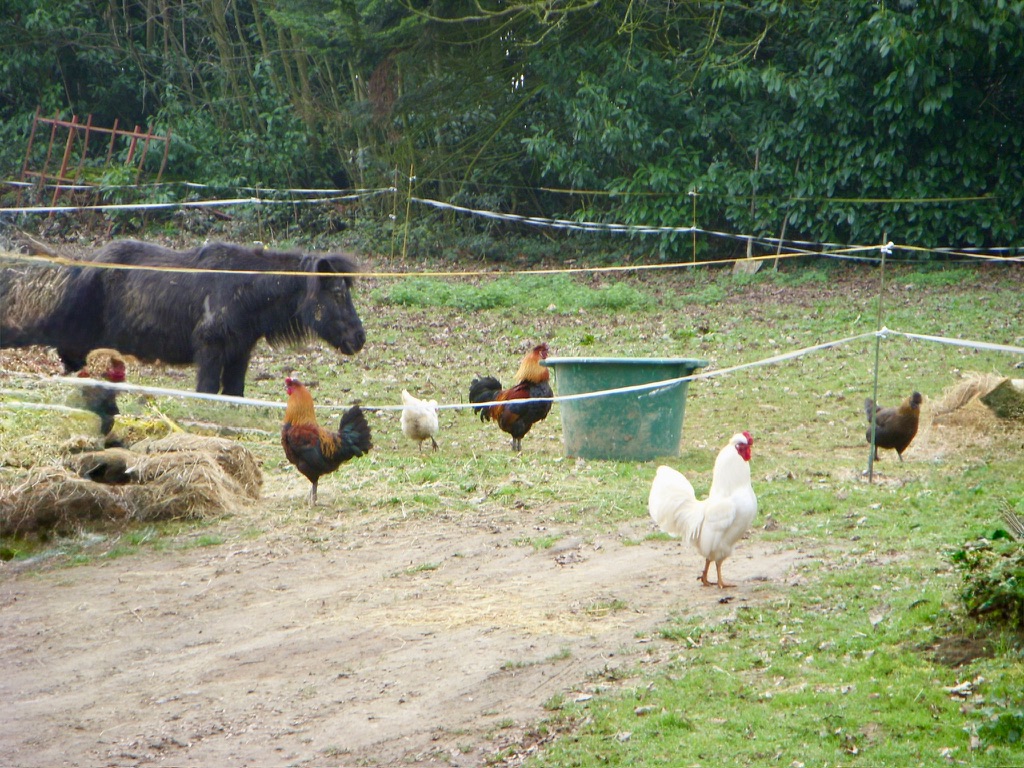
As Jean-Pierre and Catherine trailered the first two horses to our departure point at the bay, we had time back at the château to explore the grounds — greeted on the front steps by Patou, the family’s friendly German shepherd, then around the side of the château to find geese, rabbits, and chickens, roosters announcing the morning. One rooster, we were told, was about ten years old, something of an anomaly. The pastures around the château were filled with Shetland ponies and Selle Français horses (French sport horses).
Jean-Pierre and Catherine are certified equestrian guides of the Bay of Mont St. Michel, a certification not taken lightly in this region. When not leading equestrian vacations, Catherine runs the family’s lesson barn and pony club as head instructor.
Into the Saddle: Riding the Bay of Mont St. Michel
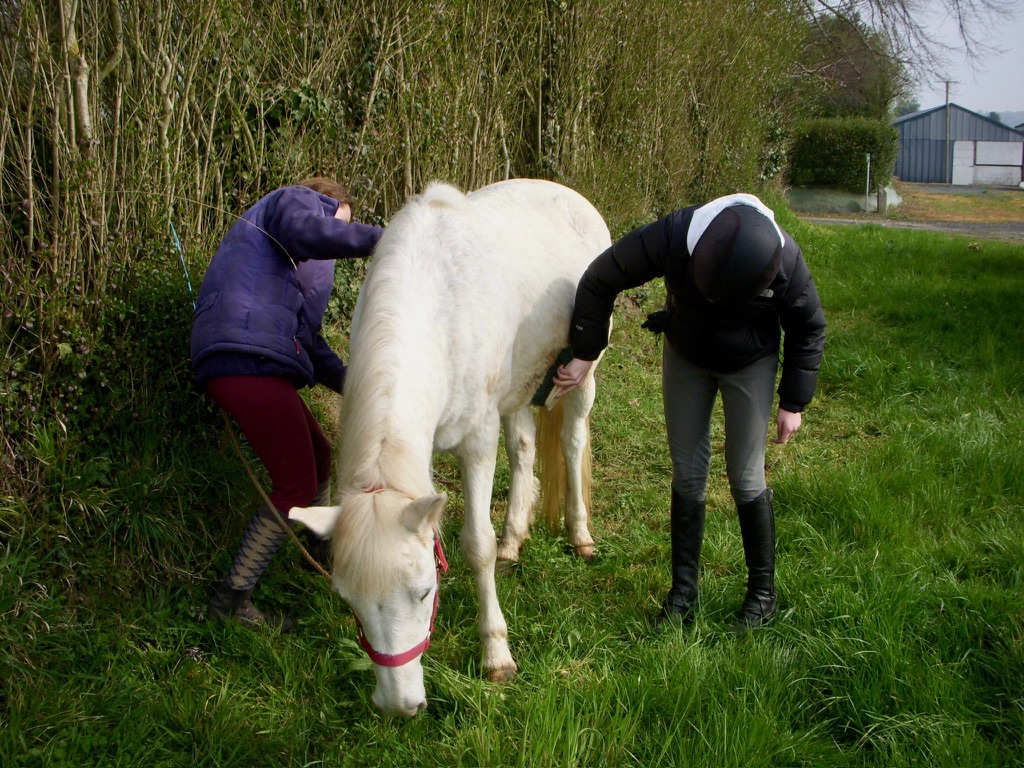
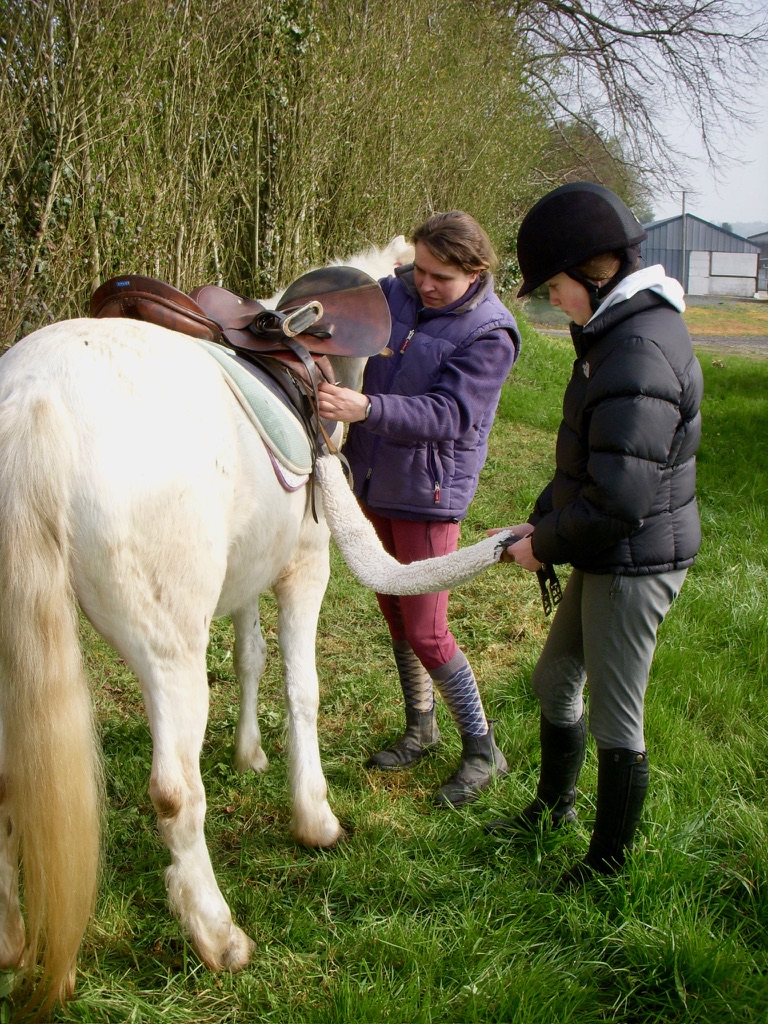
Jean-Pierre returned and loaded the trailer with Chloe, the pony Alexis was to ride, and we set off to meet Catherine and the two horses she’d left with earlier that morning. With only one day to ride, we trailered the horses the first part of a trek that normally takes five hours to reach the bay. We arrived at the meeting point and helped tack up the horses. Alexis helped curry Chloe, who — despite being bathed the night before — had rolled overnight and needed another good grooming before departure.
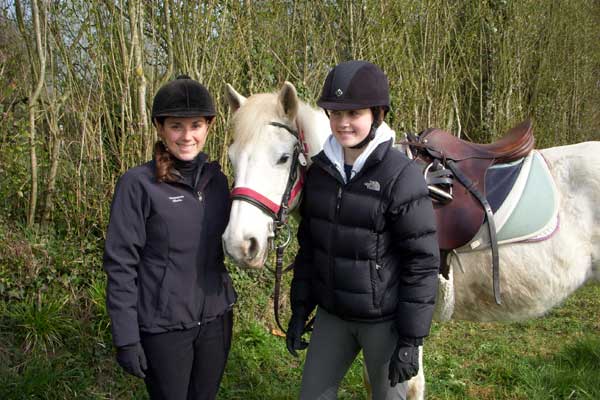
Once in the saddle, we started up the north side of the bay, timed precisely with the first low tide of the day to allow safe passage along the paths ahead. Victor Hugo once described these tides as moving “à la vitesse d’un cheval au galop” — “as swiftly as a galloping horse” — and they can change just as quickly.
The first leg let us get to know our horses. As we traveled the narrow path, submerged in a few inches of water much of the time, Catherine told us about the bay’s low lands and salt marshes, uncovered and covered again with each tide.
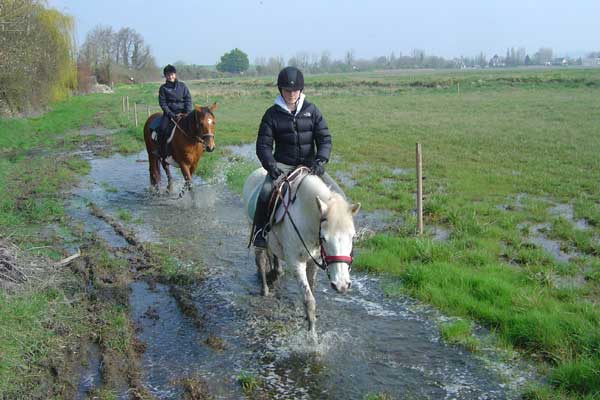
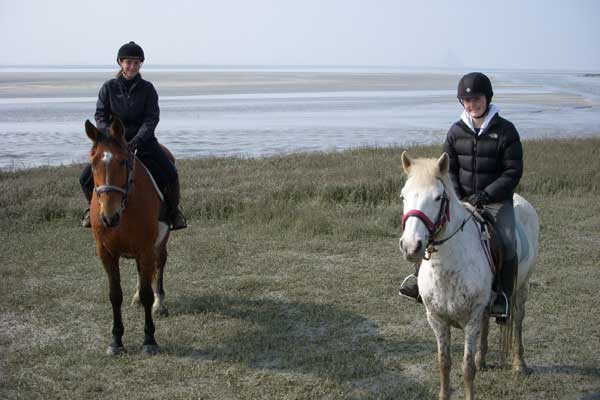
These salt marsh meadows, shaped by waves and occasional flooding, are ideally suited for grazing sheep. As we trotted and galloped across the path, we reached an open field on a hill where Mont St. Michel came into view. The morning fog was lifting, and the Abbey gave off a mystical aura, as if rising out of the bay itself.
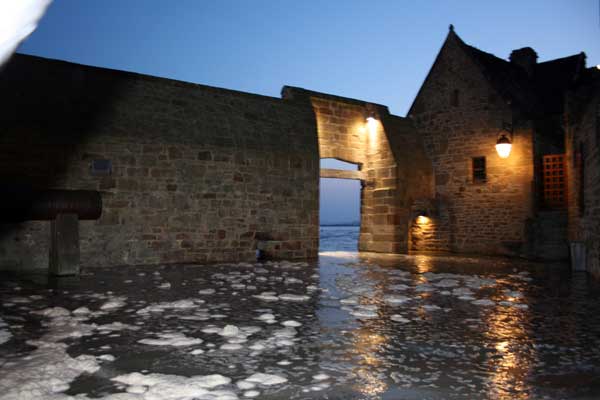
Mont St. Michel sits on a rocky tidal island amid vast sandbanks. Its first settlers are thought to have arrived in the 6th century A.D., followed by the construction of its Gothic-style Benedictine Abbey in the 8th century. Today, about 50 residents remain, along with the well-visited Abbey, visible for miles.
The tide beginning to return.
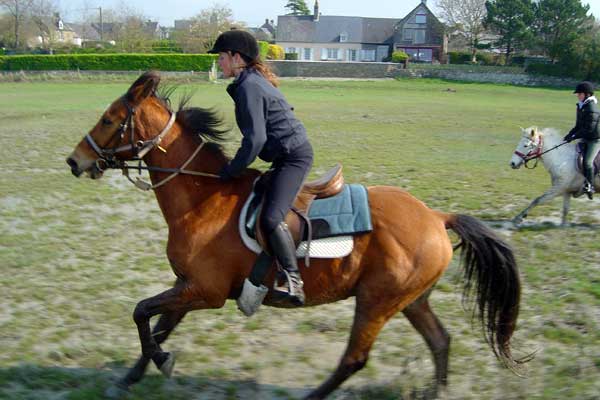
After an exhilarating gallop up the hill, we continued past local farms and fields, learning that Normandy has indigenous cows identified by dark rings around their nose and eyes, and smaller Jersey cattle with markings tracing back to the Isle of Guernsey, just off the Norman coast.
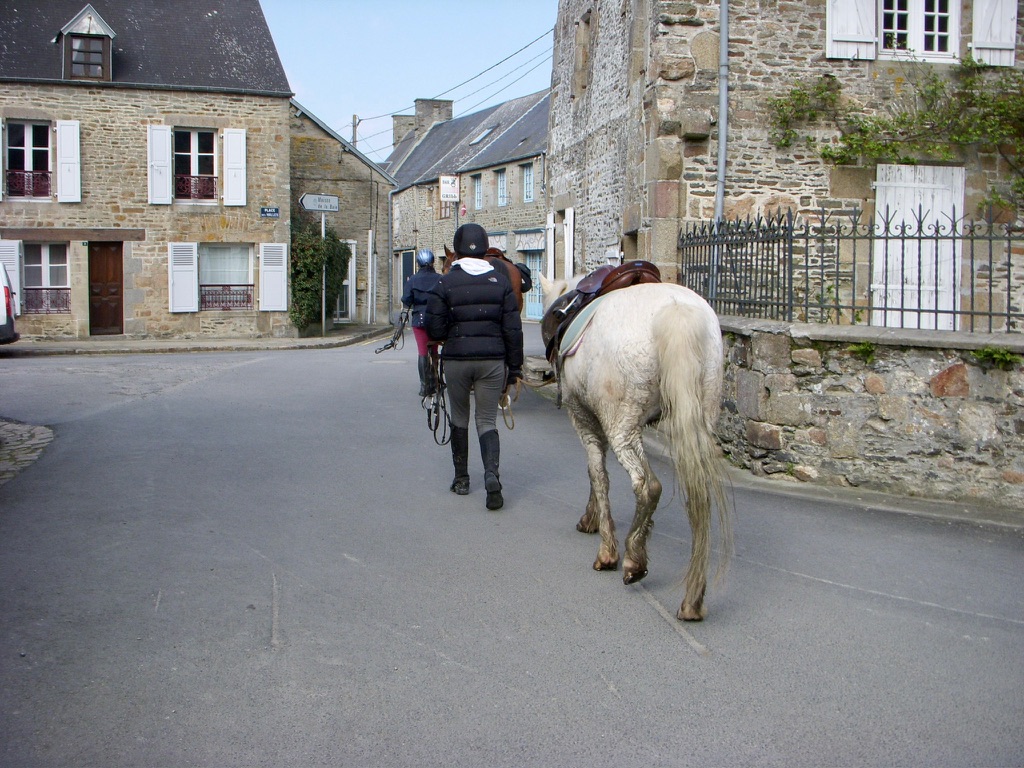
Catherine pointed out the hedgerows separating the fields from the bay, filled in summer with berries she and other riders — and the horses — take at liberty as they pass. With the mention of berries, Alexis and I realized we were hungry, and were glad to hear lunch was close. We dismounted near a seaside town and led our horses to a grassy area where Catherine created a temporary corral for them to rest too.
Leading the horses to a rest stop.
Over a “galette complète” — a buckwheat crepe filled with ham, cheese, and egg — Catherine explained that although many people claim to know the bay, becoming an official guide requires a series of exams certifying one’s knowledge of both horses and the bay’s very real dangers, particularly quicksand.
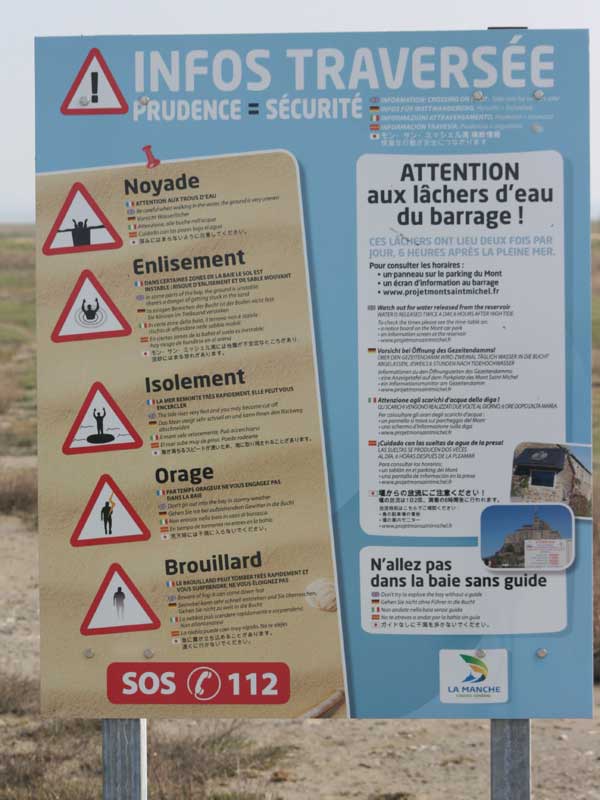
We learned that three rivers — the Couesnon, the Sélune, and the Sée — run through the bay even at low tide. The Couesnon has long been the source of a boundary dispute between Normandy and Brittany: Bretons claim it marks the traditional frontier, but after the river’s course shifted over the centuries, Mont St. Michel now sits on the Norman side.
A boundary marker in the bay.
All three rivers carry strong currents and steep, invisible drops, and quicksand — created by pockets of air and water trapped beneath the sand as the tide recedes — is a constant concern. Official guides are trained to spot the telltale signs: unusual sand, air bubbles, and safe crossing points.
One thing that amazed me, five hours into trekking through deep, thick, wet sand, was that our horses wore metal shoes the entire time. I asked Catherine if losing a shoe in that mud was ever an issue — she said not at all, and I told her their farrier must be a miracle worker. That was the one part of the conversation lost to language, or perhaps they simply weren’t willing to give up the secret.
Heading Back to Avranches
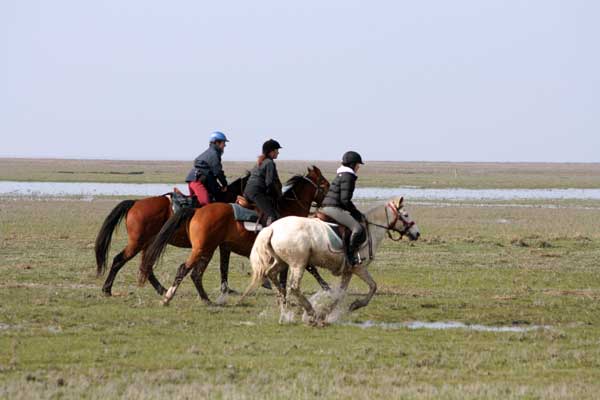
After a last gallop along the north shore, it was time to head back. Between April and October, in optimal conditions, Catherine and Jean-Pierre lead riders across the full 6-kilometer (nearly 4-mile) stretch of sand to reach the Mont itself. Given how early in the season we were, and with the year’s highest tide bearing down, conditions weren’t safe — nor would we have had time to reach the Mont before the tide returned. Even without crossing the bay itself, it was an unforgettable day of riding in Normandy.
Plan Your Visit
Where: Avranches, Normandy — about 3 hours from Paris by train, with pickup arranged by Cheval-Plaisir.
Season: Guided rides run April through October; full bay crossings to Mont St. Michel depend on tide and season.
Good to know: Bring riding clothes you don’t mind getting wet and sandy — much of the trek crosses shallow water and soft sand. Rides can be tailored from a single day up to five.
Continue the story: Meeting a Haras du Pin Foal on a Normandy Horse Farm and Mont St. Michel by Night: Visiting the Abbey and Giving the Mont Back to the Sea.