

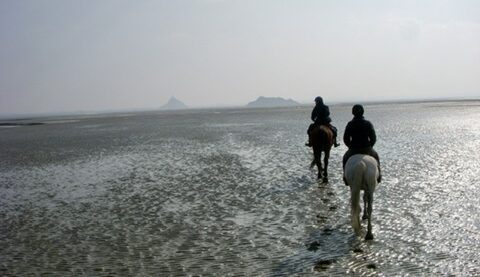
Part 3 of 3: Cheval-Plaisir, Normandy
Visiting Mont St. Michel
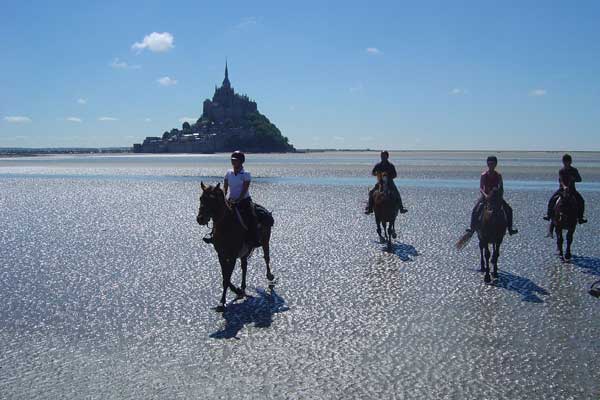
In order to witness the year’s highest tide come in around the Mont that evening, our hosts, the Jouvins, insisted we stay an extra night — giving us the chance to experience this rare tide and enjoy dinner together in Mont St. Michel. We freshened up after our six hours in the saddle and set off with Jean-Pierre, Annette, and Catherine for Mont St. Michel.
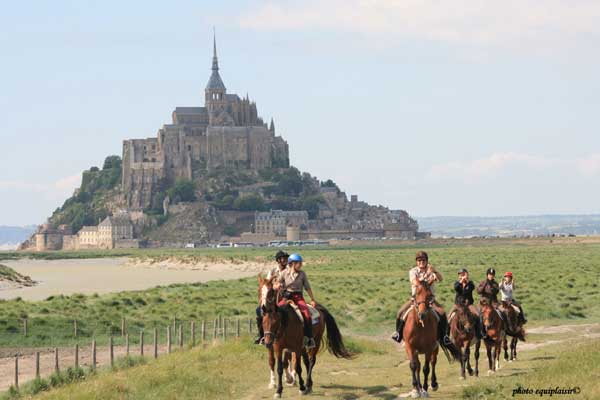
Riding near Mont St. Michel.
About a half hour’s drive from Avranches, Mont St. Michel is recognized as a UNESCO World Heritage Site. Its first inhabitants date back to the 6th century A.D. Today only about 50 residents remain, though the site draws more than 3 million visitors annually.
As we got closer, the Abbey jutting out of the sea, we drove toward the most beautiful sunset I’ve ever seen. Since we were driving, no photo could capture it — in some ways, a photo wouldn’t have done it justice anyway, so I’ll leave it to you to imagine, and hopefully witness yourself one day.
The small town streets were lined with cars and people waiting to see the rare high water reach its peak. We continued toward the Mont and reached the jetty early enough to find parking, marveling at the sight in front of us, now lit up as the last of the sunset dropped below the horizon.
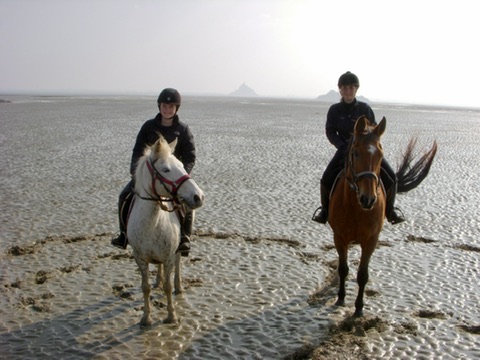
We waited for the water to reach its peak, then climbed several sets of stairs to the Abbey walls. Catherine pointed out, in the distance, where we’d ridden earlier that day, and showed us where we would have crossed the bay had conditions allowed it.
Having visited Mont St. Michel twice before, we skipped the Abbey itself this time — though it’s a must on a first visit, with views stretching for miles.
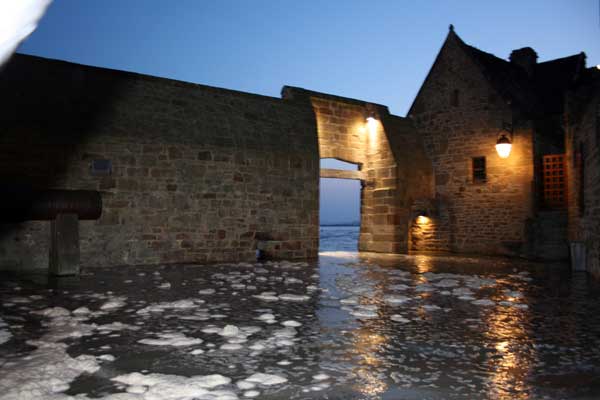
The bay at its highest tide of the year.
I’ll admit I was glad to have seen it already, because after six hours in the saddle, the 400-some steps to the top were more than my legs could take that day. Even my daughter, then 13, was happy to skip the 400 steps after our vigorous ride (she’d visited once before too), and was glad when we started our descent toward the restaurant.
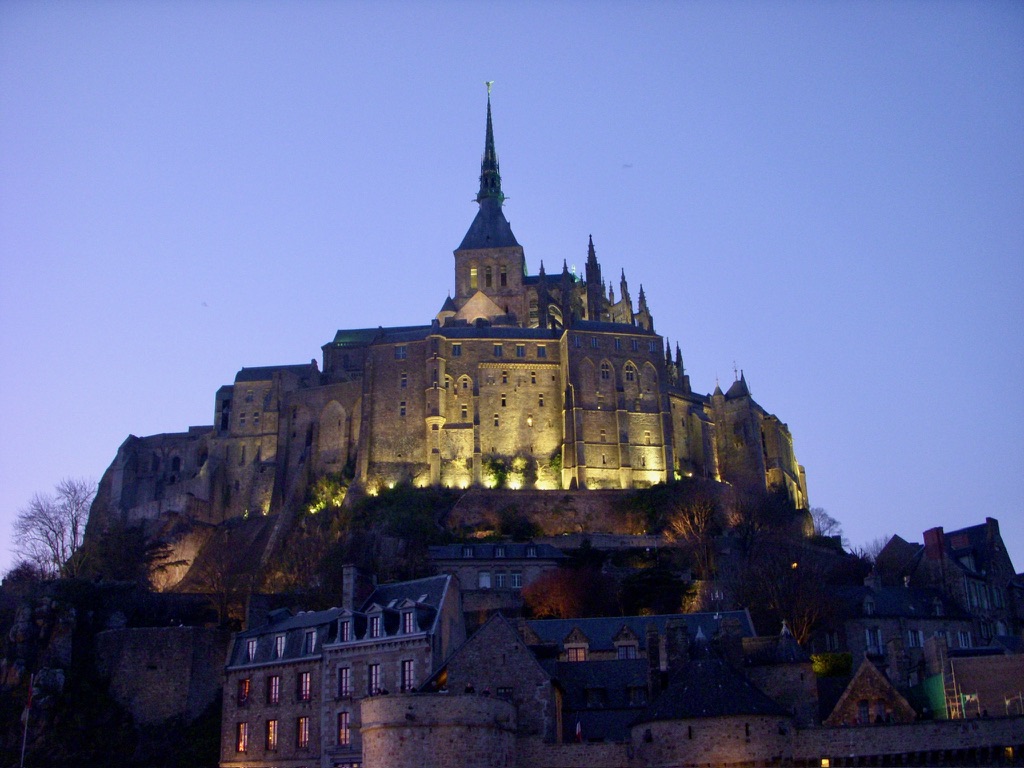
Mont St. Michel at sunset.
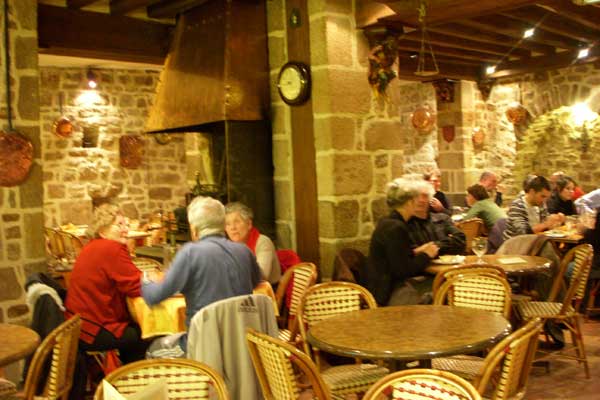
Dinner was at Le Saint-Pierre, a 15th-century inn and restaurant just inside the town walls where the Jouvins customarily bring their riding guests. Over Normandy’s traditional cider, we dined on an assortment of meats cooked to perfection, including agneau de pré-salé (salt-meadow lamb), a local specialty tied to the salt-marsh diet of the region’s sheep. Very sleepy and thoroughly worn out, we returned to the château and said our good nights, climbing the stairs to our room for one final evening in Normandy.
Dinner at Le Saint-Pierre.
Giving the Mont Back to the Sea
Standing at the Abbey walls that evening, it was hard not to wonder what all of this — the sand, the tides, the causeway we’d driven in on — would look like in another decade. As it turns out, we were watching the tail end of one of the more ambitious engineering projects in Normandy’s recent history.
For most of the 20th century, Mont St. Michel was slowly losing its identity as an island. The Couesnon River had been canalized, reducing the flow of water and encouraging the bay to silt up around the Mont. In 1879, the natural land bridge connecting the Mont to the mainland was fortified into a permanent causeway — convenient for visitors, but it prevented the tide from scouring away the silt, and the bay kept filling in around the base of the Mont a little more each year.
In 2006, the French government announced a €164 million project to reverse this: a hydraulic dam using the Couesnon’s flow and the tides themselves to flush out the accumulated silt and restore Mont St. Michel’s island character. Construction began in 2009, and by 2015 the project was complete — the 1879 causeway was demolished that year and replaced by a raised footbridge that allows water to flow freely beneath it, letting the tide fully surround the Mont again for a few hours during the year’s biggest tides, just as it once did naturally.
At the time of our visit, this was still very much a live and uncertain question for the Jouvins. Cheval-Plaisir’s guided crossings depart and return at precisely timed points along the northern edge of the bay, and back then, no one knew whether horses would ultimately be allowed to use the new pedestrian bridge to reach the mainland from the Mont at high tide, the way the old causeway had allowed. As the horse was no longer an officially recognized form of transportation for the crossing, Jean-Pierre wasn’t especially optimistic.
The bay, mid-restoration.
We can’t confirm from here how that specific question was ultimately resolved. What we can confirm is that the broader tradition hasn’t disappeared: guided horseback crossings of the bay at low tide, the kind Cheval-Plaisir has run for decades, are still very much active today, alongside the walking and shuttle crossings most visitors now use to reach the Mont. The horse may no longer be the primary way to reach Mont St. Michel, but it hasn’t been written out of the bay’s story either.
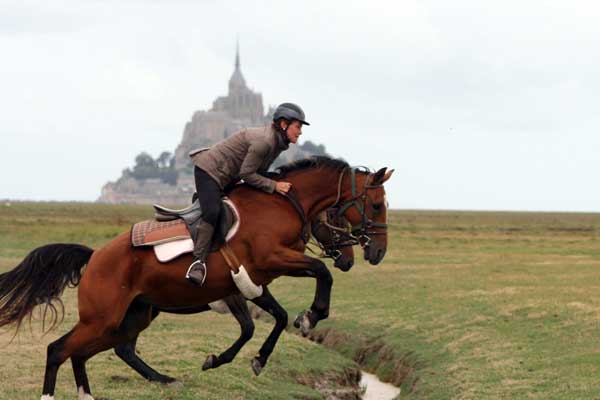
Photo credits: Cheval-Plaisir & Equestrian Destinations
Learn more about travel to Normandy.
Plan Your Visit
Where: Mont St. Michel, about a half-hour drive from Avranches — reachable by shuttle, on foot across the new footbridge, or by horse-drawn carriage at low tide.
Best for the highest tides: These occur around the full and new moons, roughly twice a month, with the very highest tides of the year (grandes marées) drawing crowds who come just to watch the water rise.
Dinner: Le Saint-Pierre (Auberge Saint-Pierre), a 15th-century inn inside the town walls, still serves the same Norman specialties today, including the salt-meadow lamb.
Continue the story: Riding the Bay of Mont St. Michel: A Weekend at Cheval-Plaisir in Normandy and Meeting a Haras du Pin Foal on a Normandy Horse Farm.